If you’ve been hanging around in education or job market talks lately, you’ve probably heard the word microcredentials. Sounds fancy, but it’s really just a bite-sized way to prove you’ve learned something. Not a whole degree, not a six-month program — just focused learning on one topic that matters to you (or your boss).
The beauty? You don’t have to press pause on life to do it. You pick a skill, work through a short learning path, and end up with proof. Not the “trust me, I know this” kind of proof — actual, clickable, shareable proof. That’s where digital certifications and badges come in.
What Means by Microcredential in 2025?
Think of it like a single Lego block of knowledge. On its own, it’s useful. Stack enough of them and you’ve built something solid. It’s a certificate for completing a small, specific course or training — like SEO Basics, Writing Better Ad Copy, or Social Media Analytics.
Instead of committing to a two-year diploma, you could do multiple microcredentials over a few months. Some people collect them to boost a résumé. Others use them to learn niche skills quickly when a job or project demands it.
They’re not designed to replace degrees. More like they live alongside them. A marketing graduate might take a microcredential in influencer outreach or Google Ads to fill in the gaps the degree didn’t cover.
The Role of Digital Badges
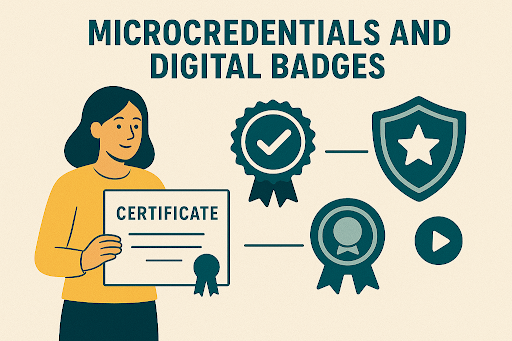
The old way? You got a paper certificate that stayed in a drawer. The new way? You get a digital badge — basically an image with magic inside it.
You can add it to your LinkedIn, your email signature, even your personal portfolio site. And when someone clicks it, they see the details:
- Who issued it
- What skills did you prove
- When you earned it
- Sometimes, even the score or project you submitted
This transparency makes it easier for employers to trust that the badge means something real — not just a “participation award.”
Why Everyone’s Talking About It
For learners:
- It’s quick. Weeks instead of years.
- It’s focused. No extra fluff.
- It’s flexible. Learn after work, on weekends, or during lunch breaks.
For businesses:
- It’s affordable training.
- It upskills teams without killing productivity.
- It makes hiring easier because you can spot verified skills.
From a marketing view, microcredentials are like catnip for busy professionals — short learning, instant recognition, and an easy way to show off results.
Real-World Examples
Let’s say you’re in marketing. Your role suddenly shifts toward content strategy, but you’ve never touched keyword research. You grab a microcredential in SEO fundamentals. Two weeks later, you’re applying what you learned — and you’ve got a badge to prove it to your manager.
Or maybe you’re freelancing. You want to pitch yourself to bigger clients, but they want proof you can run Facebook Ads. You finish a short course, get the digital certification, add it to your profile, and suddenly, your proposals look way stronger.
Where It’s Headed
Workplaces are changing so fast that big, slow degrees can’t always keep up. Microcredentials are like skill “updates” for your career. You add them whenever you need them — no massive reset required.
The marketing potential is huge, too. If you’re selling online learning, packaging it as microcredentials and offering digital badges makes it far more appealing. People love things they can finish quickly and brag about online.
Conclusion
Microcredentials and digital certifications aren’t just buzzwords. They’re the way skill-building fits into busy, unpredictable lives. Whether you’re stacking them for a long-term career or just patching a skill gap, they’re proof you can actually do the thing — not just say you can.
References
[1] Digital Promise, “The Relationship Between Digital Badges and Micro-credentials,” Digital Promise, Apr. 13, 2023. [Online]. Available: https://digitalpromise.org/2023/04/13/the-relationship-between-digital-badges-and-micro-credentials/.
[2] University of Denver, “Micro-credentials and Badges,” University of Denver, 2022. [Online]. Available: https://www.du.edu/registrar/academic-programs/micro-credentials-badges.
FAQ’s
Q1. What are microcredentials in simple terms?
Microcredentials are compact learning programs designed to teach specific skills in a short time. Unlike traditional college degrees, which often cover a broad range of subjects, these are narrow and skill-focused. Think of them as small building blocks of knowledge that can be stacked to form a larger structure of expertise. For instance, instead of enrolling in a full IT program, you might earn one in cybersecurity, another in data visualization, and another in cloud computing. Together, they showcase your proficiency in specialized areas without requiring years of study.
Q2. How are microcredentials different from traditional degrees?
Traditional degrees usually span multiple years and cover a wide curriculum, often including subjects not directly related to your career goals. In contrast, microcredentials focus entirely on one skill set. For example, a business degree may require you to study economics, accounting, and statistics, while a single short certification could zero in on project management or financial modeling. This focused approach makes them efficient and highly practical. They are not replacements for degrees but work as complements to fill knowledge gaps.
Q3. Do employers actually value microcredentials?
Yes, more employers are beginning to view them positively, especially in industries where skills evolve rapidly. In areas like digital marketing, software development, or UX design, having a degree is often not enough—employers want to see proof that you’ve kept up with the latest tools. Shorter programs provide this assurance. Many recruiters also appreciate how transparent these certifications are, especially when paired with digital badges, because they can see who issued the credential, what you learned, and when you completed it.
Q4. How do digital badges fit into the picture?
A digital badge is essentially proof of completion that you can share online. Unlike traditional paper certificates, a badge contains metadata: it shows the issuer, the criteria you met, the date, and sometimes even a portfolio piece or score. This makes it harder to fake and easier to verify. Imagine applying for a role that requires advanced Excel skills—having a badge on your LinkedIn profile that recruiters can click on instantly proves your ability.
Q5. Can digital badges be added to professional profiles like LinkedIn?
Yes, one of the biggest advantages is their shareability. Once earned, you can place them on your LinkedIn, attach them to email signatures, or embed them on your portfolio site. For example, if you’re a graphic designer, having multiple badges for tools like Photoshop, Illustrator, and After Effects can instantly set you apart. Recruiters love this because they don’t have to rely solely on your résumé claims—they can verify the badge with a single click.
Q6. Why are microcredentials becoming more popular in 2025?
In today’s world, careers evolve quickly. A professional might need to learn new technologies or marketing platforms every year. Traditional degrees simply cannot keep up with this pace. Short, targeted learning programs give individuals the agility to stay updated. Plus, remote work and global hiring trends make portable and verifiable skills even more valuable. As a result, people view these programs as “career updates” rather than long commitments.
Q7. What kinds of subjects can be covered under microcredentials?
The possibilities are wide-ranging. In technology, they might cover programming languages, cybersecurity, or artificial intelligence. In business, they can include leadership, strategy, or data analytics. Creative professionals can benefit from design, content marketing, or video editing badges. Even healthcare and education sectors are adopting them—for instance, a teacher might earn one in inclusive teaching practices or online classroom management. This variety makes them appealing across industries.
Q8. How much do microcredentials usually cost?
Prices vary widely. Some are free, especially those offered by nonprofits or open education platforms. Others may cost a few hundred dollars, particularly when tied to prestigious universities or industry giants like Google or IBM. Compared to a full degree, however, the cost is minimal. For students or professionals on a budget, they provide an affordable way to boost a résumé without significant debt.
Q9. How much time does it take to complete one?
The time commitment depends on the subject and institution. Some can be finished in just a couple of weeks with a few hours of study per week. Others may take several months if they involve projects or assessments. Flexibility is a key feature: you can learn during evenings, weekends, or lunch breaks. This makes them especially useful for working professionals or parents who can’t pause their lives for long-term study.
Q10. Can microcredentials help with career changes?
Yes, they’re particularly helpful for career transitions. Suppose you’re working in journalism but want to move into digital marketing. Instead of enrolling in another bachelor’s degree, you could complete a few short programs in SEO, content marketing, and social media analytics. Within months, you’d have proof of the new skills needed for your transition. Many career changers find this pathway faster, cheaper, and less intimidating than starting from scratch.
Q11. How do they support lifelong learning?
Lifelong learning means continuously updating skills as the world changes. Microcredentials allow exactly that. Instead of committing to formal education every few years, learners can complete short programs whenever necessary. For example, if a new programming language emerges, a developer can quickly learn it through a credential instead of going back to school. Over time, stacking multiple credentials helps create a broad, adaptable skill portfolio.
Q12. Are most of these programs available online?
Yes, the majority are online, which makes them accessible globally. Learners can sign up from anywhere, often without admission exams or lengthy paperwork. Online delivery also means interactive resources like video lectures, discussion boards, and practical projects. For people with limited time or geographic constraints, this flexibility is invaluable.
Q13. Are digital badges more reliable than paper certificates?
In many ways, yes. Traditional paper certificates can be lost, forged, or misunderstood. A digital badge, however, contains embedded details that anyone can check instantly. For employers, this means greater transparency. For learners, it means achievements are more portable and harder to dismiss. Some organizations even require digital verification now because it saves them time in background checks.
Q14. How do businesses benefit from encouraging their employees to earn microcredentials?
Businesses gain by having a more agile workforce. Instead of sending employees away for extended training, they can sponsor short, targeted programs. This ensures workers pick up specific skills without significant disruption to productivity. It’s also cost-effective: instead of paying for broad programs, companies invest only in the skills they need. Moreover, when employees proudly share badges online, it reflects positively on the organization’s commitment to growth.
Q15. What does the future look like for microcredentials and digital badges?
The future is promising. As industries change faster than universities can update curricula, smaller learning units will fill the gap. Governments and professional associations are also showing interest, which means recognition will continue to grow. In five years, it’s likely that résumés will be filled with stacks of digital badges, each representing a skill acquired at different points in a person’s career. Rather than being a trend, this movement is shaping up to be a permanent part of the education and employment ecosystem.
Penned by Apeksha S
Edited by Shashank Khandelwal, Research Analyst
For any feedback mail us at [email protected]
Transform Your Brand's Engagement with India's Youth
Drive massive brand engagement with 10 million+ college students across 3,000+ premier institutions, both online and offline. EvePaper is India’s leading youth marketing consultancy, connecting brands with the next generation of consumers through innovative, engagement-driven campaigns. Know More.
Mail us at [email protected]