
Introduction
Students often sat outside an advisor’s office, waiting for their turn, only to realize that the deadline they wanted help with has already passed. Have you seen this happen more than once? and honestly, it can be really discouraging. By the time some students finally get the chance to ask a question it is already too late to act. That is where technology feels like a lifesaver. An AI student chatbot may not always be perfect, but it can give answers immediately, day or night. Add that to a larger idea, such as a virtual campus of advice, and suddenly students do not feel quite so lost or so stuck as they once did. Rather than being restricted to office hours, advice becomes something on tap, which can make all the difference to a student’s path. This is why many schools are now exploring the use of an AI student chatbot as part of a broader virtual advice campus, so guidance is always available when needed.
5 Easy Pointers to Understand AI Student Chatbot for Academic Advising
Why the Old Way Doesn’t Always Work
Old-fashioned advising certainly has its benefits. Meeting with an advisor in person usually lends itself to reassurance, but the process does not always catch up with the way student life functions these days. Advisors are handling dozens of tasks, offices fill up fast, and let’s be honest—sometimes students are afraid to ask what seems like a “silly” question in person.
I recall one of my fellow students who waited nearly two weeks simply to verify if she was able to trade in one elective for another. She managed to get through to the appropriate office after finally calling, only to realize that the spot was taken. She wasn’t being reckless—she was just a victim of a system that took longer than she required. That kind of frustration leads students to desire a faster, more dependable system. When the help comes after a while, even minor choices snowball into more serious scholarship issues.
How Chatbots Fill the Gap
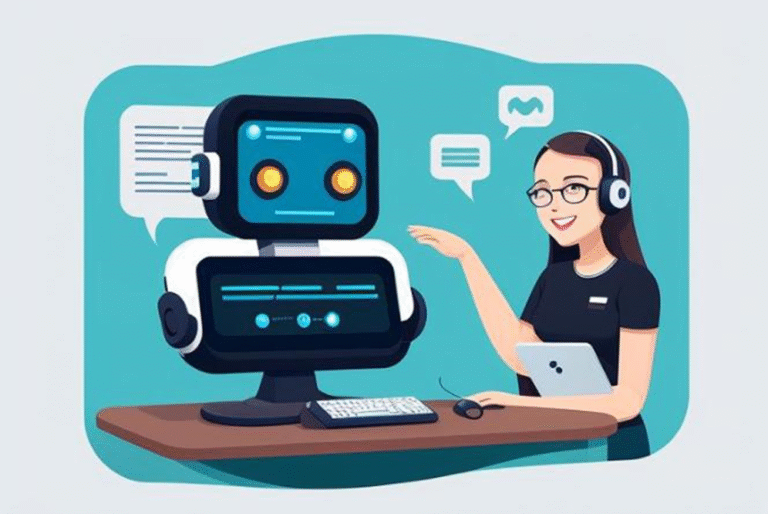
Now imagine this: it’s the middle of the night, and you’re suddenly not sure of the last date to withdraw from a course. Rather than worrying until dawn, you ask the AI student chatbot, and in a matter of seconds you have the answer. No queuing, no fear of missing office hours.
These chatbots are not merely deadline reminders. They can remind students about impending exams or paperwork, monitor degree progress, recommend resources for challenging subjects, and even change languages if that’s what works best for the student. The actual wonder is that they make light work of routine questions so human advisers can focus on more complex conversations—career advising, mental health issues, or long-term academic planning.
I have some students who were hesitant at first, saying “a bot can’t get me.” But when they used it to do simple things like check course credit or bring up policy information, they saw how much time it saved. It does not replace caring, but it cuts through the clutter.
The Concept of a Virtual Advice Campus
The term virtual advice campus may seem pretentious, but essentially, it’s about building an online community that replicates what the campus office already does. Rather than dashing between departments, you log on to one system and it’s all there—deadlines, forms, counsel, and support tools.
Some universities are already experimenting with this model. For example, Georgia State built a system that sends reminders so students don’t miss paperwork, and in Australia, Deakin University launched Genie, a digital assistant that connects calendars, emails, and learning tools in one place. Students using these systems report that it feels less like “talking to a robot” and more like having a personal guide who points them in the right direction.
The Ups and Downs
The benefit is obvious. Students save time, receive fair access to information, and are spared the anxiety of waiting weeks for responses. International students in particular gain from multilingual functionality, which facilitates better integration in a new system. Advisors, meanwhile, have more time to engage in substantive conversations rather than half a day of simply reminding students of the same deadline.
Conclusion
Ultimately, advising is about counseling, and how we provide that counseling is evolving. An AI student chatbot speeds up the process and makes it more consistent, and a virtual advice campus brings everything together in one easy place.
Yet, technology ought to be viewed as a backup system, not a substitute. No computer can substitute for the warmth or encouragement that is gained from a genuine advisor who listens and cares. All AI can do is break down barriers, save time, and ensure that students never feel behind when they are struggling. The future’s best hope is to provide students with the speed and convenience of AI combined with the empathy and wisdom of human advisers. That combination—AI for the mundane, humans for the soul—seems not just logical but al
So promising for future generations of students.
References
[1] Georgia State University, “How Chatbots Help Students Succeed,” Georgia State News Hub, 2019. [Online]. Available: https://news.gsu.edu/2019/05/21/how-chatbots-help-students-succeed
[2] Deakin University, “Genie: Your personal digital assistant,” Deakin University, 2022. [Online]. Available: https://www.deakin.edu.au/genie
[3] EDUCAUSE, “The AI Chatbot Campus,” EDUCAUSE Review, 2021. [Online]. Available: https://er.educause.edu/articles/2021/2/the-ai-chatbot-campus
[4] Inside Higher Ed, “Chatbots Move Into Student Advising,” Inside Higher Ed, 2019. [Online]. Available: https://www.insidehighered.com/news/2019/01/31/chatbots-move-student-advising
[5] UNESCO, “Artificial Intelligence in Education: Challenges and Opportunities,” UNESCO, 2021. [Online]. Available: https://unesdoc.unesco.org/ark:/48223/pf0000376706
FAQs
Q1. What is an AI student chatbot?
An AI student chatbot is a digital assistant powered by artificial intelligence that helps learners with study support, queries, and instant answers.
Q2. How does an AI student chatbot help in studies?
An AI student chatbot helps students by summarizing lessons, answering questions, creating quizzes, and offering personalized study recommendations.
Q3. Who can use an AI student chatbot effectively?
School students, college learners, and exam aspirants can use an AI student chatbot to boost productivity and improve overall learning outcomes.
Q4. Can an AI student chatbot replace teachers?
No, an AI student chatbot cannot replace teachers. Instead, it acts as a supportive learning tool by providing extra practice and quick guidance.
Q5. What features are included in an AI student chatbot?
An AI student chatbot usually includes instant Q&A, flashcards, test preparation, progress tracking, and 24/7 study assistance.
Penned by Sadaf Fatima
Edited by Sneha Seth, Research Analyst
For any feedback mail us at [email protected]
Transform Your Brand's Engagement with India's Youth
Drive massive brand engagement with 10 million+ college students across 3,000+ premier institutions, both online and offline. EvePaper is India’s leading youth marketing consultancy, connecting brands with the next generation of consumers through innovative, engagement-driven campaigns. Know More.
Mail us at [email protected]