
As technology is advancing and more things go online in the world of Tech, the students’ experience should also be rewarding and give them highs so that they don’t feel the burden of learning. Nick Pelling, a computer programmer and investigative writer, coined the term “gamification” in 2002. This is where gamified learning comes into the picture. Think of gamified learning as a blend of education and entertainment. The traditional courses, on the other hand, treat each and every student similarly, whereas gamified learning will live up to the learning capacity of the child. Gamified learning is a way in which gamified design is applied to traditional education to make it more engaging and motivating for the students. Gamified design refers to the usage of points, badges, leaderboards, and challenges to enhance user experience, and children see learning as a marvelous experience instead of a burden on them. Some examples of gamified learning include KHAN academy, Quizlet, Duolingo, Kahoot, and many more.
4 BENEFITS OF GAMIFIED LEARNING
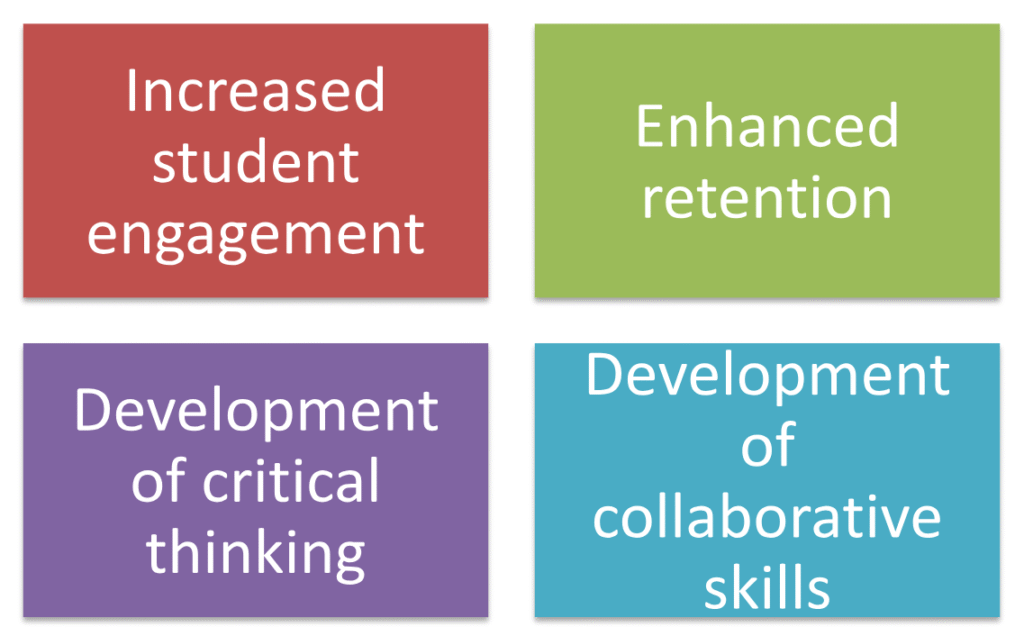
It has a range of benefits, including increased student engagement, enhanced retention, and the development of critical thinking and collaborative skills. The experience of gamified learning makes things fun and attractive for students and encourages them to participate in the exercise. Gamification is a strategy that leads to a tangible sense of achievement for students, where they earn badges and stars, which leads to a sense of fulfillment. Game-based learning makes games a part of the learning process. It is an instructional method where students can learn specific skills or enhance knowledge and strategize decisions from playing an actual game. With this kind of learning, instructional materials are turned into games that students can play. Gamification, on the other hand, solely uses game aspects in non-gaming contexts to improve information retention and content understanding. The main goal is still to improve student engagement, but gamification does not necessarily aim to teach them something new. The strategy of gamified learning should be built in such a way that everyone, from kindergarten students to college students, should be engaged in this. A 2012 study showed that intrinsic motives impact employee engagement three times more than extrinsic motives, which use rewards or incentives as motivation. For example, praise, fame, or money. Gamified learning provides real-time feedback so the student is able to make some changes to their learning schedule and strategize accordingly. When choosing gamified learning, one should always look for a suitable e learning platform to succeed.
DISADVANTAGES OF GAMIFIED LEARNING
Everything comes with pros and cons; some of the cons with gamified learning are poorly designed game mechanics, such as games that are very easy or seem very hard. Sometimes gamified learning is the best tool that you can use, but if it does not align with your goals, what is the benefit of it? The budget plays a huge role as everyone has his/her own way to do things in order to engage in the activities, so please don’t rule out your whole budget in gamification.
CONCLUSION
Gamification is a strategic and effective approach to enhancing learning and motivation. By incorporating game-like elements such as challenges, rewards, and feedback, leaders can engage individuals more deeply, encourage consistent effort, and drive better outcomes. When applied thoughtfully, gamification transforms routine tasks into motivating experiences, fostering achievement, collaboration, and sustained personal and professional growth.
Reference
[1] A. Christopoulos and S. Mystakidis, “Gamification in Education,” Encyclopedia, vol. 3, no. 4, pp. 1223–1243, 2023. [Online]. Available: https://doi.org/10.3390/encyclopedia3040089
[2] D. Gui, I. Batchelor, J. Zeidan, et al., “How gamification boosts learning in STEM higher education: a leaderboard-based approach,” STEM Education Journal, 2024. [Online]. Available: https://doi.org/10.1007/s41979-024-00187-3
[3] C. Almeida, M. Kalinowski, A. Uchoa, and B. Feijo, “Negative Effects of Gamification in Education Software: Systematic Mapping and Practitioner Perceptions,” arXiv preprint, arXiv:2305.08346, 2023. [Online]. Available: https://arxiv.org/abs/2305.08346
[4] R. Smiderle, S. J. Rigo, L. B. Marques, J. A. P. de Miranda Coelho, and P. A. Jaques, “The impact of gamification on students’ learning, engagement and behavior based on their personality traits,” Smart Learning Environments, vol. 7, no. 1, 2020. [Online]. Available: https://doi.org/10.1186/s40561-019-0106-1
[5] S. Tonhão, M. Shigenaga, J. Herculani, A. Medeiros, A. Amaral, W. Silva, T. Colanzi, and I. Steinmacher, “Gamification in Software Engineering Education: a Tertiary Study,” arXiv preprint, arXiv:2405.05209, 2024. [Online]. Available: https://arxiv.org/abs/2405.05209
Frequently Asked Questions (FAQs) on Gamified Learning
Q1. What is gamified learning?
Gamified learning is the use of game-like elements such as points, badges, leaderboards, and challenges in education to make learning more engaging, interactive, and motivating.
Q2. How is gamified learning different from game-based learning?
Game-based learning uses actual games to teach skills or knowledge, while gamified learning applies only game elements to traditional learning methods without necessarily using full games.
Q3. What are the main benefits of gamified learning?
The key benefits include increased student engagement, better retention of knowledge, improved motivation, and the development of problem-solving and collaboration skills.
Q4. Are there disadvantages of gamified learning?
Yes. If poorly designed, gamified learning can frustrate learners with games that are too hard or too easy. Budget limitations and misalignment with learning goals are also challenges.
Q5. Can gamified learning be used for all age groups?
Absolutely. Gamified learning can be adapted for kindergarten, school, college, and even workplace training, making it a versatile approach for different learning levels.
Q6. What are some examples of gamified learning platforms?
Popular examples include Khan Academy, Duolingo, Quizlet, and Kahoot, which use badges, challenges, and rewards to enhance learning experiences.
Q7. Does gamified learning really improve motivation?
Yes. Studies show that gamification boosts intrinsic motivation by giving learners a sense of achievement, progress, and recognition through rewards and feedback.