Introduction: The Significance of the Skills Gap
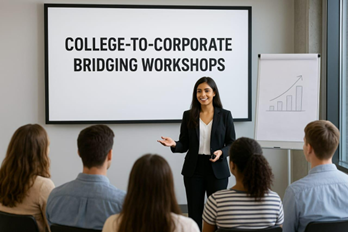
For the fresh graduates, the transition from the classroom to the boardroom has become a tough nut to crack. Frequently, there is a lack of alignment in the skills that are taught in colleges and the skills that are actually useful in business environments. For this reason, a college and corporate bridging workshop focusing on Bridging Workshops Acclimatization becomes essential. Such programs serve to help students cultivate the in-demand skills, professional etiquette, and self-assurance needed to thrive in their first positions. Indeed, the India Skills Report 2025 indicates the skills gap between skills taught in schools and those needed to be mastered is so big that there’s a need for intervention, as only 51% of graduates are employable. Given the current direct adaptability, digital fluency, and strong communication requirements from employees, Corporate Bridging Workshops serve as essential launchpads instead of mere supplements.
1. Understanding the True Skill Gap through AI
Analysis: In what ways are technology and workshops evolving together? As NASSCOM reports this year, 2024, we see the adoption of AI-powered skill gap analytics by Indian universities, which is a sign of innovation on its own. For instance, AI can now evaluate the communication, the IT literacy, or the problem-solving skills of a graduating cohort and measure them against a benchmark. These Corporate Bridging Workshops have more flexibility. They can devise tailored sessions for each particular group. With tailored workshops, students are no longer passive receivers of a predetermined syllabus, but instead, educated based on the gaps found and tailored sessions. Instead of post-graduate employment simulations, workshops ensure students are no longer passive receivers of a predetermined syllabus.
2. Proof of Necessity: The Employability Challenge
Data illustrates stories better than words. The India Skills Report of 2025 revealed that only 51% of graduates are employable in the Indian workforce. This translates to almost a 50% shortfall in meeting the industry standards. This further indicates increased training expenditure, prolonged onboarding, and poor fit hires from an employer’s perspective. Increased training expenditure, prolonged onboarding, and poor fit hires. From the student’s perspective, this often translates to a lower starting salary, underemployment, or no employment. This is why Corporate Bridging Workshops, as a holistic response, are offered. These workshops equip students with the vital missing exposure. These workshops equip students with vital missing exposure to navigating interdepartmental collaboration, managing client communication, and adapting to corporate technology tools. These workshops still provide the much-needed confidence in students and equip them to meet expectations. More critically, these workshops still provide much-needed confidence and bolster the students’ understanding of workplace etiquette.
3. Looking at Global and Indian Best Practices
This effort goes beyond India. McKinsey cited in 2024 that corporate-readiness bootcamps are becoming popular in the United States and Europe, signalling that at least some universities are beginning to appreciate their social responsibilities. These models offer practical instruction such as board meeting simulations, business case simulations, and expert mentorship. The same momentum is now manifesting in India with the recent collaborations. For example, IIM Bangalore worked with Accenture in 2024 to prepare bridging projects in the form of mock consulting projects, where they helped design business model challenges. Such collaborations demonstrate that these Corporate Bridging Workshops go far beyond theoretical frameworks and are, in fact, pathways into the professional world. Students not only grapple with real-world corporate problems but also understand the framework of corporate relations that exists far beyond industry-academia interactions.
4. Hybrid Models: The Future of Bridging
How these workshops are conducted is changing as well. The EY Future of Work Report (2025) highlights that hybrid delivery models, a combination of online and in-person, are increasingly common. Imagine a student located in Delhi who can listen to a real-time leadership session given by the CEO of a well-known company. She can join in-person simulations of group discussions and interviews. In addition, hybrid models enable persistent engagement. Students can access session recordings, complete assignments, and monitor their performance while receiving digital feedback. This approach guarantees that the Corporate Bridging Workshops enable ongoing support throughout the transition from university to workplace.
5. Conclusion: A Pathway to Building Trusting Confidence
From the data provided and the case studies examined, one fact stands out very clearly: the corporate bridging workshop for students is no longer optional. It is an absolute necessity for students who wish to succeed in the competitive job markets. These post-graduate programs are being transformed by AI-powered skill assessments, worldwide bootcamp models, and hybrid delivery. There is an increased expectation by employers for corporate bridging corporate workshops, internships, and Corporate Acclimatization initiatives. Students need a professional training framework in adaptability, professionalism, and workplace etiquette. In fact, the post-graduate programs give the participants immense self-esteem, clarity, and readiness to enter the corporate world. Integrating corporate adapt training early in student life enables students to not just get employed but truly excel in the various stages of professional life.
References
[1] Wheebox, CII, and AICTE, India Skills Report 2025. Wheebox, 2025. [Online]. Available: https://wheebox.com
[2] NASSCOM, AI in Higher Education: Skill Gap Analytics 2024. National Association of Software and Service Companies, 2024. [Online]. Available: https://nasscom.in
[3] McKinsey & Company, The Future of Work: Corporate-Readiness Bootcamps 2024. McKinsey Global Institute, 2024. [Online]. Available: https://www.mckinsey.com
[4] Indian Institute of Management Bangalore and Accenture, Bridging Academia and Industry: Consulting Project Collaborations 2024. IIM Bangalore, 2024. [Online]. Available: https://www.iimb.ac.in
[5] EY, Future of Work Report 2025: Hybrid Learning Models. Ernst & Young Global Limited, 2025. [Online]. Available: https://www.ey.com
[6] N. Gomez, S. S. Batham, M. Volonte, and T. D. Do, Virtual Interviewers, Real Results: Exploring AI-Driven Mock Technical Interviews on Student Readiness and Confidence, arXiv preprint, Jun. 19 2025. [Online]. Available: https://arxiv.org/abs/2506.16542
Penned by Himanshi Saraswat
Edited by Hamid Ali, Research Analyst
For any feedback mail us at [email protected]
Transform Your Brand's Engagement with India's Youth
Drive massive brand engagement with 10 million+ college students across 3,000+ premier institutions, both online and offline. EvePaper is India’s leading youth marketing consultancy, connecting brands with the next generation of consumers through innovative, engagement-driven campaigns. Know More.
Mail us at [email protected]