
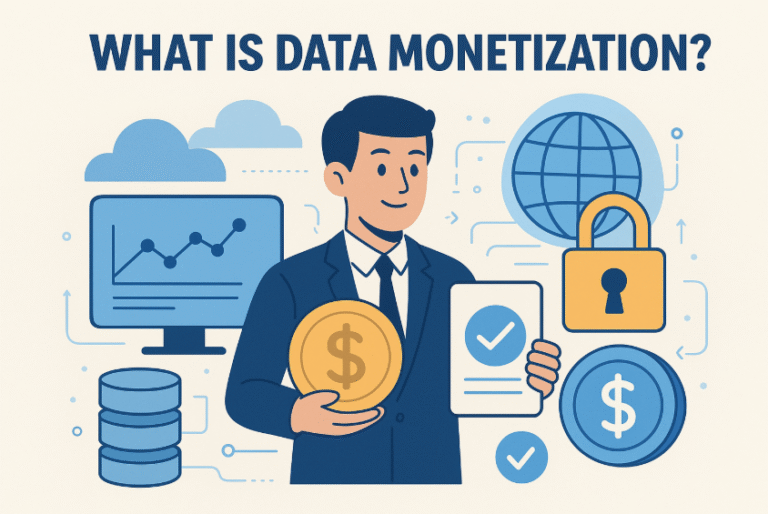
In the digital economy currently, data has been repeatedly labeled “the new oil.” Businesses across all industries rely on customer information to design goods, tailor services, and inform strategic business strategies. But aggregating, selling, and reselling information in a veiled manner is generating ethics and rule-making problems. Data monetization involving user permission is where things begin to go awry. It is a model wherein organizations gain value from information without users losing control over what information they share and how it will be used.
What is Data Monetization?
Monetization of data is merely the transformation of data to quantifiable economic value. For companies, it might be selling anonymized information to third parties, applying analytics to optimize operations, or generating new streams of income through targeted advertising. More commonly in the past, much data was gathered by businesses covertly, often without notification to users. This has been increasingly criticized as individuals catch on to the extent of their online track being traced.
The Use of User Consent
User consent refers to individuals voluntarily agreeing to give out their personal data for specific purposes. Data monetization based on consent ensures that data are not only harvested but also sold with respect to the rights of users. An example of location data-harvesting mobile application for improving recommendations needs to inform users why the data are being harvested and allow them to opt in or out.
When users opt intelligently, the business-customer relationship is clearer. Rather than being manipulated, users are enlisted as stakeholders in the value exchange. This change allows space for establishing trust, which is necessary for sustained business success.
Benefits of Consent-Based Monetization:
- Trust and Retention: Those businesses that are transparent with data practices build more trusting relationships with customers. If individuals believe that they are being handled well in terms of their privacy, then they stick around.
- Regulation Compliance: Laws such as GDPR in Europe and CCPA in California mandate the users’ direct consent prior to data collection. Not only do companies that use consent models avoid penalties but also future-proof themselves since regulations will always keep changing.
- Better Data Quality: Data collected with permission is also more likely to be accurate. If customers choose to give information on a voluntary basis, then they will tend to provide correct information, thus enhancing business intelligence.
- New Revenue Models: It is even possible for some websites to allow users to monetize their own information themselves. For example, there are new apps coming up where users can exchange their browsing or shopping history with ad agencies for rewards. This empowers individuals and offers an equitable trade of value.
Challenges to Consent Implementation
Although the idea is simple, implementation is difficult. Organizations have to provide easy and readable consent processes. Long and complicated privacy policies discourage individuals from reading and comprehending how their information would be handled.
The other problem is to keep it private and personalized. Individuals desire customized services but risk not being willing to provide sensitive information. Organizations must tread carefully by pooling or anonymizing without losing the value.
Furthermore, it is not an easy task to make it transparent in the long run. Consent must be a repetitive process, not a one-time thing. Consumers must be able to scan, update, or retract their permissions with ease.
The Future of Permission-Based Data Monetization
User data-driven behavior has begun to shift. Large tech giants are adapting to more strict privacy practices, and startups are piloting the ways in which individuals are receiving payment directly for data. We will see people being able to choose exactly what type of information they’d like to sell and how much they are being paid.
Blockchain and similar technologies can also be used to build verifiable, secure models of consent. Smart contracts, for example, would allow data-sharing protocols to be enforced automatically and would keep the user in control.
Conclusion:
User-choice data monetization is not merely a matter of staying within the law—it is the ethical and sustainable path ahead. It turns data from being something that is consumed in secret into a shared resource under the light of openness and common good. Companies can unleash new potential without sacrificing privacy through consideration of user choice. Users have more control over their online identities as well.
Finally, this equilibrium of business value and the user rights will be the one determining the health of the digital economy. Information can truly be the new oil, but only if treated responsibly—with complete agreement of the people creating it
FAQs
Q1. What is Data Monetization?
Data Monetization is the process of turning raw data into measurable economic value. Businesses use data insights to improve decision-making, enhance services, and even create new revenue models. Unlike traditional practices where data was sold without user awareness, modern Data Monetization emphasizes transparency and consent to ensure users remain in control of their personal information.
Q2. Why is Data Monetization important for businesses today?
In the digital economy, Data Monetization allows businesses to optimize operations, reduce costs, and generate new income streams. With accurate data, companies can design targeted products, tailor services to customer needs, and create stronger business strategies. The practice helps organizations stay competitive in fast-changing markets.
Q3. What are the main types of Data Monetization?
There are two key types: direct Data Monetization (selling anonymized data or insights to third parties) and indirect Data Monetization (using data analytics to improve efficiency, personalize marketing, or enhance customer retention). Both methods add measurable value when implemented with respect to privacy and consent.
Q4. How does user consent play a role in Data Monetization?
User consent ensures Data Monetization is ethical and compliant with regulations. Companies must inform users about what data is collected, how it will be used, and give them clear opt-in or opt-out choices. This creates trust and allows customers to participate willingly in the data exchange.
Q5. What are the benefits of consent-based Data Monetization?
The benefits include improved customer trust, regulatory compliance, higher data quality, and the potential for new revenue streams. When users willingly provide information, the data tends to be more accurate and valuable, helping businesses make better decisions and build stronger customer loyalty.
Q6. How does Data Monetization improve customer trust?
Transparency in Data Monetization builds confidence. When companies clearly explain their data practices and allow individuals to control their information, customers feel respected. This leads to stronger relationships, higher retention, and a long-term business advantage.
Q7. What laws regulate Data Monetization?
Regulations such as the GDPR (General Data Protection Regulation) in Europe and CCPA (California Consumer Privacy Act) in the U.S. mandate that companies must collect data with explicit user consent. Organizations engaging in Data Monetization must align with these laws to avoid penalties and maintain credibility.
Q8. Can users benefit directly from Data Monetization?
Yes. New platforms are emerging where users can monetize their own information. For example, individuals can choose to share browsing data or shopping preferences with advertisers in exchange for rewards. This shifts Data Monetization from being business-centric to user-inclusive, empowering individuals.
Q9. What challenges do companies face in Data Monetization?
Challenges include designing simple consent mechanisms, protecting privacy while personalizing services, and ensuring transparency over time. Another issue is balancing data value with user comfort, since many people hesitate to share sensitive information.
Q10. How is Data Monetization connected to personalization?
Data Monetization enables personalization by analyzing customer preferences and behaviors. However, personalization must be balanced with privacy safeguards. By using anonymized or aggregated data, businesses can deliver customized experiences without exposing individuals to unnecessary risks.
Q11. What role does blockchain play in Data Monetization?
Blockchain technology enhances Data Monetization by creating transparent, secure, and verifiable consent models. Smart contracts can automate data-sharing agreements, ensuring that users remain in control of how their data is exchanged and compensated.
Q12. Is Data Monetization only for large companies?
No. Small and medium-sized enterprises can also benefit from Data Monetization. By using analytics tools, even smaller firms can improve decision-making, reduce waste, and offer better customer experiences. Consent-based strategies make it possible for businesses of any size to adopt ethical data practices.
Q13. How will the future of Data Monetization look?
The future points toward user-choice models where individuals decide what data to share and receive fair compensation. With stricter privacy regulations and advanced technologies like blockchain, Data Monetization will become more transparent, ethical, and user-driven.
Q14. How does Data Monetization affect the digital economy?
Data Monetization fuels the digital economy by turning information into a tradable asset. When done responsibly, it drives innovation, creates value for businesses, and empowers users. However, unethical practices can harm trust and slow economic growth, making user-centric approaches essential.
Q15. What is the ethical way forward in Data Monetization?
The ethical path emphasizes consent, transparency, and fairness. Businesses must treat data as a shared resource rather than a commodity taken in secrecy. Ethical Data Monetization balances business growth with user rights, ensuring sustainability in the digital economy.
Penned by Himanshu
Edited by Sushmita Haldar, Research Analyst
For any feedback mail us at [email protected]
Transform Your Brand's Engagement with India's Youth
Drive massive brand engagement with 10 million+ college students across 3,000+ premier institutions, both online and offline. EvePaper is India’s leading youth marketing consultancy, connecting brands with the next generation of consumers through innovative, engagement-driven campaigns. Know More.
Mail us at [email protected]