
Topics: Emotional Skills, Campus Life
Introduction
For many years, the development of campus life across India has been heavily influenced by challenging studies and highly competitive examinations. As such, many of the student associations that have existed over the years have primarily focused on information technology, sports, and cultural achievements. Now, however, one of the newest and most significant categories of student associations has emerged: Emotional Skill Mapping Groups/Clubs. The mission of these associations is to foster a greater understanding of young adults’ emotions and how they can react to them, enabling the community members to feel “smart” about their academic success and about their emotional intelligence and social skills.
As increasing numbers of young adults enter competitive academic environments in India, the clubs have become instrumental in developing emotionally resilient and compassionate student communities.
1. Why Emotional Acuity is the New Academic Edge
Throughout India, students must deal with enormous amounts of anxiety related to accomplishing such tasks as receiving a good score on an entrance exam (JEE or NEET), obtaining a sought-after internship, or achieving a high salary upon completion of their degree. With the amount of pressure they experience daily, emotional well-being has taken a back seat. The recognition of the impact that students’ ability to identify and control their emotions has on academic achievement, productivity, and relationships has become evident to university leaders and faculty. The development of emotional skills, including empathy, self-regulation, active listening, and conflict resolution, will no longer be viewed exclusively as “soft skills”. These are essential skills needed to survive in the rapidly changing world of work. Employers and recruiters are demanding that job candidates demonstrate the ability to successfully accept or respond to emotions, and to work collaboratively with others rather than rely solely on the technical knowledge they have acquired during their studies. By demonstrating that they are intelligent about their entire self, as well as their GPA, through participation in Clubs, they will feel prepared to enter the workforce and compete effectively in today’s economy.
2. Understanding Emotional Skill Mapping
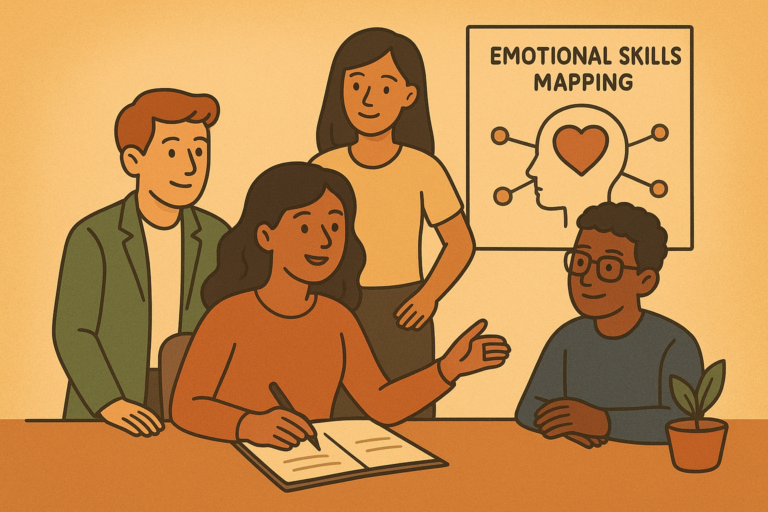
Emotional skill mapping clubs are designed for students’ access to a peer support system for recognising their emotional typification and emotional strengths, challenges, and stressors. They are non-judgmental, practical, and structured with discussions/reflective exercises and interactions with peers to help students develop better self-understanding and self-awareness. The key idea of mapping is to provide the clearest possible understanding of a student’s emotion(s). By allowing students to see where their feelings stem from (the root source) and where they are headed (the trajectory), they will be better able to manage their feelings. Emotional skill mapping clubs are not intended to replace professional counselling, but as a place where students can proactively explore and express their feelings in a supportive environment, and develop connections to one another that might otherwise be difficult to achieve in the digitally focused campus lifestyle.
3. Key Activities that Make Students Feel Smart Emotionally
The core activities of these clubs are designed to make emotional intelligence measurable and desirable, shifting the perception of emotional awareness from a vulnerability to a strength.
Reflection Circles and Dialogue
Dialogue circles provide a support system in the form of guided conversations around common themes such as life’s challenges, how to handle academic pressures, overcoming rejection and developing healthy friendships. A facilitator uses prompts to help create empathy and constructive listening in dialogue circles. Reflection circles provide a place where the members can share their recent experiences and can analyse what they were feeling together to decrease impulsive reactions and confusion.
Emotional Mapping and Journaling
Another component of an effective college experience is the creation of individual journals to capture both an individual’s thoughts and feelings as well as the ability to use that journal to identify patterns of stress, motivation, and interpersonal issues. As another means of identifying patterns associated with emotional responses, the younger generation of individuals who attend India’s universities is more likely to have an analytical mindset, and therefore, they will be more comfortable with using various forms of visual data representation (e.g., emotion mapping sheets) to identify their individual emotional triggers. This visual representation of data provides the analytical generation of Indian youth with a clearer understanding of the sources of their emotional responses.
Simulation and Peer Mentorship
Many student clubs host role-play simulations where club members will act out certain scenarios that place them under high levels of stress. Examples of such scenarios include “conflict resolution”, “group decision making”, and “leadership challenges”. Through this method of practice, students will have the opportunity to safely learn and practice their emotional control skills. In many clubs, experienced members serve as peer mentors to help newer members identify their strengths and weaknesses related to their emotional responses to others in the campus community. For this reason, many students develop a strong sense of belonging to the campus community and the individual clubs they belong to.
4. The Transformational Impact on Indian Campus Life
Emotional Skill Mapping Clubs’ widespread adoption shows an enormous cultural transformation within India’s higher education system. Historically, traditional educational norms have denoted emotional expression as something done within private spaces, but Generation Z’s approach to education has shifted towards collective and publicly recognised emotional support systems. This has resulted in Gen Z students searching for spaces where they can demonstrate their True selves, show vulnerability, and publicly express their feelings while establishing honest relationships.
Strengthening Campus Relationships:
Emotional Skill Mapping Clubs create the ability for honest conversations to take place and empathy to be given towards each other, creating bonds between students that are deeper than the normal campus-based relationship between students—this bond helps to alleviate the feeling of isolation many students feel when attending school in a competitive atmosphere.
Enhancing Academic Performance:
Emotionally balanced students are more able than emotionally unbalanced students to handle stress, avoid being burnt out, stay motivated, leading to consistent academic success and develop healthy study habits.
Improving Placement Readiness:
Students who have participated in Emotional Skill Mapping Club-type activities develop skills required for conflict resolution and team collaboration; students who have developed these skills become effective communicators and are valued by today’s employers who seek to hire collaborative individuals.
Promoting Mental Well-being:
These clubs serve as crucial preventative spaces, reducing the stigma associated with emotional struggles and proactively encouraging students to seek professional help when needed, aligning with India’s rising focus on mental health awareness.
5. Why Gen Z Connects with Emotional Skill Mapping
Generation Z is arguably the most psychologically cognizant generation to this point (i.e., the most conscious or ethically aware) as they emphasise authenticity and being truthful to themselves. Because of this factor, their idea of an affinity group resonates strongly with their worldview because it promotes self-searching and open dialogue free of judgment.
They have also realised that being emotionally smart is as important as technicality in their studies. They believe that identifying and developing one’s emotional intelligence is a vital skill for accepting the role of working well with others and managing a variety of confusing or time-consuming relationships (including friendships) in their personal and professional lives. Therefore, Generation Z is ahead of the curve on this type of proactive approach to caring for one’s feelings and mental health has been placed at the forefront of all campus life due to many students coming together with large national organisations to promote effective mental health resources on their campuses.
6. Challenges and Sensitivities in the Indian Context
Clubs have many benefits with numerous advantages; however, they will face challenges relating to cultural and logistical aspects that are particular to India, as per below:
Cultural Resistance:
Students might not want to express their thoughts and emotions in the beginning, as discussing emotions may have been discouraged through cultural norms or through promoting stoicism. Therefore, building trust and maintaining total confidentiality are critical to overcoming this.
Training and Facilitation:
Trained student facilitators are essential for the clubs to ensure they fulfil their objectives, preventing misinformation and providing proper coping methods. Therefore, working with campus counsellors/psychologists to assist in the training of student facilitators is essential to ensure a proper level of training is provided.
Confidentiality and Boundaries:
Maintaining sensitivity and confidentiality is paramount. The clubs must communicate thoroughly to their members that they are strictly peer support systems and not meant to replace professional therapy. Members must understand that their reliance on fellow members for guidance about serious issues may be detrimental.
7. A Roadmap for Strengthening Emotional Skill Clubs
For colleges to maximise the impact of Emotional Skill Mapping Clubs and fully embed them into campus life, strategic support is essential:
Professional Partnership:
Creating strong partnerships between psychological professionals and wellness practitioners to provide continuous training and supervision of Club Facilitators.
Dedicated Space and Integration:
Creating a dedicated space on campus where reflection circles and activities can occur and integrating Emotional Skill sessions as part of the mandatory Orientation Program for all incoming students.
Faculty and Academic Support:
Encouraging faculty to occasionally participate in non-judgmental ways to help bridge communication gaps and reinforce the value of emotional skill development as part of student development.
Formal Recognition:
Providing formal and informal recognition to Club members (e.g. Certifications or Micro-Credentials) for their active engagement in this program, thus reinforcing the fact that emotional intelligence is a skill that should be valued equally with academic learning.
Conclusion
Emotional Skills Mapping Club’s mission is to create a better, closer, and much more emotionally based life in the Colleges of India through empowering students with the ability to discover and develop their own emotional self, foster quality relationships, and develop vital skills for living in an increasingly competitive world. Emotional Skills Mapping Club allows students to find success in the present and future by giving them tools to help them feel intelligent and competent throughout their entire lives. As more colleges adopt this revolutionary approach, Indian College will continue the path that leads to openness, empathy and communal health and wellness
References
[1] “The Emergence of Emotional Intelligence in Indian Higher Education,” Journal of Indian Campus Life, vol. 15, no. 4, pp. 32-40, 2023.
[2] “Bridging the Gap: Emotional Skills vs. Academic Preparedness in Indian Youth,” Academic Wellness Review, vol. 8, no. 1, pp. 115-125, 2024.
[3] “Employer Demand for Emotional Intelligence in India’s Job Market,” Indian Corporate HR Report, vol. 3, no. 2, pp. 55-65, 2023.
[4] “The Role of Peer Support in Reducing Social Isolation on University Campuses,” Higher Education Research Quarterly, vol. 19, no. 3, pp. 90-100, 2022.
[5] “Visual Tools and Emotional Mapping for Self-Awareness,” Psychological Methods in Education, vol. 11, no. 1, pp. 40-50, 2024.
[6] “Gen Z’s Preference for Authenticity and Emotional Openness,” Youth Culture and Behaviour Journal, vol. 6, no. 4, pp. 12-22, 2023.
[7] “Mental Health Awareness Campaigns and Student-Led Initiatives in India,” Public Health and Wellness Review, vol. 14, no. 2, pp. 75-85, 2022.
[8] “Best Practices for Implementing Peer Mentorship Programs in Indian Colleges,” Student Development and Training Report, vol. 2, no. 1, pp. 30-40, 2023.
[9] “Emotional Intelligence and Student Well-being,” Indian Psychology Review. [Online].
Available: https://indianpsychologyreview.org
[10] “Youth Mental Health Trends in India,” National Wellness Report, 2023. [Online].
Available: https://nationalwellnessreport.in
[11] R. Gupta, “Emotional Skills in Higher Education,” Education Insight Journal, 2022. [Online].
Available: https://educationinsightjournal.com
FAQs
Q1. What are emotional skills mapping clubs?
Clubs that map Emotional Skills like resilience and empathy to improve student well-being and Campus Life.
Q2. Why are emotional skills important in Indian colleges?
They reduce stress, improve teamwork, and strengthen Campus Life connections.
Q3. Do emotional clubs replace therapy?
No. They support Emotional Skills growth and encourage professional referrals when needed.
Q4. How do clubs improve campus life?
Through gratitude, dialogue, peer mentorship, and resilience, uplifting Campus Life.
Q5. What is emotional skill mapping?
A structured way to understand personal Emotional Skills and responses that shape Campus Life interactions.
Q6. Who can join these clubs?
Any student wanting stronger Emotional Skills and a healthier Campus Life.
Q7. How do reflection circles help?
They improve emotional clarity and reduce impulsive reactions affecting Campus Life.
Q8. What skills do peer mentors develop?
Leadership, empathy, and advanced Emotional Skills for better Campus Life support.
Q9. Why does Gen Z connect with these clubs?
They value measurable Emotional Skills and authentic Campus Life bonds.
Q10. How should colleges support these clubs?
With facilitator training for Emotional Skills and safe spaces that enrich Campus Life.
Penned by Pranjali
Edited by Isha Yadav, Research Analyst
For any feedback mail us at [email protected]
Transform Your Brand's Engagement with India's Youth
Drive massive brand engagement with 10 million+ college students across 3,000+ premier institutions, both online and offline. EvePaper is India’s leading youth marketing consultancy, connecting brands with the next generation of consumers through innovative, engagement-driven campaigns. Know More.
Mail us at [email protected]