To explain this topic in a better way, let me explain a korean drama named – Mask Girl. The plot of this series revolves around a young timid girl, who is severely bullied for not having socially approved Korean beauty features. Frustrated, she alienated herself all her life. But in spite of all this social exclusion, she is a superhit celebrity on social media, who lures men. How does she do that? She masks her face. Nobody knew how she looked, or where she lived, but by using a mask and numerous filters she was able to become a famous person. Whenever she removed the mask and looked at herself in the mirror, she never liked herself, disgusted by the way she looked she never expected her true self. This series highlights how this woman goes through a difficult journey and finally comes to accept herself.
What does this drama indicate? There are strong and cultural incentives to look as good as possible, this definition of good is moreover based on western beauty standards which are suited for western population. Implying the same for people belonging to other countries creates a lot of social stigma on what constitutes beauty, and what becomes the medium for popularizing these beauty standards?. The correct answer for this would be Social Media. While digital platforms provide opportunities for social connection, self expression and mental health awareness, it also includes significant risks such as – compulsive social media use, cyberbullying, unrealistic beauty standards and exposure to substance related context.
The complex relationship between the youths mental health and digital media is causing pressing concerns, as it leads to –
- heightened impulsivity
- Attention deficit
- increased risk of addiction like behaviors
- low self confidence and self esteem
- higher rates of body dysmorphic disorder
- rise on cosmetic procedures.
A research conducted by DOVE Self-Esteem Projects in 2020 found out that 80% of girls downloaded a filter based app when they turned 18. A City University of London report found that beauty filters have become increasingly popular on social media. For example, Snapchat found that over 90% of young people in the US, France and the UK, used filter products on their apps. In addition, Meta reports that over 600 million have used filters on facebook or instagram. researchers at the city university of London explores the adverse effects of filters on mental health. In a sample of 175 participants, with an average age of 20, 90% of young women reported using filters or editing their photos. When they were asked about which type of filter were used, they explained that filters which made them look and have – thin,white washed skinned,pointy nose,clear jaw line, fuller lips and big eyes.
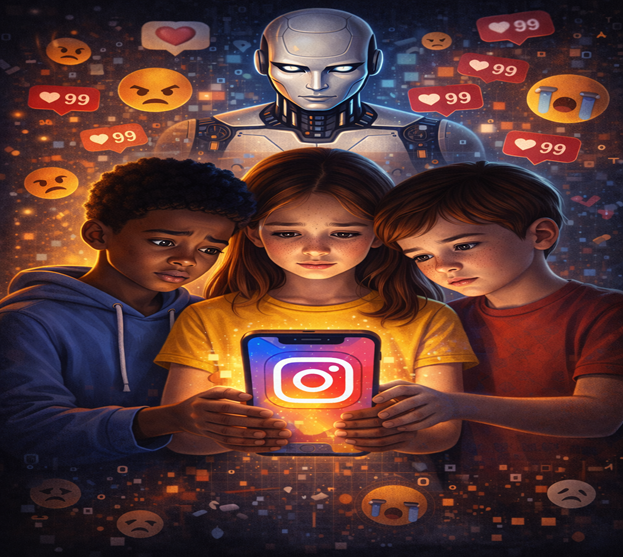
The use of AI has been exemplary in this case. AI- generated images created using deep learning models such as GAN’s ( Generative Adversarial Networks) which are trained on vast datasets to generate entirely new images that resonate real-life photos. These AI tools can help create almost anything. you want taj mahal, behind you, give a prompt to AI and it’s done, or if you want to have a photo with Shahrukh Khan, give a prompt and a real life image is produced for you. Similarly this method has been used to make one look younger, thinner, and with different facial features.
The Impact on Body Image and Self Esteem
The use of ai – generated images have become a medium through which people are able to express themselves with a new identity. This acts as a pressure for individuals to meet up with unattainable beauty standards. This becomes particularly hard for those who have low self esteem with respect to their body image and get affected immensely. When young people constantly see the so-called perfect bodies, faces, and lifestyles in their feeds, they aspire to have the same, and it acts as a medium for faster and easier ways for them to attain that kind of identity. It may result in temporary satisfaction but leads to feelings of inadequacy, self-doubt, and frustration.
Unrealistic Beauty Standard –
AI generated images prompt us with a new identity we never thought we could have, it makes us hide under a pretense of who we could be, but are not. This makes people feel dissatisfied with their own appearances and question their worth based on mere simulation.
Social Media Filters and Layered Reality –
AI generated simulations take this concept to the next level. Constant exposure to these artificially perfected images blurs the line between reality and fantasy, leaving people with distorted perceptions of beauty.
Increased Pressure to Conform –
As AI generated images become more popular, users may feel pressured to portray themselves in a similarly perfect way. The recent example of this can be taken off the Ghibli images that were used all over the world to have animated images of oneself.
Impact of Instagram and Artificial Intelligence Filters on Mental Health –
Increased Anxiety and Depression –
Continuous comparison of oneself with the ai generated image leads to the feeling of inadequacy and depression, self criticism, diminished sense of self worth and heightened anxiety.
Social Comparison –
Social comparison leads to unhealthy competition that leads to rise of hatred, bullying and can erode self esteem. Social comparison should be healthy, it should make one believe in making themselves a better version of their existing self.
FOMO (Fear of missing out) –
AI generated images can highlight a lavish lifestyle making others feel that they are missing out in life and that they are incapable of doing things as others are doing. This comparison makes one question their capabilities which results in increased mental stress.
Body Dysmorphia –
Body dysmorphia is a mental health condition, where an individual becomes obsessed with perceived flaws in their appearance. The more they see “perfect”images, the more distorted their self image becomes.
What can be done which can help us maintain a healthy mental health.
Unlike medication or highway plates, social media platforms do not come with any warning labels.
Parents and Educators should –
Not outrightly ban or restrict the use of social media but rather should have healthy conversations with their wards and their students.
Balance Online and Offline Life By –
- Spending time on hobbies or mastering any artform.
- Meeting friends face-to-face and making memories that are much healthier than those curated out of simulations.
Know When to Take a Break –
Try a 24 – hour digital detox to reset engagement with social media platforms.
Promote Positive Self Talk –
Actively challenge negative thoughts about one’s particular body types and replace them with positive body affirmations such as my body is strong or i am more than my appearance.
Unfollowing or blocking –
Accounts make one feel bad about oneself.
Conclusion
So what is the need of the hour? It is to embrace oneself. Every human is born with certain uniqueness, so why do we tend to generalise ourselves according to the current trends?. The need of the hour is to recognize who we are? what we are? and how we can be better versions of ourselves?. Let’s take a painting for instance belonging to the Ajanta Caves of India. Observe the paintings carefully, you will be able to see that there are multiple human images, but each one is different. Each such figurine has a distinctive facial structure, pattern, body shape, complexion,etc., and now when you look at it from afar you can understand that all those differences culminated into a holistic image. Similarly our differences when we bring together can end up becoming something beautiful that we did not imagine about. It is only when we accept ourselves as who we are will be the better versions we aspire to become.
References
[1] “The Hidden Danger of Online Beauty Filters,”.Psychology Today. [Online].
Available:https://share.google/V6OPROBJZYb0dejfS
[2] “Impact of AI on mental health,”.Tough enough to care. [Online].
Available: https://share.google/TdP1cN4drekD7ddYa
[3] “Social media and its effect on youth mental health in India,”.10Live,Love,Laugh. [Online].
Available: https://share.google/TdP1cN4drekD7ddYa
[4] “Are Teens Getting Addicted to Chatbots and AI Companions?,”.Mobicip. [Online].
Available: https://share.google/PvMlsq6xThO0UxqOu
[5] “Volume 28, 2025. Information, Communication and society,”.Taylor and Francis. [Online].
Available: https://www.google.com/url?q=https://www.tandfonline.com/doi/full/10.1080/1369118X.2025.2470227&sa=U&sqi=2&ved=2ahUKEwi8ioLY39KRAxWryTgGHf1gM1AQFnoECFsQAQ&usg=AOvVaw1oz_Wr-B6kKvUee7pGLjD2
FAQs on Artificial Intelligence Filters
Q1. What are artificial intelligence filters?
Artificial intelligence filters are AI-powered tools that digitally alter facial features, skin tone, or appearance in photos and videos using machine learning models.
Q2. How do artificial intelligence filters work?
They use deep learning algorithms trained on large image datasets to detect facial features and apply real-time visual modifications.
Q3. Why are artificial intelligence filters popular on social media?
They offer instant enhancement, creativity, and social validation, making content more engaging and shareable.
Q4. How do artificial intelligence filters affect mental health?
Frequent use can increase anxiety, low self-esteem, body dissatisfaction, and distorted self-image.
Q5. Can artificial intelligence filters cause body dysmorphia?
Yes. Repeated exposure to idealized filtered images may intensify fixation on perceived flaws and trigger body dysmorphic tendencies.
Q6. Are youth more affected by artificial intelligence filters?
Yes. Youth are still forming self-identity, making them more vulnerable to appearance-based comparison and validation.
Q7. Do artificial intelligence filters promote unrealistic beauty standards?
They often reinforce narrow beauty ideals by modifying facial symmetry, skin tone, and body proportions.
Q8. Can artificial intelligence filters influence cosmetic procedures?
Research suggests that filter-driven dissatisfaction may increase interest in cosmetic enhancements.
Q9. Are artificial intelligence filters always harmful?
No. When used moderately, they support creativity and self-expression, but overuse increases psychological risks.
Q10. How can users reduce the negative effects of artificial intelligence filters?
By limiting filter use, unfollowing triggering accounts, practicing digital detox, and promoting positive self-talk.
Q11. Should artificial intelligence filters be labeled on social media?
Yes. Transparency labels can help users distinguish between real and AI-altered images.
Q12. Can artificial intelligence filters be used ethically?
Yes. Ethical use includes transparency, diversity-friendly designs, and avoiding harmful beauty manipulation.
Penned by Krushna
Edited by Pranjali, Research Analyst
For any feedback mail us at [email protected]
Transform Your Brand's Engagement with India's Youth
Drive massive brand engagement with 10 million+ college students across 3,000+ premier institutions, both online and offline. EvePaper is India’s leading youth marketing consultancy, connecting brands with the next generation of consumers through innovative, engagement-driven campaigns. Know More.
Mail us at [email protected]