Writing a thesis or managing a project can almost feel like you are drowning when the ideas, data, and deadlines begin to pile up. Digital tools emerged as crucial and giving structure to creativity and clarity to complex research. Among these, the mind map tool, most favoured by student communities, is perhaps the most effective way to brainstorm ideas, organize them, and track the evolution of a project.
Conversely, a project visualization app helps individuals synthesize their abstract concepts into concrete steps. Therefore, together these tools play complementary roles in supporting academic life and training in professional project management.
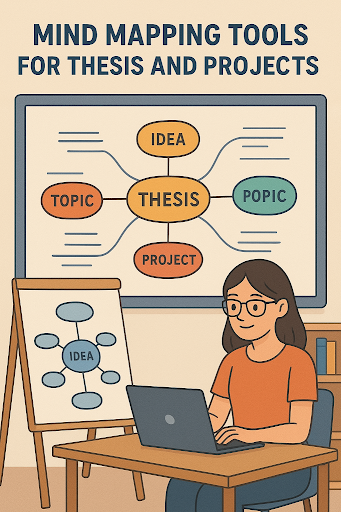
To a student, the thesis is more than a mere academic project; it is a test of individual planning, analysis, and synthesis. A mind map tool that students can use helps in breaking down large topics into smaller branches that can easily be tackled.
By creating a visual connection from research questions to literature, methodology, and findings, the student perceives interrelations that otherwise may be lost in linear note-taking. In this regard, the mind map creates:
- Clear thought and organization: Complex topics are broken into smaller pieces.
- Promotes Creativity: Visual layout engenders new associations and insights.
- Aids in memory retention: Visually organized notes are often easier to remember than text-heavy notes.
These advantages imply that mind map tools should naturally be considered as options during thesis planning, literature reviews, and outlining chapters.
3 Value Additions Through Project Visualization Apps
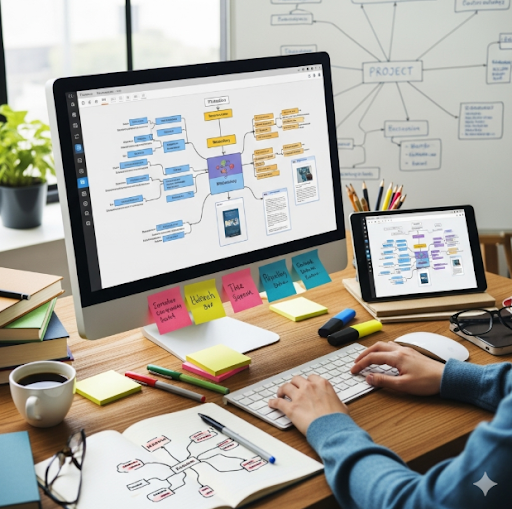
If project visualization complements mind mapping by translating ideas into timelines, workflows, and task boards, mind maps help during ideation, and the visualization apps help the students with execution. Accordingly, student-generated research milestones will typically include such items as data collection, data analysis, and draft submission, all plotted on Gantt charts or Kanban boards.
Such apps permit:
- Tracking progress: Students can ascertain how far they’ve gone or what awaits them.
- Collaboration: In group projects, shared dashboards and task allocations would prove to be beneficial.
- Integration: Many apps interlink with calendars, file storage, and reference managers.
With mind mapping and visualization apps used together, students get conceptual clarity coupled with practical efficiency.
4 Popular Tools for Students and Academic Researchers
The digital ecosystem offers many platforms tailored to academic and project needs. Some noteworthy recommendations would be:
- MindMeister / XMind: A frequent mind mapping tool model platform used by students to generate new ideas, structure their research, or develop visual notes.
- Miro / Lucidchart: Very suitable for collaborative mapping and whiteboarding in real-time; often application in thesis group consultations.
- Trello / Notion: Much more effective project visualizer apps with boards, timelines, and databases to keep track of thesis milestones.
- Coggle / SimpleMind: Very simple and most user-friendly mind mapping tools fit for beginners who want to initiate their projects.
These tools vary; some free student-friendly versions, to advanced paid plans with integrations, are suitable for research-intensive projects.
4 Educational Use Benefits of Visual Thinking Tools
Incorporating both a mind map tool for students and a project visualization app would prove beneficial for education in a couple of ways:
- Enhanced critical thinking: Students see connections between literature, concepts, and data.
- Better time management: Last-minute rushes are avoided when deadlines are visible with visualization apps.
- Collaboration and communication: More structure comes to group thesis or project work with shared visuals.
- Cross-disciplinary learning: These tools can cut across sciences, humanities, or business studies.
Research has shown beyond this that visual learning methods enhance not just comprehension but retention, making it a powerful tool for academic excellence.
The Future of Thesis and Project Planning
The future of research and project planning remains ever more digital and visual. As artificial intelligence becomes embedded into mind mapping software, the near future may present students with automated suggestions to help structure arguments, pinpoint gaps in the literature, and even generate draft outlines. Similar indicators will interface with future project visualization apps to give students foresight about impending workload bottlenecks or help them effortlessly juggle multiple deadlines.
For contemporary students, incorporating the utilization of these tools means gaining immediate benefit to academic achievement as well as developing skills that they will need for their future careers. Companies around the globe are using visualization and mapping for strategy, innovation, and collaboration. Accordingly, students who learn these techniques during their thesis journey will equip themselves for their future work life.
Conclusion
A thesis or major project requires creativity, discipline, and strong organizational skills. By using a mind map tool, student researchers can tear apart complex academic content to reach clear, structured ideas. On the other hand, a project visualization app ensures that those ideas are translated into concrete steps with measurable results. Together, these tools make up a fantastic pair that aids both in intellectual exploration and practical project execution. As education goes digital, visual thinkers are not an extra; they are becoming one of the must-have buddies for every student builder of ideas.
References
[1] M. C. Babadoğan, “Mind Mapping as a Learning Tool: A Course Design Example for Higher Education,” PERR Journal, vol. 14, no. 1, 2025. perrjournal.com
[2] Y. Dong, S. Zhu, and W. Li, “Promoting Sustainable Creativity: An Empirical Study on the Application of Mind Mapping Tools in Graphic Design Education,” Sustainability, vol. 13, no. 10, art. 5373, 2021. MDPI
[3] Research findings showing mind mapping enhances writing focus and idea generation. IUBAT, 2011. ResearchGate
FAQs
1. What is a mind map tool and why is it important for students?
A mind map tool is a digital platform designed to visually organize ideas, topics, and data. Instead of writing information in a linear, text-heavy format, students can create branching structures that connect concepts and show relationships clearly. This approach is particularly useful when working on a thesis or project because it helps break down complex subjects into manageable sections. Using a mind map tool, student researchers can see the bigger picture, link literature with methodology, and improve their understanding of how all parts of their research fit together.
2. How can a mind map tool help students during thesis writing?
A mind map tool used during thesis preparation acts as a visual framework for structuring thoughts and arguments. It allows students to map out chapters, organize references, and connect research questions with findings. This visual process ensures that no part of the research is overlooked and helps maintain logical flow throughout the writing. A student can also identify gaps, plan the order of sections, and even brainstorm new ideas based on the connections they see. Overall, using a mind map tool gives student researchers more clarity and direction during the writing process.
3. What are the main benefits of using a mind map tool for students?
The benefits of using a mind map tool include simplifying complex topics by breaking them into smaller, manageable parts, enhancing creativity by visually linking ideas, improving memory retention through visual structures, and boosting organization and time management since the student can see the entire research structure at a glance. These advantages make mind map tools student-friendly and ideal for tackling big academic tasks like a thesis.
4. How does a project visualization app differ from a mind map tool?
While a mind map tool focuses on idea generation and conceptual clarity, a project visualization app emphasizes implementation and execution. After creating a structured outline with a mind map, students can use a project visualization app to set timelines, assign tasks, and track progress. This tool is especially useful when managing multiple deadlines or collaborating with others. Together, the two tools form a complete solution: the mind map tool handles creative planning, while the project visualization app ensures organized execution.
5. What are some of the best mind mapping tools for students?
Some popular mind mapping tools include MindMeister and XMind for detailed maps, Coggle and SimpleMind for beginners due to their simplicity, and Miro and Lucidchart for collaborative projects. The right choice depends on the student’s academic needs and whether they prefer a simple interface or advanced features for complex projects.
6. How do mind map tools support collaboration among students?
Mind map tools support collaboration by offering shared spaces where ideas can be built, edited, and refined together. Group members can contribute insights and see how their ideas connect with others. When used alongside a project visualization app, tasks can be assigned, deadlines tracked, and progress monitored collectively. This combination makes group work more efficient and ensures that everyone remains aligned with the project’s goals.
7. Are mind map tools useful across different fields of study?
Yes, mind map tools are beneficial across almost every academic discipline. In scientific fields, they help structure theories and methodologies. In humanities, they support organizing literature, arguments, and sources. In technical or business fields, they aid in planning workflows, presentations, and coding structures. Their adaptability makes mind map tools an essential part of any study strategy.
8. Can mind map tools and project visualization apps improve academic performance?
Yes, using both tools can significantly improve academic performance. Mind map tools enhance understanding, analytical skills, and organized thinking, while project visualization apps ensure tasks are completed on time, reducing stress. Together, they create a system where students can plan more effectively, execute efficiently, and improve overall project quality and academic outcomes.
9. How can beginners start using mind mapping effectively?
Beginners should start with a simple, student-friendly mind map tool. Begin with a central topic and add branches for subtopics, key points, and references. Using color-coding and icons makes the map engaging and memorable. Once the structure is complete, linking it with a project visualization app helps convert ideas into actionable steps. Gradually, students can explore advanced features like collaborative mapping and AI-generated suggestions.
10. What is the future of mind mapping tools for students?
The future of mind mapping tools involves integration with artificial intelligence and automation. Tools will not only organize ideas but also suggest research directions, identify missing references, and even generate draft outlines. Project visualization apps will predict potential delays and optimize scheduling automatically. Mastering these tools prepares students for academic success and equips them for careers where digital planning and visual thinking are essential.
Penned by tanjal kapoor
Edited by reeya kumari, Research Analyst
For any feedback mail us at [email protected]
Transform Your Brand's Engagement with India's Youth
Drive massive brand engagement with 10 million+ college students across 3,000+ premier institutions, both online and offline. EvePaper is India’s leading youth marketing consultancy, connecting brands with the next generation of consumers through innovative, engagement-driven campaigns. Know More.
Mail us at [email protected]