
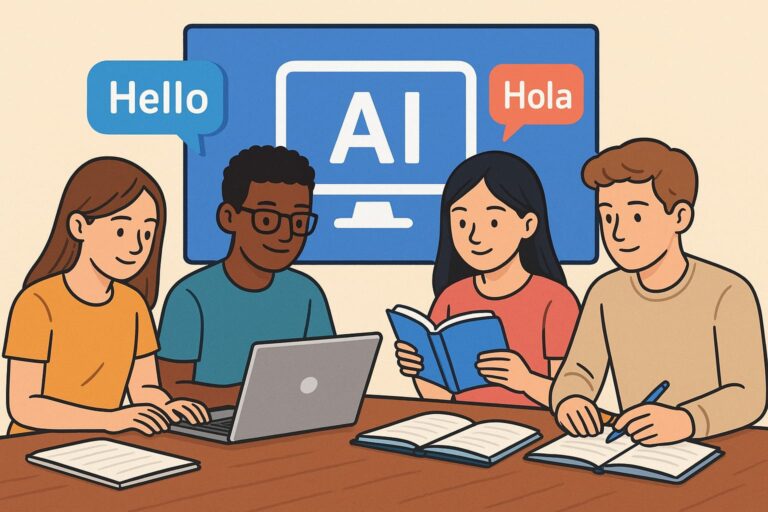
For today’s students, the classrooms are not only confined in four walls or say assignments are not only confined in one language; whether it’s a French literature review, a Spanish history essay, or a research paper in English for an international class, multilingual assignments are becoming an indispensable part of education. That’s where AI translation tools are changing the game.
7 Ways AI Transforms Multilingual Assignments for Students
AI- Student’s Helping Partner:
Not too long ago, students relied on translation apps and dictionaries for multilingual assignments. With AI, completing this work has become much easier, and it acts as a useful partner. Now, we don’t have to spend hours finding translations. Instead, we can finish assignments in seconds using AI. This not only improves creativity but also saves time by removing language barriers. AI translates words efficiently and lets students focus more on learning than searching for meanings.
As AI tools get smarter, they help with more than simple translation. They assist students in practicing pronunciation, understanding cultural references, and collaborating across borders in real time. For global students, this means more than just finishing multilingual assignments quickly. It encourages real learning and understanding in multiple languages. It makes student life easy as it brings convenience and also it is easy to use; being easily accessible makes it perfect for the students to use it.
Cons of AI for students:
As every coin has two sides, it also has two aspects- positive and negative. Let’s flip the coin and know about the other side as well. AI is just a computer software, not a human so we cannot expect perfection in its every work because it does not have its own understanding, it only runs on codes and how it is programmed.
AI sometimes misreads words and also misinterprets idioms which lead to a different meaning as compared to the real one. AI is a good tool to help students but we cannot rely on it too much as it will destroy the researching habit of the students. If the students rely on it too much then they will also lack the basic language skill which they need to develop in order to understand any language better. It keeps improving, we might see tools that can translate while keeping your personality intact, help you practice pronunciation, or even explain cultural references.
Conclusion:
We cannot totally rely on AI. We need to use our own understanding as well. It’s true that for students, it’s not just about getting assignments done faster—it’s about connecting with the world in more languages than ever before. With the help of AI they can do it easily and effortlessly, but AI can’t replace the human touch, it’s becoming an incredible partner for students working across languages. It can be very helpful if the students use it to learn new things, not just for the mere completion of their homework. So that it will help them to grow and develop so students need to work for their betterment not as a tool for being lethargic instead they should use it to expand their knowledge and do their work more effectively and efficiently.
References
[1]Koehn, P. (2020). Neural Machine Translation. Cambridge University Press https://www.researchgate.net
[2]Castilho, S., Moorkens, J., Gaspari, F., & Way, A. (2018). Translation Quality Assessment in the Age of AI. Springer.
[3]Wu, Y., et al. (2016). Google’s Neural Machine Translation System: Bridging the Gap Between Human and Machine Translation. arXiv preprint arXiv:1609.08144.
FAQs
Q1. What are multilingual assignments?
Multilingual assignments are academic tasks that require writing, translation, or research in more than one language for better learning outcomes.
Q2. Why are multilingual assignments important for students?
Multilingual assignments are important because they improve language skills, cultural understanding, and global communication abilities.
Q3. How do multilingual assignments improve learning?
Multilingual assignments improve learning by encouraging students to think critically, compare languages, and develop advanced writing skills.
Q4. Who usually gives multilingual assignments?
Professors in language studies, translation courses, and global communication programs often assign multilingual assignments to students.
Penned by Reema Gupta
Edited by Ridhima Sharma, Research Analyst
For any feedback mail us at [email protected]
Transform Your Brand's Engagement with India's Youth
Drive massive brand engagement with 10 million+ college students across 3,000+ premier institutions, both online and offline. EvePaper is India’s leading youth marketing consultancy, connecting brands with the next generation of consumers through innovative, engagement-driven campaigns. Know More.
Mail us at [email protected]