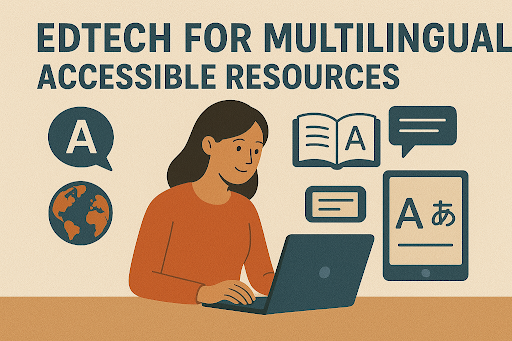
Education has been the door to possibility and hope for centuries. What if the language itself were to be the barrier, though? For most learners around the world, high-quality content in the language of choice isn’t even an option. Enter with multilingual EdTech—not as a tech advance but as a force for empowerment. By making any language accessible to learn, EdTech is making knowledge borderless, providing opportunities for translation students to practice and refine their skills while contributing to accessible learning resources.
The Power of Multilingual EdTech
In the past, online content has been primarily created in English, to the detriment of non-English language learners. But the demand for accessibility is putting pressure on platforms to come up with innovative solutions that bank on translation, voice recognition, and local content.
Multilingual EdTech technologies are bridging this gap by making content available in numerous other languages so that students with diverse backgrounds have the ability to learn at their own pace. From subtitle lectures to live translation in online classes, they are more accessible than ever.
Translation Students as Key Beneficiaries
One of the intriguing dimensions of this trend is how translation students are both donors and recipients. Currently, translation students are able to utilize high-tech computer software that allows them to practice and improve their skills in a real application. They are also, in the same ratio, tasked with making sure multilingual materials are not robotically translated but are even culturally sensitive locally.
For example, in translating a biology textbook from Spanish or Hindi, it’s not only a question of word-for-word replacement but also context-dependent local words and grammar. Translators learn as students under EdTech infrastructure and are part of this open society of learning.
Humanizing Multilingual Learning
Behind the apps, the algorithms, and the codes stands a very human imperative—the imperative to be known and to know. Think of a physics student in an Indian village with access to high-quality Hindi classes, or a refugee youngster in Europe who can receive maths lessons in the medium of language they speak at home as they integrate into a new school community. These all suggest the way that multilingual EdTech is not just about technology, but most fundamentally about dignity, identity, and belonging.
When students finally learn their own language, they become visible. Visibility increases confidence and reduces drop-outs, demonstrating once more that accessibility is both practical and emotional.
Tools and Technologies Enabling It
The growth in multilingual accessible content has been facilitated by innovations in:
- AI-Powered Translation: Google Translate and DeepL are incorporated into EdTech platforms to provide real-time language assistance.
- Speech-to-Text Technology: Hearing-impaired students can read their home language captions of live classes.
- Localized Learning Apps: Duolingo and Byju’s, to name a few, translate their interface and bugs into several languages and hence are easily available.
- Adaptive Learning Platforms: System-wise platforms not only modify the level of difficulty but also the language of content according to the learning requirements.
Challenges Ahead
Although set to improve, multilingual EdTech is still confronted with difficulties
- Accuracy of Translations: Computers can get it wrong in interpreting context and make the translations incorrect.
- Cultural Sensitivity: Free translation will not always translate into preserving native meaning or traditions.
- Cost of Development: Multilingual content is an expensive project to produce.
- Digital Divide: Without the provision of a stable internet or equipment, even the best multilingual content is not feasible.
These obstacles must be bridged by balancing technologists, educators, and translation students who are able to combine language abilities with computer technology.
Future of Multilingual Accessible Resources
Future multilingual EdTech will be collaborative. Governments, higher education institutions, and EdTech organizations must invest in creating ecosystems centred on accessibility. Translators will have new professional opportunities as cultural interpreters and digital content specialists.
We will have classrooms where AI translates in real time as students converse, or textbooks that self-adjust the reading level for the student. The goal is simple: a world where no student is left behind by the language they are studying.
Conclusion
Multilingual EdTech is not only the future of technology—it’s a social movement. It brings together languages and enables students across the globe to be fearless in learning. It opens up chances and presents challenges for translation students who are education and accessibility champions.
As far as human language goes, EdTech is not just platforms and apps—it’s a voice to all the learners for the language they hear in their own homes. The future of education is accessible, inclusive, and multilingual—and it’s already happening right before our very eyes.
References
[1] “Education in a Multilingual World”, UNESCO. [Online]. Available: https://unesdoc.unesco.org/ark:/48223/pf0000129728
[2] “How EdTech Can Drive Multilingual Education,” World Economic Forum. [Online]. Available: https://www.weforum.org/
[3] “The Rise of Multilingual Learning Tools in EdTech,” EdSurge. [Online]. Available: https://www.edsurge.com/
FAQs: Multilingual EdTech – EdTech for Accessible Multilingual Content
1. What is Multilingual EdTech?
Multilingual EdTech refers to educational technologies designed to provide learning content in multiple languages. It ensures that students can access quality education regardless of the language they speak. By integrating AI, translation tools, and adaptive learning platforms, Multilingual EdTech bridges the language gap, making education accessible to diverse learners globally.
2. Why is Multilingual EdTech important for accessibility?
Language has long been a barrier to education. Multilingual EdTech ensures that learners from different linguistic backgrounds can study, understand, and engage with educational content in their preferred language. This not only improves comprehension but also boosts confidence and reduces dropout rates among students.
3. Who benefits from Multilingual EdTech?
A variety of stakeholders benefit:
Students: Can learn in their native language or a secondary language of choice.
Translation students: Practice their skills by creating culturally sensitive content.
Teachers and educators: Can reach a broader student base without language constraints.
Educational institutions: Expand their reach to global audiences and improve inclusivity.
4. How do translation students interact with Multilingual EdTech?
Translation students play a dual role. They act as both users and contributors, using EdTech platforms to enhance their skills while helping to create accurate and culturally sensitive multilingual content. Tools like AI-powered translation software allow them to practice in real-time while producing educational materials that benefit other learners.
5. What technologies enable Multilingual EdTech?
Several innovations drive Multilingual EdTech:
AI-Powered Translation: Platforms like Google Translate and DeepL assist in real-time content translation.
Speech-to-Text Technology: Converts spoken words into readable text in multiple languages.
Localized Learning Apps: Applications such as Duolingo and Byju’s adapt their interfaces to various languages.
Adaptive Learning Platforms: Tailor both content difficulty and language to individual learner needs.
6. How does Multilingual EdTech promote inclusive learning?
By offering lessons and resources in multiple languages, Multilingual EdTech ensures that no student is left behind due to linguistic barriers. It supports learners from rural, marginalized, or refugee backgrounds, allowing them to participate fully in education without feeling excluded or overwhelmed by language difficulties.
7. What challenges does Multilingual EdTech face?
Despite its potential, Multilingual EdTech encounters obstacles:
Translation Accuracy: Machine translations can misinterpret context.
Cultural Sensitivity: Preserving local meaning and traditions is complex.
Development Costs: Producing multilingual content is resource-intensive.
Digital Divide: Access to reliable internet and devices is crucial for success.
8. Can Multilingual EdTech replace human translators?
No, Multilingual EdTech is designed to support human translators, not replace them. While AI can provide instant translations, human oversight ensures cultural accuracy, nuance, and context sensitivity, making content genuinely accessible and meaningful for learners.
9. How does Multilingual EdTech enhance the learning experience?
Multilingual EdTech transforms learning by allowing students to interact with content in a familiar language, reducing cognitive load and increasing engagement. Features like live translation, subtitles, and adaptive language options enable learners to fully grasp complex concepts and participate actively in classrooms or online courses.
10. What role do AI and adaptive learning play in Multilingual EdTech?
AI and adaptive learning platforms personalize the learning experience. AI can translate content in real time, while adaptive platforms adjust reading levels, difficulty, and language to suit individual learners. This combination ensures efficient, accessible, and inclusive education tailored to each student’s needs.
11. How can institutions implement Multilingual EdTech effectively?
To implement Multilingual EdTech successfully, institutions should:
Invest in AI-driven translation tools.
Train educators and students on multilingual platforms.
Collaborate with translation students for content creation.
Ensure content meets cultural and linguistic standards.
Address accessibility issues, such as internet and device availability.
12. What is the future of Multilingual EdTech?
The future of Multilingual EdTech is collaborative, inclusive, and technology-driven. Governments, institutions, and EdTech companies will likely work together to expand multilingual content access. AI may provide real-time translations in classrooms, and textbooks could automatically adjust reading levels and languages. Ultimately, Multilingual EdTech aims to create a world where every learner can access education in the language they understand best
Penned by Nitya Gosain
Edited by Shashank Khandelwal, Research Analyst
For any feedback mail us at [email protected]
Transform Your Brand's Engagement with India's Youth
Drive massive brand engagement with 10 million+ college students across 3,000+ premier institutions, both online and offline. EvePaper is India’s leading youth marketing consultancy, connecting brands with the next generation of consumers through innovative, engagement-driven campaigns. Know More.
Mail us at [email protected]