
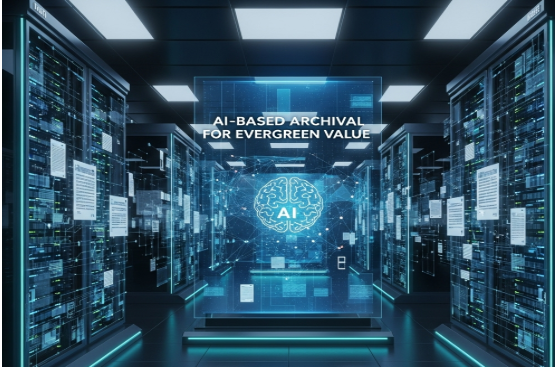
With the advent of the digital world, untold amounts of information and data have never been easier to generate and share. Research documents, Business profiles, Government and archival documents, Digital cultural and world heritage, and many others have been shared and stored in various formats and varying platforms. The question arises, how do you keep such information in perpetuity, in an organized manner, retaining relevance to the modern world? This question is perfectly answered by Archival systems, designed to preserve information for an indefinite period of time.
What is an AI-Based Archival?
AI-based archival is the digitization of documents using techniques of AI such as machine learning, NLP, and computer vision. Unlike the old method of maintaining and organizing documents in an archive, which is manual and static in nature, Archival systems, which are AI-enabled, continually evolve with new technology as well as organizational changes.
Key Features of AI-Based Archival
Automated Classification – The AI system is designed to analyze information from large and complex datasets, generating its own rationale to tag and organize different documents. This resolves the human error aspect and retains the most important aspect of data management, which is retrieval, faster and with the utmost precision.
Intelligent Search – AI systems can now answer complex queries and participate in human-like conversations. This is achieved through Natural Language Processing (NLP) modules. Unlike traditional methods that match answers to stored documents and databases, these systems identify relevant answers and store them in appropriate locations.
Predictive Preservation –AI forecasts the degradation and obsolescence of files by evaluating degradation patterns, storage environments, and file formats. Such capability ensures that the critical data set does not vanish into digital obsolescence, allowing premeditative preservation answers to be put in place.
Conclusion and Knowledge Summarization & Insights- From the files, AI is able to draw conclusions; for instance, it can generate information from cross-sections of articles and books spanning decades of historical medical research papers to identify some of their trends and several gaps in the available knowledge. AI archives are dynamic systems that are responsive to change. Algorithms are able to learn and adjust to serve user-centered content as user proximity redefines the emphasis on the context in which the user is working, and relevancy becomes critical.
Evergreen Value- From Data to Living Knowledge -Evergreen value in this context stresses timelessness, and on the other hand, the aspect of relevance. Not all kinds of information are always timeless, and few, in fact, the core elements that comprise it contribute to the advancement of any society in the period that follows. These irreducible elements are: culture, science, and law.
AI facilitates the creation of evergreen value in such ways as:
Protecting and Preserving Cultural Continuity: Enhancing, creating, and interweaving contextual metadata with digital copies of manuscripts and traditional artworks, as well as oral narratives, to sustain their relevance.
Generational Learning: Access to research, revolutionary discoveries, and best practices is meticulously documented for future learners and creators.
Challenges and Ethical Considerations: While AI offers incredible productivity likely to be very disruptive, a number of pressing challenges will need to be surmounted.
Algorithmic Bias: AI has the potential to distort the historical accuracy through biased AI classification and prioritization of archives.
Data Privacy and Security: Information governance frameworks must be adopted to ensure sensitive information is not misused.
Cost and Accessibility: Excluded from developing strategies, advanced AI systems will most likely be developed in other countries.
Autonomous AI Over-Reliance: Human wisdom over an AI-independent system is crucial. Both Context-sensitive and Cultural archives must be balanced.
The Future of AI-Based Archival:The shift toward visually driven intelligent architectures is likely to advance ecosystems’ knowledge. Some potential future scenarios are.
Integration of the Semantic Web: AI will assist in pattern recognition across different domains, enabling it to cross disciplines to discover and retrieve insightful archives.
Immersive Access: People will be able to experience the holographic elations of the past, where they can visualize themselves walking in the archives of ancient civilizations or the labs of past scientists.
Archival Decentralization with Blockchain: Blockchain networks will ensure the AI’s authenticity with unalterable records and protection against manipulation, stored and cross-indexed, will remain guaranteed, indexed, and immutable.
Conclusion
AI curation marks an exceptional leap in how people propose to preserve knowledge. It changes the paradigm from dull storage to vibrant, dynamic ecosystems of wisdom. Through intelligent classification. AI preserves and retrieves priceless information, ensuring that archives have true evergreen utility-not just for this generation, but for generations that follow. Indeed, AI enables us to preserve the collective memory of humanity and safeguard cultural identity while stimulating innovation with what is already known. Future archives will not just record and preserve information. They will serve as guides for the future.
References
Archively AI – AI-Powered Archiving Platform
Chronik AI – Intelligent Archiving & Discovery
Archive Intel – AI for Communication
Jatheon – Multi-Channel Archiving Solutions
SmartarchivS by SBL Corp – AI-Driven Document Archival https://sblcorp.com/products/smartarchivs
Penned by Reema Gupta
Edited by Aarti Gupta, Research Analyst
For any feedback mail us at [email protected]
Transform Your Brand's Engagement with India's Youth
Drive massive brand engagement with 10 million+ college students across 3,000+ premier institutions, both online and offline. EvePaper is India’s leading youth marketing consultancy, connecting brands with the next generation of consumers through innovative, engagement-driven campaigns. Know More.
Mail us at [email protected]