
7 Electrifying Reasons Flavor World Street Feasts are the Ultimate Campus Revolution
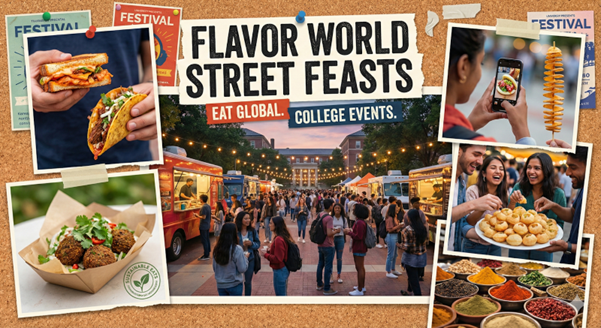
Close your eyes for a moment. Forget about those fluorescent library lights and the smell of stale coffee. Picture the air thick with charcoal smoke and spices. To your left, you hear the rhythmic clack of a metal spatula chopping grilled meat on a flat top. To your right, someone shouts out order numbers over the bass-heavy beat of an Afrobeats track. You are holding a paper boat filled with something hot and spicy, covered in fresh herbs.
This isn’t a backpacking trip through a night market in Bangkok or a taco crawl through Mexico City. This is the campus quad on a Tuesday.
Welcome to the Flavor World Street Feast: a movement that is quietly—sometimes loudly—changing the perception of the college event from dull to vibrant. Thankfully, the days of pizza parties and lukewarm chafing dishes are behind us. Today’s students crave more than just food; they seek to be thrilled. They want to eat global, connect authentically, and turn lunch into a mini-adventure.
Here’s why this street food revolution is taking over campuses everywhere. It feels much more alive than anything we’ve seen before.
1.The “Micro-Tourism” Hack (Because We’re All Broke)
Let’s be honest: the student budget is a myth. It exists, but only just barely. We live in a time where everyone wants to travel—our social media feeds are full of people enjoying islands in Greece or slurping noodles in Japan—but our bank accounts scream “instant ramen.”
That’s where street food comes in. It bridges the gap between wanderlust and reality.
Take a student to the street food festival right on campus, and you’re offering a plane ticket for the price of a latte. For five or six bucks, you can experience an explosion of flavors from an Indian pani puri or the comforting taste of a Venezuelan arepa. It allows students to eat globally without needing a passport or savings.
This isn’t just about calories; it’s about access. A simple lunch break becomes a lesson in culinary culture. We are seeing a shift where luxury is out and “accessible exploration” is in. Street food is the great equalizer—it doesn’t matter if you’re a freshman on a meal plan or a professor; everyone waits in the same line for dumplings.
2. Faking it is Out, Flavor is in
If there’s one thing this generation has, it’s a powerful BS detector. We grew up online. We know what real food looks like. You can’t cover spaghetti with soy sauce and call it “Asian Night” anymore.
The street feast model thrives on authenticity. The best college events today aren’t trying to represent entire continents with a single dish. They focus on specifics.
Students want this kind of clarity. They are interested in the story behind the food. When a local auntie comes to campus selling the same curry she’s made for her family for thirty years, that’s special. It feels respectful and real. It transforms the campus from a corporate entity into a lively, diverse community.
3. Chaos Cooking: The Tasty Art of Breaking Rules
While tradition matters, let’s not overlook the best part: breaking the rules. A trend called “chaos cooking” is taking over, fitting perfectly on a college campus.
Chaos cooking joyfully mashes up cultures that might not seem to go together but absolutely do. It reflects the student experience—backgrounds, majors, and ideas collide in a messy mix.
Think Kimchi grilled cheese: the sharp funk of Korean kimchi cutting through the greasy bliss of melted American cheddar.
Think Sushi Burritos: all the fresh flavors of Japan wrapped up in a way you can eat while rushing to class.
These combinations work because they’re fun and don’t take themselves too seriously. A street feast is the perfect setting to encourage students to try something different, laugh, and maybe find their new favorite dish. It brings back the playful side of eating that the dining hall can’t replicate.
4. Saving the Planet, One Paper Wrapper at a Time
We can’t think about the future without considering climate issues. But here’s the deal: no one wants a lecture while trying to enjoy lunch.
Street food helps with sustainability because it is naturally low-waste.
No Hardware: You don’t need a plastic tray, a metal fork, a knife, or three side plates. You just need one hand and maybe a napkin. Most street food comes in its own edible wrapper—like a tortilla or bun—or a simple paper boat.
Rooted in Plants: A lot of the best street food is naturally vegetarian or vegan. You don’t need processed “fake meats” to satisfy people. A really good Falafel sandwich or spicy Szechuan tofu does the trick.
When college events take this into account, they meet their green goals without feeling forced. It’s activism that tastes amazing. It aligns with the student body’s values, making the event feel like a joint effort rather than a top-down mandate.
5. If You Didn’t Post it, Did it Even Happen?
Let’s talk about the elephant in the room: “phone eats first.” To some, that phrase may seem silly, but consider this. Taking a photo of your food shows, “I’m enjoying this moment. This is cool.”
Street food is visually striking. It demands attention. That bright red glaze on a Tanghulu fruit skewer, the steam rising from a bamboo basket, the vibrant greens and purples of a poke bowl—they all pop on screens.
For a university, this is invaluable. When students post stories of themselves laughing with friends while holding spiral potatoes on a stick, they’re promoting a vibe. They show the world that their campus is lively, diverse, and fun. It’s organic marketing that can’t be bought. A Flavor World Street Feast creates a digital ripple effect, making the campus seem like the place to be.
6. The “Cafeteria Coma.”
“Dining Hall Fatigue” is real. It usually kicks in around mid-October. The salad bar looks sad, the pizza is questionable, and you just want to go home. Boring food brings down morale. Boring food makes the campus feel dull.
A street feast acts as a refreshment. It shifts the rhythm of daily life. You set up stalls in the parking lot, the quad, or the lawn, and everything changes. Suddenly, you’re not just sitting with the same three people. You’re standing in line next to a Physics major you’ve never met. You’re sharing a table with an exchange student who is giving you tips on how much spicy sauce to add to your noodles. The casual atmosphere of street food encourages mingling, breaking down the invisible walls in a cafeteria, and getting people talking.
7. It is About the Neighborhood, Not Just the Campus.
Finally, the best events recognize that a university isn’t an isolated place. There’s a whole world outside the campus gates, and students often miss it. Flavor World Street Feasts provide a great reason to invite the community in. Rather than bringing in an impersonal catering company, these events include local food trucks, family-run restaurants, and weekend market vendors. It connects the “town” and “gown.” It puts money directly into the hands of local small business owners. It introduces students to new treasures in their city. It establishes a relationship in which the university is not just a fortress on a hill, but an active part of the local community.
So, How Do We Pull This Off?
If you’ve gotten this far and thought, “I need this at my school,” here’s a quick guide to make it happen without losing your mind:
Curate, Don’t Just Fill Spots:
You can’t just book five burger trucks and call it a day. That’s boring. You need variety. Look for gaps. If you have a taco truck, find a dumpling stand. If there’s BBQ, include a vegan Ethiopian spot. Aim to eat globally.
Vibe Check (Music):
A street feast can’t happen in silence. That’s awkward. You need music that travels as well as the food. Reggaeton, K-Pop, Afrobeats, Bollywood—keep the energy high.
Moveable Seating:
Don’t use formal tables. Milk crates, hay bales, or high-top tables work well. You want people moving around, mingling, and bumping into each other. That’s where the energy comes from.
The message is clear:
Traditional white tablecloths are out, and greaseproof paper is in. Flavor World Street Feasts are not just a way to fill a lunch hour; they celebrate the messy, delicious, interconnected world we live in. So grab a napkin—or three—because it’s going to get messy, and that’s exactly how it should be.
References
[1] Tastewise, “Street food trends 2025,” Tastewise, 2024. [Online].
Available: https://tastewise.io/foodtrends/street-food.
[2] Tastewise, “Snack trends 2025,” Tastewise, 2024. [Online].
Available: https://tastewise.io/foodtrends/snack.
[3] US Foods, “A look at chaos cooking in 2024,” US Foods, 2024. [Online].
Available: https://www.usfoods.com/great-food/food-trends/a-look-at-chaos-cooking-in-2024.html.
[4] Food Dive, “Gen Z trends: Spicy ‘chaos cuisine’ flavors, chef-producers’ creations food,” Food Dive, 2024. [Online].
Available: https://www.fooddive.com/news/gen-z-trends-spicy-chaos-cuisine-flavors-chef-producers-creations-food/729265/.
[5] Nestlé Professional, “Campus dining shapes Gen Z tastes,” Nestlé Professional, [n.d.]. [Online].
Available: https://www.nestleprofessional.us/trends-insights/campus-dining-gen-z.
[6] Toast, “Gen Z food trends and statistics,” Toast POS, 2024. [Online].
Available: https://pos.toasttab.com/blog/on-the-line/gen-z-food-trends-and-statistics.
[7] Bidfood, “Flavours less travelled 2025,” Bidfood, 2024. [Online].
Available: https://www.bidfood.co.uk/food-and-drink-trends-2025/flavours-less-travelled/.
FAQs: Street Feasts on College Campuses
1. What is a street feast?
A street feast is a food event inspired by global street food culture, featuring multiple vendors, open-air dining, and casual, interactive eating experiences.
2. Why are street feasts popular on college campuses?
Street feasts are popular because they offer affordable global flavors, encourage social interaction, and break the routine of traditional campus dining.
3. How is a street feast different from a regular campus food event?
Unlike formal catering or cafeteria meals, street feasts focus on authenticity, mobility, live cooking, and informal seating, creating a lively atmosphere.
4. What types of food are usually served at street feasts?
Street feasts typically include global street foods such as tacos, dumplings, shawarma, noodles, falafel, grilled snacks, and vegetarian or vegan options.
5. Are street feasts environmentally friendly?
Yes, many street feasts are low-waste events that use paper packaging, minimal utensils, and plant-forward menus, supporting sustainability goals.
6. How do street feasts help build campus community?
Street feasts bring students, faculty, and local vendors together, encouraging conversation, cultural exchange, and a sense of belonging.
7. Can street feasts support local businesses?
Street feasts often feature local food trucks and family-run vendors, helping small businesses reach students and strengthening town–gown relationships.
8. Are street feasts affordable for students?
Most street feasts are designed with student budgets in mind, offering small portions and affordable pricing to ensure inclusivity.
9. How can colleges organize a successful street feast?
Successful street feasts require diverse vendor selection, good music, flexible seating, crowd management, and attention to food safety.
10. Are street feasts suitable for all dietary preferences?
Yes, street feasts usually offer vegetarian, vegan, and allergen-aware options, making them accessible to a wide range of students.
Penned by Sanskriti
Edited by Pranjali, Research Analyst
For any feedback mail us at [email protected]
Transform Your Brand's Engagement with India's Youth
Drive massive brand engagement with 10 million+ college students across 3,000+ premier institutions, both online and offline. EvePaper is India’s leading youth marketing consultancy, connecting brands with the next generation of consumers through innovative, engagement-driven campaigns. Know More.
Mail us at [email protected]