
The Comeback Effect: 7 Strong Arguments for the Reintroduction of In-Person Office Requirements
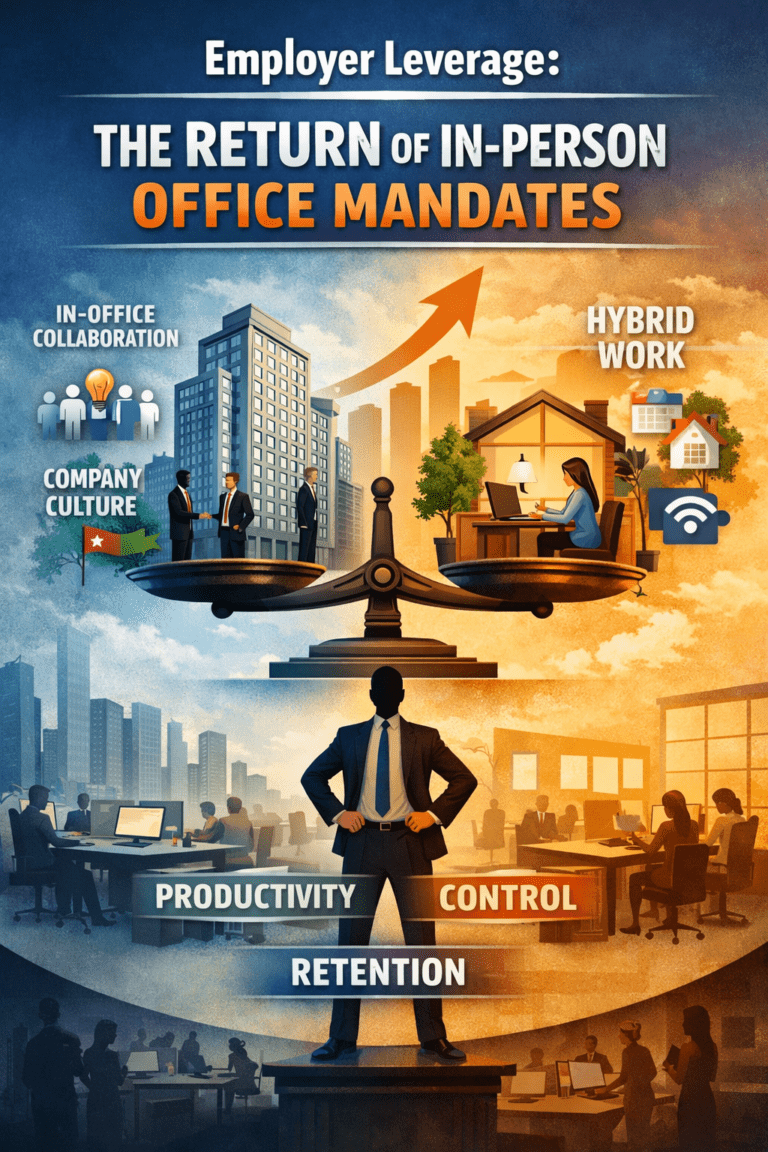
Topics: In-Person Office Mandates, Hybrid Work
Introduction
Overview: A Well-Known Door Reopens
People began working from home or various remote locations, changing both how we work and live. Adaptability became common, commutes disappeared, and our calendars breathed easier. Now something new is happening: people are going back to the office as companies around the world are starting new office mandate policies.
It’s not just about asking employees to come to offices; it’s deeper: a conversation about culture, productivity, collaboration, trust, and balance. Standing between fully remote freedom and five-day office attendance is a middle ground that many companies are carefully navigating: Hybrid Work.
Before we explore the central arguments for in-office mandates, it’s important to consider the evolving meaning of the workplace and why this shift is gaining traction now.
The Changing Meaning of the Office
Offices were the undisputed hubs of professional life before the pandemic. “Showing up” equated with “being there.” “Visibility” equated with “value.” Then came a disruption that called every assumption into question.
The value of hybrid work was proven: results could be achieved without physical proximity. Collaboration occurred across time zones. Productivity numbers, in many cases, improved. Employees experienced autonomy, and managers experienced trust.
However, over time, imperfections have cropped up. New employees find it difficult to adapt. The pace of innovation seems less swift. Trying to define a corporation’s culture through a screen only becomes tougher.
A more modern office mandate is appearing not as a denial of the potential for work from anywhere, but rather in understanding what the office means in today’s world-a space shared for connection, creation, and alignment.
The Increasing Importance of In-Office Requirements
There are several overlapping factors: some strategic, some cultural, and some very human- driving people back to offices.
-
Rebuilding Collaboration and Creativity
In-person, brainstorming with a whiteboard, face-to-face conversations and solving problems can be done more effectively. The argument from leaders is that being close together breeds innovations that current technology can’t quite capture yet, if ever.
-
Enhancing Company Culture
“Culture is something that is lived, not written,” and while working remotely ensured that the business was operating effectively, “many organisations felt the values,” or sense of identity and belonging, “slipping away.” In-person interaction can help build a sense of shared purpose.
-
Supporting Learning and Mentorship
Younger employees and new staff can benefit from observation, questions, and informal learning. Office settings also offer opportunities that may not be present within virtual meetings.
-
Addressing Productivity Gaps
While many were succeeding from a distance, not all were. Some jobs may be better served by stronger collaboration, quicker cycles of feedback, or utilisation of physical facilities.
Where Hybrid Work Fits In?
Today, it is not an “office vs. remote” discussion but how much of each is effective. This is where hybrid work solutions come into play.
Hybrid models enable workers to spend time both at home and in the office. It helps employees inculcate a sense of freedom while ensuring that they are not getting too comfortable working remotely.
However, the hybrid model is definitely not everyone’s cup of tea. It can be confusing, unfair, and burnout-inducing if poorly managed. Yet a good hybrid is a transition between liberty and connection.
7 Careful Steps to Put an Effective Office Mandate into Practice
Organisations require intention and empathy in order to make the return to office meaningful rather than just required in name. The transition can be guided by these seven useful steps.
Step 1: Clearly State the Office’s Goal
Workers must comprehend the reason behind the request to return. Is it to work together? Education? client communication? An office mandate feels arbitrary in the absence of clarity.
Step 2: Opt for Structure Rather than Monitoring
Micromanagement should not be a result of mandates. Prioritise results over hours. Even inside an office, trust is still crucial.
Step 3: Carefully Create Hybrid Timetables
Choose if hybrid days are set or adjustable. While allowing for individual choice, consistency aids teams in organising collaboration.
Step 4: Invest in the Office Experience
To bring the workers back, the office must bring them something-a quiet area, collaboration areas, ergonomic workspaces, and nice amenities to make the commute to work worth it.
Step 5: Teach Hybrid Leadership to Supervisors
Leading this type of team also requires new skills, such as inclusive communication and proximity bias awareness. It also requires that the supervisor can manage either in-person and/or virtual workers.
Step 6: Be Aware and Adapt
Feedback should guide changes. Companies can use open platforms, pulse surveys, and communicate effectively to address policy issues without any form of conflict.
Step 7: Measure What Truly Matters
Monitor engagement, retention, collaboration effectiveness, and happiness – not just attendance. The key to the success of a hybrid work culture is its sustainability.
The Employee Perspective: Mixed Emotions, Real Concerns
For workers, having to report back to the office means mixed feelings. A structure, a certain amount of social interaction, and a distinction between work life and home life are always welcome. Because losing flexibility, the commute, and child care are major concerns too.
It is important to realise that productivity and presence are not equal. This requires a well-considered office mandate.
Rethinking Flexibility, Not Removing It
“One of the greatest concerns about office mandates is the perceived threat to flexibility.” Nevertheless, flexibility “does not disappear with in-person work, but rather develops.
Flexible start times, reduced workweeks, hybrid rotations, or performance-based evaluations could easily be allowed in a physical office environment. Afterall the future of work is about working through a human potential interface.
The Bigger Picture: A Cultural Reset
The return to the office is not a step backwards; it is a cultural reset. This is the implication organisations have learned: Work is not a task; it is a relationship between people, purpose, and a place.
Hybrid Work recognizes the reality that employees are people with entire lives outside of the digital realm. Office Mandates can and should be used to enhance the relationship between the worker and technology healthily.
Conclusion: Finding Balance Moving Forward
In-person office return mandates represent a critical juncture in the journey of work. Organisations are being challenged to look beyond tradition and reactivity toward work designed for the future.
The most effective enterprises will not ask “How can we bring people back?”
They’ll come asking, “How do we bring people together?”
When the strategies of office mandate are synchronised with empathy, flexibility, and a sense of purpose, and when hybrid work gets transformed from a rigid model into a dynamic model, it would be possible to build a productive, human, and resilient work environment.
The office is not coming back like it used to be. It is a return in a far more considered, flexible, and human way.
References:
[1] D. Tahlyan et al., “In-Person, Hybrid or Remote? Employers’ Perspectives on Remote Work,” arXiv, 2024. [Online]. Available: https://arxiv.org/pdf/2402.18459
[2] X. Lu and Y. Yu, “Balancing Turnover and Promotion Outcomes: Evidence on the Optimal Hybrid-Work Frequency,” arXiv, Dec. 2025. [Online]. Available: https://arxiv.org/pdf/2512.10328
[3] D. Smite et al., “Half-Empty Offices in Flexible Work Arrangements: Why Are Employees Not Returning?,” arXiv, Aug. 2022. [Online]. Available: https://arxiv.org/pdf/2208.12797
[4] Jayalakshmi Iyer Venkatraman, “Transforming India into a Modern and Flexible Economy,” TIJER, May 2023. [Online]. Available: https://tijer.org/tijer/papers/TIJER2305390
[5] R. Tripathi and C. Goyal, “Impact of remote working on employee productivity and work-life balance in Indian IT companies,” Int. J. Commerce and Management Research, vol. 11, no. 7, 2025. [Online]. Available: https://www.managejournal.com/assets/archives/2025/vol11issue7/11106.PDF
[6] “Hybrid Models and Women’s Work in India: Emerging Insights,” iWWAGE, 2023. [Online]. Available: https://iwwage.org/wp-content/uploads/2023/03/Hybrid_Models_and_Womens_Work_in_India_Emerging_Insights_2023.pdf
[7] “Developing an Inclusive Hybrid Work Policy for India,” Hybrid Work Whitepaper, Dec. 2022. [Online]. Available: https://thequantumhub.com/wp-content/uploads/2022/12/Hybrid_work-whitepaper.pdf
FAQs
Q1. What are in-person office mandates?
In-person office mandates are company policies that require employees to work from a physical office for a defined number of days each week instead of working fully remotely.
Q2. Why are companies reintroducing in-person office mandates?
Many organizations believe in-person office mandates improve collaboration, strengthen company culture, support mentorship, and increase alignment among teams compared to fully remote setups.
Q3. How do in-person office mandates impact productivity?
In-person office mandates can boost productivity for roles that depend on fast feedback, teamwork, and real-time problem-solving, though results vary by role and industry.
Q4. What is the connection between in-person office mandates and hybrid work?
Hybrid work acts as a middle ground, allowing in-person office mandates to coexist with flexibility by balancing office days with remote work options.
Q5. Do in-person office mandates affect employee morale?
Employee reactions to in-person office mandates are mixed. Some appreciate structure and social interaction, while others worry about reduced flexibility and longer commutes.
Q6. Are in-person office mandates suitable for all job roles?
Not all roles benefit equally from in-person office mandates. Jobs requiring collaboration or physical resources gain more value than fully independent or digital-only roles.
Q7. How can companies implement in-person office mandates effectively?
Clear communication, flexible scheduling, and investment in office experiences help ensure in-person office mandates feel purposeful rather than forced.
Q8. What challenges do employees face with in-person office mandates?
Common challenges include commuting time, childcare arrangements, relocation concerns, and balancing personal responsibilities with mandatory office attendance.
Q9. Can in-person office mandates coexist with flexibility?
Yes. In-person office mandates can still support flexibility through staggered hours, hybrid schedules, and performance-based evaluations instead of rigid attendance rules.
Q10. Are in-person office mandates the future of work?
Rather than replacing remote work entirely, in-person office mandates are shaping a blended future where physical presence and hybrid work models coexist strategically.
Penned by Tanuja
Edited by Pranjali, Research Analyst
For any feedback mail us at [email protected]
Transform Your Brand's Engagement with India's Youth
Drive massive brand engagement with 10 million+ college students across 3,000+ premier institutions, both online and offline. EvePaper is India’s leading youth marketing consultancy, connecting brands with the next generation of consumers through innovative, engagement-driven campaigns. Know More.
Mail us at [email protected]