
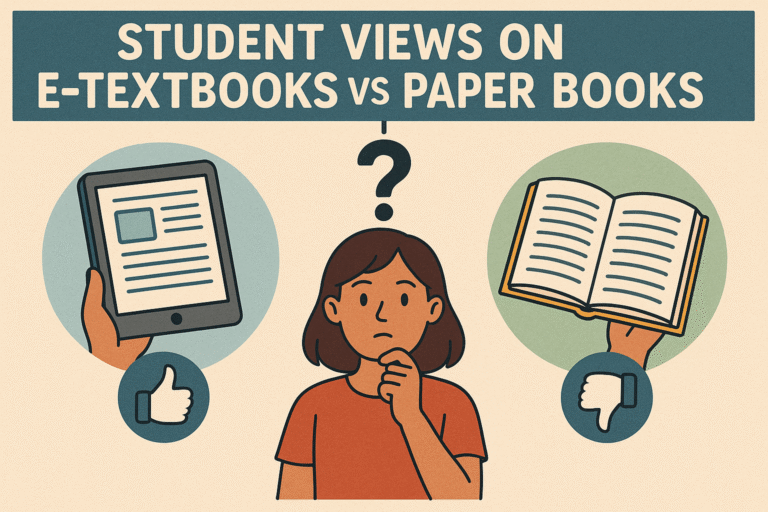
These days, the way students study has changed a lot. Like, back then, everything was about books, notes, and heavy bags. Now most stuff’s on screen-PDFs, apps, e-books, all that. E-textbooks are everywhere now, and they do feel modern. But when it comes to e-textbooks’ pros and cons, opinions vary widely. does that mean they’re better than paper textbooks?
Families often have mixed thoughts. Some like it, some don’t. And from the marketing point of view, brands are trying hard to promote both sides. Students, too, face a dilemma, as their student learning preferences often balance between digital convenience and traditional concentration.
Crack the Truth: E-Books—Handy but Not Perfect
There is one thing that is the truth-e-textbooks are simply convenient to carry. All-in-one device does it all. It can take 2 minutes to download it, without the need to go to a store and wait days for delivery. There are students who even claim that it is fun to use due to the search and highlight tools.
To the family, it is about price. The majority of e-books are cheaper, and this is logical when you have 2-3 children studying. It also uses less paper, and thus some individuals can fall over the environmental thing, too.
However, after a few weeks, a lot of students begin reporting such phrases as, “My eyes are tired,” or, “I cannot concentrate too long.” Spending hours looking at the screen is not a very easy thing to do, even in exams. And we know we are not lying-there are distractions in phones and tablets. It takes only one message pop-up, and you are out of line.
Paper Books Still Have a Place
Now, paper textbooks, yeah, they’re old-style, but they work. A lot of students say they remember better when they read a chapter on paper vs a screen. Plus, the act of turning pages, underlining with pen… it just hits different.
Also, for parents, there’s more trust in printed books. No worry about screen time, battery, app errors, or kids switching to YouTube mid-study. In terms of branding, paper books give that feeling of stability. It’s like, “if it’s printed, it’s official.
And some students-especially during boards or college entrances back to paper because they feel more focused. Even teachers say the same sometimes.
Marketing Push: How It Shapes Choice
This is where marketing enters the scene. Companies pushing e-books usually use words like “smart learning,” “anywhere access,” and “cost-friendly.” They make it sound flexible and updated. And yeah, that’s what Gen Z likes.
On the other side, physical book publishers focus on “better concentration,” “exam success,” and “trusted by teachers.” Their ads target families more than students.
Some schools mix both e-books for regular classes and printed ones before final exams. This hybrid trend is also pushed in marketing by saying “best of both worlds,” which kinda works well for everyone.
Conclusion: It’s Not About Choosing One
At the end, there’s no one right answer. E-books are good for speed, space, and savings. Paper books are solid for focus, memory, and comfort.
Students today need a mix. And families, too, are learning that. From a business angle, companies that really get both the emotional side (parent trust, student comfort) and practical side (price, tech access) are the ones that’ll do best. Learning isn’t just about how fast info loads-it’s about how well it stays with you. And for that, the right mix is always better than just one side.
Sources
https://www.researchgate.net/publication/
FAQs
Q1. What are student learning preferences?
A1. Student learning preferences describe the different ways students absorb, process, and retain information, such as visual, auditory, or kinesthetic learning.
Q2. Why are student learning preferences important?
A2. Understanding student learning preferences is important because it helps teachers adapt lessons to improve engagement and academic success.
Q3. What are the main types of student learning preferences?
A3. The main types of student learning preferences include visual, auditory, reading/writing, and kinesthetic learning styles.
Q4. How can teachers identify student learning preferences?
A4. Teachers can identify student learning preferences by using surveys, classroom observations, and performance feedback across different teaching methods.
Q5. Do student learning preferences affect academic performance?
A5. Yes, aligning teaching strategies with student learning preferences can boost motivation, comprehension, and long-term retention of knowledge.
Penned by Krishna Jain
Edited by Shashank Khandelwal, Research Analyst
For any feedback mail us at [email protected]
Transform Your Brand's Engagement with India's Youth
Drive massive brand engagement with 10 million+ college students across 3,000+ premier institutions, both online and offline. EvePaper is India’s leading youth marketing consultancy, connecting brands with the next generation of consumers through innovative, engagement-driven campaigns. Know More.
Mail us at [email protected]