In today’s fast-changing job market, graduating with a degree is no longer enough. Employers increasingly demand concrete skills like technical, digital, and soft skills that go beyond the curriculum. This is where skill building programs come in: targeted, hands-on training initiatives designed to close the gap between what students know academically and what the industry needs.
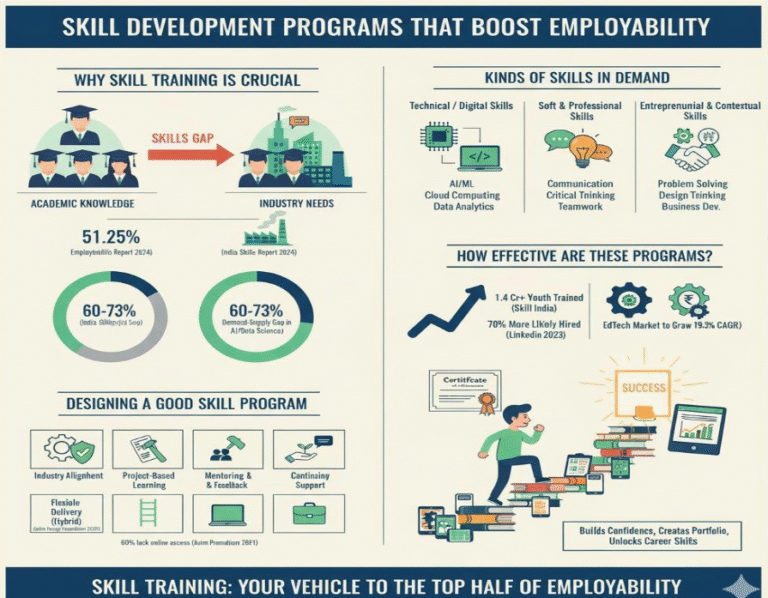
One of the most startling revelations of recent years is that the skills gap is a mismatch between what graduates offer and what employers expect. According to the India Skills Report 2024, the overall young employability in India has risen to 51.25 %, but that still leaves nearly half the youth struggling to find work aligned with their education.Further, the report highlights that in specialized sectors such as AI, data science, and automation.
The demand-supply gap is as high as 60–73 % for roles such as machine learning engineers, DevOps, and data architects.In parallel, the Institute for Competitiveness (IFC) has found that 88 % of India’s workforce remains clustered in low-competency occupation jobs that do not sufficiently tap human potential or pay well. In short, many graduates are not “employable” in the sense that industries require them to be. Skill development programs are one of the most effective ways to bridge this divide.
3.Kinds of Skills that are in Demand
- Technical / Digital Skills Examples: programming, AI/ML, cloud computing, data analytics, cybersecurity, Internet of Things (IoT). These are rapidly rising areas; the India Skills Report 2024 projects demand for AI professionals to reach about 1 million nationally by 2026 (from a base of 4.16 lakh in 2023).
- Soft Skills & Professional Skills Examples: communication, critical thinking, teamwork, leadership, time management, and adaptability. Many employers cite a lack of these as a key reason for rejecting otherwise qualified candidates.
- Entrepreneurial & Contextual Skills Examples: problem solving in local markets, domain knowledge (healthcare, agriculture, finance), design thinking, business development. These help especially in startup ecosystems or regional employment.
How Effective Are These Programs?
There is encouraging evidence that good skill programs do make a difference:
- The India Skills Report 2024 is based on data from 3.88 lakh candidates across India taking the Wheebox National Employability Test (WNET), working with 152 corporations.
- Government-driven initiatives like Skill India have cumulatively trained over 1.4 crore youth over the years (various estimates) through vocational training, apprenticeships, and short-term certificate programs.
- The Indian EdTech / Online Learning Market is booming: in 2023, the India EdTech content market was already worth about USD 1,898.3 million and is expected to grow to USD 6,522.1 million by 2030, with a CAGR of ~19.3 %.
- The online/digital education sector in India, more broadly, is projected to expand dramatically. One estimate puts the digital education market at USD 4.20 billion in 2024, rising to USD 34.84 billion by 2033 (CAGR ~25.2 %).
- The Indian EdTech market is expected to hit Rs. 2,50,850 crore (≈ USD 29 billion) by 2030 from ~Rs. 64,875 crore in 2024, indicating how much investment and reach is at stake.
These numbers show the scale and growth of the skill/education market, signaling both the need and opportunity for students to engage.
Designing a Good Skill Building Program (for Students)
If you are a student considering enrolling in a skill development course (or persuading your college to offer one), here’s what you should look for:
- Industry Alignment & Certification:- The training should be designed in consultation with industry partners, and ideally offer recognized certification.
- Project-Based Learning:- Real-world projects, case studies, internships or capstone assignments help you apply learning. Theory-only modules are less useful.
- Mentoring & Feedback Loops:- Having mentors or instructors who can review your work, give feedback, and guide you makes a big difference.
- Continuing Support:- After training, you should get placement assistance, help in building portfolios/resumes, or access to alumni networks.
- Flexible Delivery (Hybrid / Online + Offline):-In India, digital reach is mixed: a study by Azim Premji Foundation (2021) showed that nearly 60 % of school children cannot access online learning opportunities due to a lack of infrastructure.
Conclusion
Hence, a mix of city centers, weekend bootcamps, and online modules works better.Skill development does more than just get you a job. It builds confidence, orientation, and adaptability. It gives you tangible evidence, certificates, projects, and portfolios to show to employers. In the long run, people who continuously reskill tend to navigate career shifts more successfully. As the India Skills Report shows, crossing 50 % employability is an achievement, but to genuinely excel, you should aim to place yourself in the top half of that distribution. Skill training is your vehicle.
FAQs
1. What is the main purpose of a skill development program?
Skill development programs aim to bridge the gap between academic knowledge and industry requirements by providing hands-on, practical training that enhances employability and professional readiness.
2. Why is a degree no longer enough in today’s job market?
Because employers now seek candidates who possess not only theoretical knowledge but also technical, digital, and interpersonal skills necessary to perform efficiently in a dynamic, tech-driven work environment.
3. What is the current employability rate of Indian youth?
According to the India Skills Report 2024, the overall employability of young people in India is 51.25%, meaning nearly half still struggle to find jobs aligned with their education.
4. Which skill areas are most in demand today?
High-demand areas include AI & Machine Learning, data analytics, cloud computing, cybersecurity, and IoT, along with strong communication and leadership skills.
5. What causes the “skills gap” between graduates and employers?
The skills gap arises when educational curricula do not align with changing industry needs—leaving graduates with theoretical knowledge but lacking in practical or job-relevant competencies.
6. How effective are India’s skill development initiatives?
Programs like Skill India have trained over 1.4 crore youth, while the booming EdTech sector (worth nearly USD 1.9 billion in 2023) shows rising demand for upskilling through online learning.
7. How can students choose a good skill development course?
Look for programs with industry certification, project-based learning, mentorship, placement support, and flexible delivery modes (online/offline/hybrid).
8. Do soft skills matter as much as technical skills?
Yes. Many employers reject candidates due to poor communication, teamwork, or critical thinking—even if they are technically qualified. Soft skills are essential for career growth and workplace success.
9. How does the growth of the EdTech market reflect the importance of skill training?
India’s EdTech market is projected to reach Rs. 2,50,850 crore (≈ USD 29 billion) by 2030, highlighting massive investment in skill-oriented education and increasing accessibility for learners nationwide.
10. How can continuous skill development benefit a student’s career?
Regular upskilling enhances adaptability, confidence, and long-term employability. It helps professionals stay relevant, pivot during industry shifts, and progress faster in their chosen fields.
REFERENCES
[1] IMARC Group, “India Digital Education Market Report 2024–2033,” 2024. [Online]. Available: https://www.imarcgroup.com/india-digital-education-market
[2] Wheebox, AICTE, CII, Taggd, UNDP, and Microsoft, “India Skills Report 2024: Building Skills. Empowering Youth,” Wheebox, Gurgaon, India, 2024. [Online]. Available: https://www.wheebox.com/india-skills-report.htm
[3] Institute for Competitiveness (IFC), “India Competitiveness Report,” New Delhi, 2023. [Online]. Available: https://www.competitiveness.in
[4] Ministry of Skill Development and Entrepreneurship (MSDE), “Skill India Mission: Annual Report,” Government of India, 2023. [Online]. Available: https://www.msde.gov.in
[5] Azim Premji Foundation, “Myths of Online Education,” Bengaluru, 2021. [Online]. Available: https://azimpremjifoundation.org
[6] IMARC Group, “India EdTech Market Report 2024–2030,” 2024. [Online]. Available: https://www.imarcgroup.com/india-edtech-market
Penned by Sana Praween
Edited by Reeya Kumari, Research Analyst
For any feedback mail us at [email protected]
Transform Your Brand's Engagement with India's Youth
Drive massive brand engagement with 10 million+ college students across 3,000+ premier institutions, both online and offline. EvePaper is India’s leading youth marketing consultancy, connecting brands with the next generation of consumers through innovative, engagement-driven campaigns. Know More.
Mail us at [email protected]