
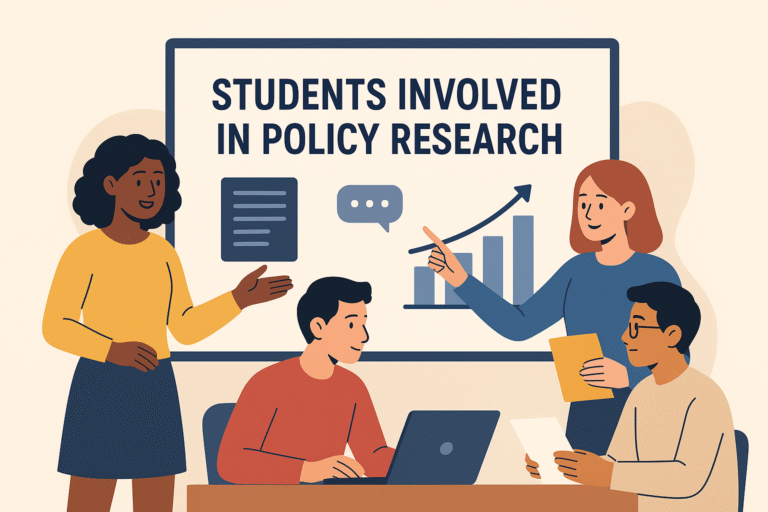
The study of policy is not a faraway intellectual venture. Nowadays, it has become a dynamic sector where students have been able to play a direct role in influencing how decisions that impact the communities and the institutions are handled. Engagement of students develops analytical skills and an effective form of civic engagement campus. The procedure will help bridge the gap between what learners understand in classrooms and the practice of solving concrete problems in the real world, and the involvement of young people in the decision-making that will form the future.
3 Proven Ways That Involve Students in Policy Research
The usefulness of Student Policy Research
There is a connection between education and governance through student policy research. It enables the learners to examine some urgent problems like education reform, issues of health and the policy regarding the climate in an evidence-based manner. The students learn about the design, test, and implementation of policies by working on actual research projects. This is an active participation that makes them not only go through a learning process but also participate in their national as well as local decision-making processes.
In a time when the social, economic, and environmental landscape is changing faster than before, such participation also makes the student ready to engage in the fields of public policy, advocacy, and research when it comes to their careers. Institutions also gain since they receive new expert information and data-based knowledge that makes them more successful and inclusive in offering solutions.
Developing Civic Engagement on Campus
Students should be involved in policy research because this aspect encourages civic activities on the campus. This implies that students not only learn about citizenship theoretically but also learn by participating through active involvement in projects, with the help of which the public good is served.
As an example, the work regarding the study of education policies involves seeking the feedback of teachers, parents and local leaders. Students will have practice in consulting communities and gathering data. This practical style makes them aware of the effectiveness of policies in real life, both in terms of life and in terms of confidence to engage in democratic processes.
Strategies to engage students in Policy Research
1.Generate Policy Research Internships
The universities should collaborate with the governmental organisations, non-profit organisations and international organisations to provide internships. Such positions enable students to engage in live policy projects through their research, whose results would be used in official reports or suggestions.
2. Incorporate Policy Research in coursework
The instructors can formulate assignments where present-day policy issues are covered. Students can analyse a case study, gather field data, and write a policy brief. This will make classroom learning a life-like policy experience.
3. Investigate Campus Policy Labs
A policy lab is a specific place to help students, faculty and outside experts work on urgent problems. The subjects addressed in these labs may be education reform, environmental sustainability or healthcare.
4. Enable Community-Based Research
Students will be allowed to carry out surveys, interviews, and focus groups in the immediate communities. The approach helps to base propositions of policies on the lived experiences. It also changes the level of knowledge of the students about the effects of policies on actual citizens.
5. Conduct Research and Advocacy Skill Workshops
A curriculum involving training on research design, ethics, and communicative skills prepares the students to generate acceptable and convincing work. They are trained in advocacy workshops on how to present findings to decision makers.
6. Encourage Policy Projects by Students
Student organisations can be sponsors and fund research groups that come up with their research initiatives. Some of the projects may involve examining issues on campus, like sustainability projects or student welfare policy.
7. Work with Think Tanks and International Networks
The conjoined term to link students to established policy research organisations also provides access to mentorship, resources, and platforms where they can share their work. It also makes them familiar with international policy issues and comparative aspects.
Conclusion
Putting students into policy research is an educational and administrative investment. It helps the youth to become prepared and skilled at influencing the future. Universities can mentor students into becoming influencers of policy by providing detailed opportunities and resources that are ethical. The outcome is that there will be a more vibrant academic community, a society that is more prepared to meet its greatest needs.
References
[1] American Political Science Association, “Student Policy Research: Bridging Education and Governance,” APSA, 2023. [Online]. Available: https://politicalscience.org/student-policy-research
[2] UNESCO, “Youth Engagement in Public Policy: Building Civic Participation Through Research,” UNESCO, 2024. [Online]. Available: https://unesco.org/youth-policy-research
FAQs
Q1. What is student involvement in research?
A1. Student involvement in research means engaging students in academic projects, experiments, or studies to enhance their learning and skill development.
Q2. Why is student involvement in research important?
A2. Student involvement in research is important because it improves problem-solving, critical thinking, and career opportunities for students.
Q3. How does student involvement in research benefit learning?
A3. Student involvement in research helps learners apply classroom knowledge in real-world projects, leading to deeper understanding.
Q4. Can student involvement in research improve career growth?
A4. Yes, student involvement in research provides practical experience, builds a strong resume, and opens doors to academic and professional opportunities.
Q5. What skills are gained through student involvement in research?
A5. Students gain analytical, communication, teamwork, and leadership skills through active student involvement in research.
Q6. How can universities encourage student involvement in research?
A6. Universities can promote student involvement in research by offering internships, mentorship programs, and funded academic projects.
Q7. Is student involvement in research helpful for higher studies?
A7. Absolutely, student involvement in research strengthens applications for higher studies and scholarships by showcasing academic potential.
Q8. What challenges come with student involvement in research?
A8. Challenges of student involvement in research include time management, limited resources, and balancing academics with research work.
Q9. How does student involvement in research support innovation?
A9. Student involvement in research fosters creativity and innovation by allowing students to explore new ideas and test practical solutions.
Q10. Where can students find opportunities for student involvement in research?
A10. Students can find opportunities for student involvement in research through faculty guidance, online research programs, and academic institutions.
Penned by Priyanka Bhambhu
Edited by Shashank Khandelwal, Research Analyst
For any feedback mail us at [email protected]
Transform Your Brand's Engagement with India's Youth
Drive massive brand engagement with 10 million+ college students across 3,000+ premier institutions, both online and offline. EvePaper is India’s leading youth marketing consultancy, connecting brands with the next generation of consumers through innovative, engagement-driven campaigns. Know More.
Mail us at [email protected]