
The Value of Bilingual Education
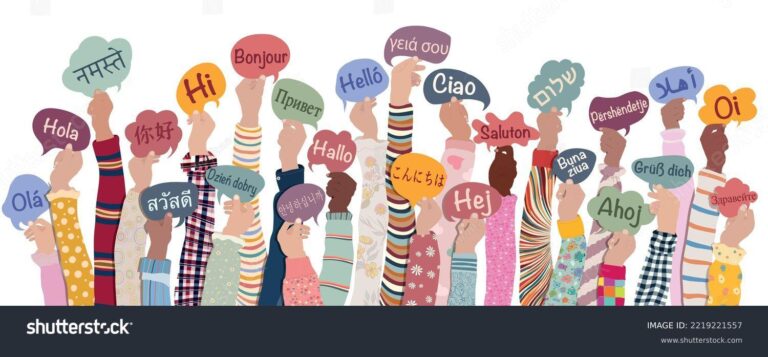
We live in a globalized society, and the ability to be multilingual isn’t just a nice thing to have—it is a necessity. There is growing interest worldwide in education, or teaching students in two languages. With the rapid development of an increasingly globalized world, the significance of using bilingual education has never been more important. This type of teaching not only supports language variety but also offers many mental, academic, and cultural benefits to students.
Cognitive Advantages
Bilingualism – The mind benefits of learning a language. Without a question, one of the key language learning benefits is mind growth. According to studies, knowing two languages can improve your problem-solving capacity, improve your memory, and speed up your thinking. Learning the skill of switching between languages is a learned ability that acts as an enhancement for your brain.
When learners become proficient at the skill of switching languages, their brains are faster, sharper, and better able to maintain attention and block distractions. These mental skills, such as attention, are important not only for students to succeed but also to make smart choices in life.
In a paper published by Frontiers in Psychology (2016), bilingual subjects were found to perform well over monolinguals in attention-based, brain control and short memory activities. Their brain exercise enables them to perform complex tasks and do many things at the same time better. In a modern world that needs constant change, bilingual education provides students with a strong brain base for learning throughout life.
Academic Success
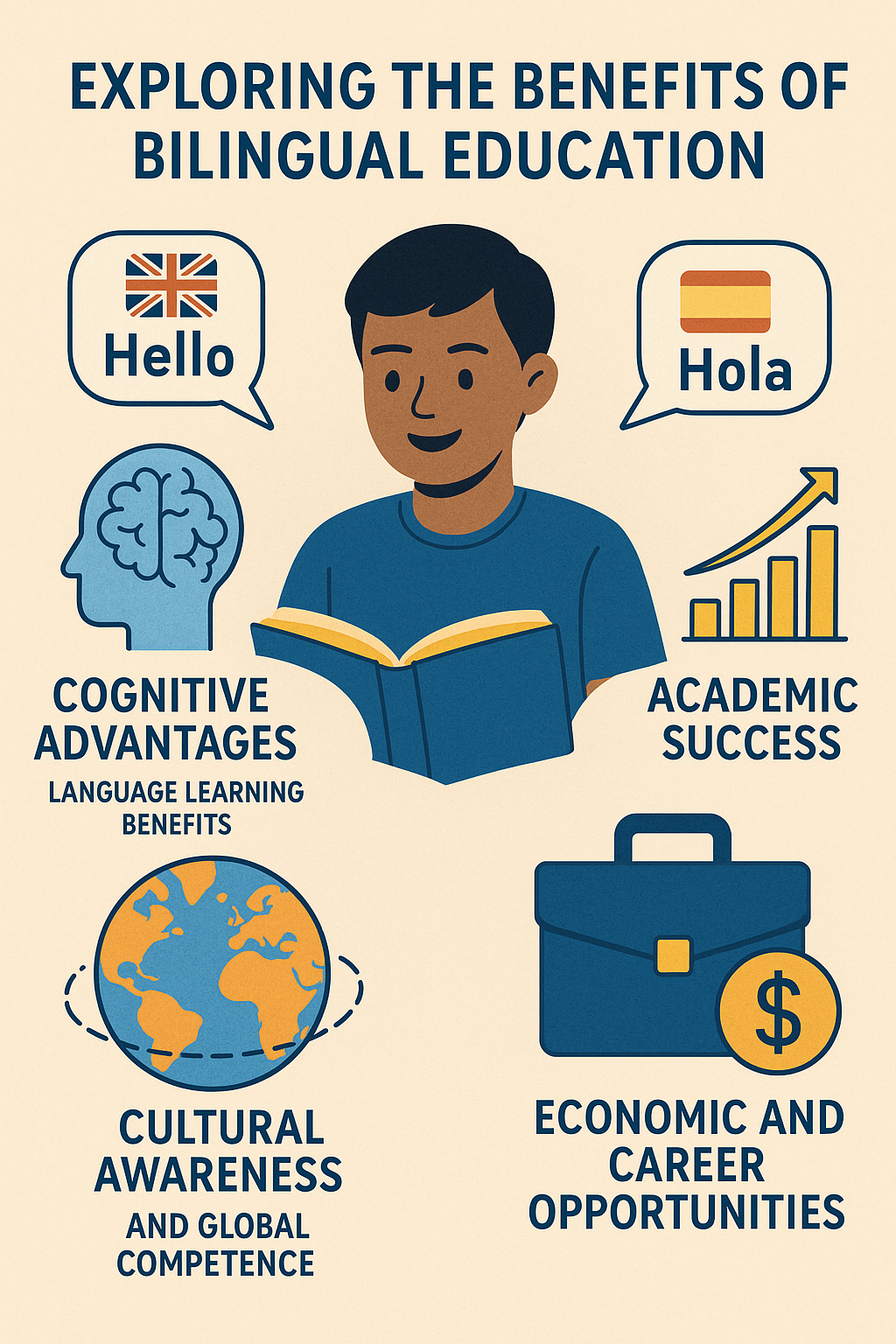
In addition to intellectual growth, bilingual education also results in improved school or study results. Bilingual students tend to have higher grades in reading, math, and science than their monolingual peers. Knowing two languages enhances understanding and analytical ability, with which complex topics are easier to learn.
Bilingual learners gain a thorough understanding of how a language works, which not only helps them to learn other languages more quickly, but also helps them with their bilingual development. Most bilingual programs promote optimal and rich learning environments that foster collaboration, sharing of ideas, and support among students, and that result in greater learning outcomes.
Cultural Understanding and Global Citizenship
A bilingual education program teaches words and grammar, but there is another positive aspect of being able to comprehend a second culture. The kid learns not just a new way to talk, but also the ways, habits, and views of the people who speak it. This makes learning two languages worth more; it might even make them kinder and, maybe, better people of the world, which matters a lot in a world with many cultures.
Liking many cultures helps students think highly of and care for different thoughts. Developing an appreciation of many cultures helps students value and respect differences in opinions. Understanding and valuing diverse lifestyles is important in many contexts, primarily as students these days are expected to engage and work with colleagues across nations.

Economic and Career Opportunities
The good results of knowing by using a language continue into students’ careers. In the world-connected job market of today, being bilingual means having a door ajar to more career possibilities. Companies in business, healthcare, education, and those dealing with people from other countries really want people who have the skill to talk simply between languages and cultures.
In India, for example, individuals who are English-proficient and trained in a local or other country’s language, like Mandarin, French, or Spanish, get more benefit in the job market. Bilinguals also usually get better-paying and top jobs because they can speak with more types of clients or others.
Challenges and Considerations
whereas the advantages of bilingual education are obvious, a successful Action plan is a task that needs to be handled with planning. Teachers should be fully trained in both languages and qualified to provide bilingual instruction in a good and successful way. Schools must plan study plans that combine both languages without putting too much pressure on the students. Parental support and help from the community are also key to maintaining the speed of language learning programs.
Conclusion
In short, bilingual education is not just a tool for learning languages—it is connected to thinking, learning, culture, and jobs. The many language-learning advantages linked with bilingualism show that it is a big part of modern education. By promoting bilingual education in schools and societies, we are not only raising more students that are intelligent students but also creating more diverse, caring, and accepting citizens.
Reference
[1] R. Barac and E. Bialystok, “Bilingual effects on cognitive and linguistic development: Role of language, cultural background, and education,” Child Development, vol. 83, no. 2, pp. 413–422, Mar. 2012. [Online].Available:https://srcd.onlinelibrary.wiley.com/doi/abs/10.1111/j.1467-8624.2011.01707.x
Frequently Asked Questions (FAQs)
1. What are the main bilingual language learning benefits for students?
The primary bilingual learning benefits include improved cognitive flexibility, stronger memory retention, and enhanced multitasking ability. Research shows that when students switch between two languages, their brains build stronger executive functioning skills. This makes them better at problem-solving, paying attention, and avoiding distractions.
2. How does bilingual education impact brain development?
One of the most researched language learning benefits is cognitive growth. The brain of a bilingual individual undergoes constant exercise by switching between two linguistic systems. This process strengthens the prefrontal cortex, which is responsible for attention control, reasoning, and decision-making.
Studies from institutions like Frontiers in Psychology have found that bilingual individuals perform better in memory tests and attention-based tasks compared to monolinguals. Essentially, bilingual education works as a natural “mental gym” that sharpens the brain for complex problem-solving and lifelong learning.
3. Are there academic advantages to language learning benefits?
Yes. Academic success is one of the clearest bilingual learning benefits. Students who learn in two languages often develop stronger literacy skills because they compare grammatical structures, vocabulary, and sentence patterns across languages. This deeper understanding of how language works makes it easier for them to learn additional languages later.
4. What cultural benefits come from bilingual education?
Among the most meaningful bilingual learning benefits is cultural awareness. Language is deeply connected to culture, traditions, and ways of thinking. When children learn a second language, they also gain exposure to new customs, beliefs, and perspectives.
This exposure makes them more empathetic and respectful toward people from diverse backgrounds. They learn that there are multiple ways of viewing the world, which helps them become open-minded and compassionate global citizens. In a multicultural world, this skill is as important as academic or cognitive abilities.
5. How do bilingual learning benefits affect career opportunities?
The job market increasingly values bilingual professionals. Companies working across borders need employees who can communicate with clients and partners in different languages. Some of the strongest bilingual learning benefits for careers include:
Access to more job opportunities in global companies.
Higher salaries compared to monolingual professionals.
Ability to work in industries like international business, healthcare, tourism, and education.
6. Can bilingual education improve social and emotional skills?
Yes. Another overlooked but powerful bilingual learning benefit is the development of social and emotional intelligence. Learning in two languages allows students to engage with people from different backgrounds. They develop empathy, patience, and tolerance because they can see situations from multiple cultural viewpoints.
In classrooms, bilingual students also show stronger teamwork skills because they are used to sharing ideas across languages. This prepares them to work in multicultural teams later in their careers, a skill that is becoming increasingly important worldwide.
7. Are there challenges to achieving bilingual learning benefits?
Another challenge is parental and community involvement. For bilingual programs to succeed, families need to support learning at home by encouraging reading, speaking, and practicing both languages. With the right resources and planning, these obstacles can be overcome, ensuring that students receive the full range of bilingual learning benefits.
8. Do bilingual students learn slower than monolingual students at first?
Sometimes, children in bilingual programs may appear to take longer to master vocabulary or grammar in one language compared to monolingual peers. However, this temporary delay is outweighed by the long-term bilingual learning benefits.
9. How early should children start bilingual education?
Experts suggest that the earlier, the better. Childhood is when the brain is most flexible and capable of absorbing multiple languages. Introducing bilingual education in preschool or early primary school maximizes bilingual learning benefits because children pick up pronunciation, grammar, and vocabulary faster.
10. Why is bilingual education important in a globalized world?
We live in an interconnected society where communication across cultures is crucial. Bilingual learning benefits extend beyond personal achievement—they also help build stronger global communities. By learning two languages, students can bridge cultural gaps, engage in international collaborations, and contribute to peace and understanding.
Penned by Anjum mulani
Edited by Shashank Khandelwal, Research Analyst
For any feedback mail us at [email protected]
Transform Your Brand's Engagement with India's Youth
Drive massive brand engagement with 10 million+ college students across 3,000+ premier institutions, both online and offline. EvePaper is India’s leading youth marketing consultancy, connecting brands with the next generation of consumers through innovative, engagement-driven campaigns. Know More.
Mail us at [email protected]
Penned by Names
Edited by Ritika Sharma, Research Analyst
For any feedback mail us at [email protected]
Transform Your Brand's Engagement with India's Youth
Drive massive brand engagement with 10 million+ college students across 3,000+ premier institutions, both online and offline. EvePaper is India’s leading youth marketing consultancy, connecting brands with the next generation of consumers through innovative, engagement-driven campaigns. Know More.
Mail us at [email protected]
Penned by Names
Edited by Ritika Sharma, Research Analyst
For any feedback mail us at [email protected]
Transform Your Brand's Engagement with India's Youth
Drive massive brand engagement with 10 million+ college students across 3,000+ premier institutions, both online and offline. EvePaper is India’s leading youth marketing consultancy, connecting brands with the next generation of consumers through innovative, engagement-driven campaigns. Know More.
Mail us at [email protected]
Penned by Names
Edited by Ritika Sharma, Research Analyst
For any feedback mail us at [email protected]
Transform Your Brand's Engagement with India's Youth
Drive massive brand engagement with 10 million+ college students across 3,000+ premier institutions, both online and offline. EvePaper is India’s leading youth marketing consultancy, connecting brands with the next generation of consumers through innovative, engagement-driven campaigns. Know More.
Mail us at [email protected]