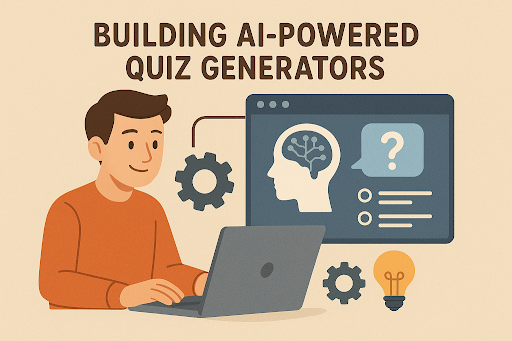
So, you want an AI quiz generator to crank out quizzes. Not the boring kind that repeats the same three questions with slightly different wording — actual, useful checks for understanding that don’t make learners groan. The good news: totally doable. The catch: if you just throw raw content at a model and click “generate,” you’ll get… mid. You need a tiny bit of structure, a few guardrails, and some taste. And when you connect it with adaptive learning tools, those quizzes can adjust to what learners really need instead of being one-size-fits-all.
6 Smart Strategies to Build AI-Powered Quiz Generators for Education
Start With a Source You Trust
Obvious, but ignored. Feed the AI clean inputs: a chapter summary, slides, bullet notes, even a transcript. The tighter the source, the better the questions. If your input is messy (half jokes, half tangents), the model will echo that mess back at you. Think “curated bundle,” not “internet soup.”
Tell the AI What Style You Want (Like,
Literally Tell It)
Don’t ask for “questions.” Ask for:
5 multiple-choice questions, one correct answer, three believable distractors
2 short-answer prompts that require reasoning
1 “explain your choice” reflection item
You spell it out, you get what you asked for. You stay vague, it improvises — and not always in a good way.
Control the Difficulty With Signals
You can nudge challenge level with cues like: “Use concrete examples,” “one conceptual trap per MCQ,” “avoid trivia.” If you need leveling, tag sections as intro, practice, stretch. The model will map that framing into question difficulty better than you’d expect. Not magic, just consistent hints.
Make Distractors Plausible (But Not Evil)
Bad distractors teach nothing. Good distractors expose common misunderstandings. Here’s a quick formula:
One close but wrong answer that flips a definition
One calculation slip (off by a factor, wrong unit)
One context bait that sounds familiar but doesn’t apply here
Avoid silly options; they make guessers lucky and good learners annoyed.
Shuffle Formats, On Purpose
If every item is MCQ, people sleepwalk. Mix it up: cloze (fill-in-the-blank), “select all that apply,” drag-to-match (if your platform supports it), one mini case with two questions. Variety forces retrieval in different ways, which is the whole point. Also: hide the pattern. Don’t always make C the right answer. Learners notice.
Add Explanations Right Away
This is the difference between “quiz” and “learning tool.” After each item, include:
Why the correct answer is right (one sentence)
Why the others are wrong (half a sentence each)
A tiny nudge back to the source (“See slide 12: energy transfer example”)
Explanations turn misses into progress instead of just, well, misses.
Keep a Tiny Memory: What Did They Miss?
If the platform allows it, track missed concepts and re-surface them later with new wording. Same idea, different wrapping. Two or three cycles and most concepts stick. No giant user profile needed — just a short list of tags like fractions_division, photosynthesis_inputs, SQL_joins. This is where adaptive learning tools shine, as they can automate this spaced review intelligently.
Guard Against Hallucinations
AI can invent facts if you let it. Quick safeguards:
Tell it to cite the exact line (or timestamp) from the source it used
Run a “verification pass” where the model checks each answer against the source again
Flag anything without a citation for human review
A little paranoia saves you cleanup later.
Let Learners Talk Back (Lightly)
Add one reflection slot every set: “Which item felt trickiest and why?” or “Rewrite one wrong answer into a correct statement.” Doesn’t need grading. You’re collecting signals for the next round and getting learners to restate the concept — free reinforcement.
Build a Quick Loop: Draft → Sample → Fix
Don’t ship the first batch. Test with three humans (not just you). Ask them:
Which question felt unfair or nitpicky?
Which explanation fixed confusion fastest?
Where did the wording feel off?
Patch those. Then publish. Fast cycles beat big launches.
Accessibility Isn’t Optional
Plain language, consistent labels, alt text for images, keyboard navigable controls, color contrast that doesn’t punish color-blind users. Also: read questions out loud once. If you trip, the sentence is too knotty. Untangle it.
A Simple Architecture That Works
Input: Clean notes or transcript → chunk into small sections (say, 200–500 words)
Generation: Prompt per chunk with your spec (formats, difficulty, distractors)
Validation: Secondary pass to cross-check answers against the chunk
Assembly: Shuffle items, tag them by concept and difficulty
Review (optional but smart): Human spot-check flagged items
Delivery: Randomize order per learner; store misses for spaced review
It’s not fancy; it works.
When to Get Fancy (and When Not To)
Adaptive difficulty, spaced repetition schedulers, item response theory — great if you have time. If you don’t, get the basics right: good sources, clear prompts, plausible distractors, instant explanations. Most of the learning gains come from those first four things anyway.
Final Thoughts
An AI quiz generator can mass-produce quiz items. You’re there to make them good. Feed better inputs, ask for specific formats, test with real humans, and keep a tiny memory so weak spots get another shot. Do that, and your quiz tool stops being a content mill and starts acting like a real learning partner — which is the whole reason to build it in the first place.
References
[1] EdTech Magazine, “Educators Express Mixed Feelings on AI in Education,” Sep. 2024. [Online].
[2] EduSciences, “How Generative AI Tools Improve Learning,” [Online].
[3] Learning Corner, “Adaptive Learning – Glossary,” [Online].
[4] Wikipedia, “Adaptive Learning,” [Online].
[5] Every Learner Everywhere, “7 Adaptive Learning Case Studies That Show When and How It Is Effective,” [Online].
FAQ’s
Q1. What is an AI quiz generator?
An AI quiz generator is a tool that uses artificial intelligence to create quiz questions automatically from learning materials, saving time while improving accuracy.
Q2. How do adaptive learning tools work with an AI quiz generator?
Adaptive learning tools adjust the quiz difficulty based on learner performance. When paired with an AI quiz generator, they deliver personalized assessments.
Q3. Why are adaptive learning tools important in education?
They make quizzes more effective by focusing on each learner’s weak areas, ensuring better understanding and retention compared to one-size-fits-all testing.
Q4. Can an AI quiz generator create different question formats?
Yes, it can produce multiple-choice, short-answer, true/false, or reflection-based items, depending on how you structure the prompts.
Q5. How do I ensure quiz quality with AI quiz generators?
Feed the system clean inputs like summaries or lecture notes and specify question types clearly. Adaptive learning tools then refine the quiz delivery.
Q6. Do adaptive learning tools track learner progress?
Yes, they monitor missed concepts and resurface them in new questions, making quizzes a continuous learning experience.
Q7. Are AI quiz generators accurate without human review?
While they are efficient, human review is still important to check for hallucinations and ensure accuracy.
Q8. How do adaptive learning tools make quizzes engaging?
They adjust difficulty, mix formats, and provide instant feedback so learners stay challenged without feeling overwhelmed.
Q9. Can AI quiz generators save teachers’ time?
Absolutely. Teachers spend less time writing questions and more time focusing on explanations and guiding students.
Q10. How do adaptive learning tools support spaced repetition?
They revisit missed concepts over time, strengthening memory through repeated exposure to varied question formats.
Q11. Are explanations included in AI-generated quizzes?
Yes, when designed well, they provide reasons for correct and incorrect answers, turning quizzes into mini learning sessions.
Q12. Do AI quiz generators work for all subjects?
They are flexible and can handle topics ranging from math and science to history, coding, and language learning.
Q13. How can I control quiz difficulty?
You can signal difficulty levels in prompts. Adaptive learning tools then adjust questions according to learner needs.
Q14. What role do distractors play in AI quiz generators?
Good distractors highlight common misconceptions, making quizzes not just tests but learning opportunities.
Q15. Why combine AI quiz generators with adaptive learning tools?
Together, they create dynamic, personalized quizzes that boost retention, save time, and improve the overall learning experience.
Penned by Adish Devadiga
Edited by Shashank Khandelwal, Research Analyst
For any feedback mail us at [email protected]
Transform Your Brand's Engagement with India's Youth
Drive massive brand engagement with 10 million+ college students across 3,000+ premier institutions, both online and offline. EvePaper is India’s leading youth marketing consultancy, connecting brands with the next generation of consumers through innovative, engagement-driven campaigns. Know More.
Mail us at [email protected]