Introduction: A Different Picture of Science Class
Think about the last time you walked into a school science lab. Chances are, half the class was standing around one setup, waiting for their turn. Some students didn’t even touch the equipment. Others barely understood what was happening because the whole thing ended too quickly. That’s been the reality for years.
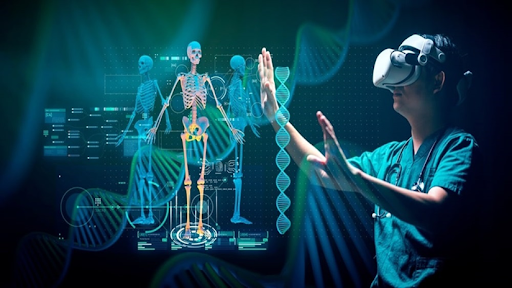
Now imagine a VR science lab. Instead of waiting, every student steps into the same digital lab with their headset on. Everyone gets a chance. Nobody is left out. And the surprising part? The focus shifts from just doing an experiment to actually working together. That is where immersive collaboration comes in, students interact in real time like teammates on a project, not just passive observers.
Why Traditional Labs Don’t Always Work
To be fair, real labs are important. They teach students how to handle actual tools, follow safety steps, and deal with real-world mess. But there are problems too. Equipment is expensive. Chemicals run out. Some experiments are risky. And let’s be honest—sometimes students spend more time watching the teacher than actually experimenting themselves. The beauty of immersive collaboration is that it prepares them for how science really works—collectively.
A VR science lab doesn’t magically replace the real thing, but it fills in the gaps. It gives students chances to explore things schools normally can’t afford, like zooming inside a cell or modeling a black hole. You don’t need a budget of millions. Just a headset and the software. And the good part? You can try the same experiment again and again until it finally makes sense.
5 Big Reasons VR Labs Matter
- Immersive Collaboration
This is the highlight. In a virtual lab, students don’t just “sit and watch.” They join the same digital space, talk through ideas, test things, and share what they notice. That’s real teamwork. It feels more like group research than a class exercise.
Making Hard Topics Clearer
Some things in science are tough to picture. Atoms. Magnetic fields. DNA spirals. A flat drawing in a book doesn’t always stick. But in VR, students can grab a 3D model, twist it around, pull it apart, and see how it works. That moment of “Oh, I get it now” happens much faster.
Safe, No-Risk Experiments
Let’s be honest—schools avoid certain experiments because they’re dangerous. You can’t exactly let students play with explosions or strong acids. In VR, though, you can. No burns, no accidents, just learning. And it gives students freedom to ask, “What if I mix this with that?” without fearing disaster.
Equal Access for All
One of the biggest gaps in education is between city schools with modern labs and rural schools with barely any. Virtual labs close that gap. A student in a small town can log in and do the same high-level experiments as someone in a top-tier school. It’s a way of saying: learning shouldn’t depend on your zip code.
Cheaper in the Long Run
Real labs are expensive to keep running. Things break. Materials expire. Schools spend money every year. VR flips that. Once you set up the system, it’s ready for repeated use. Sure, headsets cost money upfront, but compared to years of buying lab supplies? It ends up being much more sustainable.
Real Stories from Classroom
This isn’t a “future dream.” It’s happening now. Some American schools already use VR modules for biology and physics. In India, a few rural schools have adopted VR labs to give students a chance they never had before. Universities are going even bigger—medical students practice surgeries virtually, while engineering students test giant structures in VR before they’re ever built.
And here’s something interesting: early studies say VR students actually remember lessons longer. They’re not just memorizing for a test—they’re seeing and experiencing. That sense of “being there” makes concepts stick.
What’s Next for Science Education
Will every school have a VR science lab someday? Honestly, it looks likely. Prices of headsets are coming down, internet access is spreading, and schools are looking for new ways to keep students engaged. Most likely, we’ll see a mix of both worlds: real labs for hands-on practice, VR labs for unlimited exploration.
Conclusion
The real win is how it shapes teamwork. Future doctors, scientists, and engineers will work with colleagues Globally. They will need to share, argue, and problem-solve together. Practicing that kind of engaging collaboration in school. That is a skill you cannot put a price on.
It builds habits of immersive collaboration, showing students how to work together, not just alone. That’s what makes this shift so powerful. VR science labs aren’t just a fancy tool; they’re a step toward making science learning fairer, safer, and way more engaging.
References
[1] National Institute of Standards and Technology, “Virtual Reality in Education,” U.S. Department of Commerce, 2022. [Online]. Available: https://www.nist.gov/news-events/news/2022/07/virtual-reality-education
[2] Virtual Labs Project, “About Virtual Labs,” Ministry of Education, Government of India, 2023. [Online].
[3] P. Radianti, T. A. Majchrzak, J. Fromm, and I. Wohlgenannt, “A systematic review of immersive virtual reality applications for higher education: Design elements, lessons learned, and research agenda,” Computers & Education, vol. 147, 2020. [Online].
[4] M. Slater and M. V. Sanchez-Vives, “Enhancing our lives with immersive virtual reality,” Frontiers in Robotics and AI, vol. 3, 2016. [Online].
[5] EdTech Review, “How VR Labs Are Changing Classrooms in India,” EdTech Review, 2023. [Online].
[6] Mindflight7, “Immersive Learning Experiences,” Mindflight7 Australia, 2023. [Online].
FAQs
Q1. What is a VR science lab and how does it work?
A VR science lab is a virtual environment where students can conduct experiments, explore scientific models, and collaborate in real time using headsets and software. Instead of relying only on physical equipment, the VR science lab simulates chemicals, apparatus, and biological systems in a safe, interactive digital space. It works by rendering immersive 3D visuals and allowing students to manipulate objects, conduct experiments, and even repeat them as many times as needed. This accessibility makes learning more engaging and bridges gaps where schools lack expensive resources.
Q2. Why are schools adopting VR science labs?
Schools are turning to VR science labs because traditional labs have limitations like high costs, safety risks, and limited access. In a VR science lab, every student gets equal opportunity to participate, experiments are risk-free, and even complex concepts like DNA, black holes, or molecular structures become easier to grasp. Additionally, the VR science lab reduces recurring expenses, since digital simulations replace fragile equipment and consumable chemicals. This makes science education more inclusive, sustainable, and future-focused.
Q3. How does a VR science lab improve collaboration among students?
Collaboration is one of the biggest advantages of a VR science lab. Instead of waiting for turns in a crowded physical lab, students enter the same digital lab environment simultaneously. They interact with peers, share observations, and solve problems collectively—just like real scientific teams. A VR science lab encourages teamwork by allowing students to test hypotheses together, discuss outcomes in real time, and contribute equally. This immersive collaboration develops critical communication, problem-solving, and leadership skills.
Q4. Can a VR science lab replace traditional science labs?
A VR science lab does not fully replace traditional labs, but it complements them. Physical labs are essential for teaching hands-on skills such as handling real instruments, maintaining safety protocols, and managing real-world challenges. However, a VR science lab fills the gaps by enabling experiments that are too costly, risky, or impractical in real settings. The future of education lies in hybrid models where both physical and virtual labs work together to provide the best of both worlds.
Q5. Is a VR science lab safe for students to use?
Yes, a VR science lab is completely safe. Unlike physical labs where accidents with chemicals, fire, or electrical equipment may occur, a VR science lab allows students to experiment in a risk-free environment. They can safely explore reactions, test hazardous combinations, or simulate dangerous physics experiments without any harm. This makes science education more approachable, especially for younger learners or schools with limited safety infrastructure.
Q6. What subjects can benefit most from a VR science lab?
A VR science lab is versatile and supports multiple subjects, including physics, chemistry, biology, and earth sciences. In physics, students can simulate electromagnetism or study planetary systems. In chemistry, they can mix virtual compounds or visualize molecular bonds. Biology students benefit from exploring 3D models of cells, DNA, or human anatomy. Even environmental science topics like climate change and ecosystems are easier to study in a VR science lab. The adaptability makes it useful across grade levels and subjects.
Q7. How does a VR science lab make complex topics easier to understand?
Complex topics like quantum mechanics, genetics, or magnetic fields are often abstract and difficult to visualize. A VR science lab solves this by providing immersive 3D models that students can explore interactively. For instance, they can rotate a DNA helix, zoom inside a cell, or model gravitational waves. This hands-on engagement accelerates comprehension and retention. The VR science lab transforms learning from rote memorization to experiential understanding.
Q8. Is setting up a VR science lab expensive?
The initial setup of a VR science lab requires investment in headsets, software, and sometimes computers with strong processing power. However, in the long run, it is more cost-effective than maintaining physical labs. Traditional labs require constant restocking of chemicals, replacing broken glassware, and handling maintenance costs. A VR science lab, once established, can be reused indefinitely with software updates. This makes it an economical solution for schools, especially those with budget constraints.
Q9. Can rural or underfunded schools benefit from a VR science lab?
Absolutely. One of the biggest strengths of a VR science lab is equal access. Rural and underfunded schools often struggle to provide fully equipped labs. With VR, students from small towns or remote areas can perform the same advanced experiments as those in top-tier schools. The VR science lab democratizes education, ensuring that learning opportunities are not limited by geography or resources.
Q10. What are the long-term benefits of using a VR science lab?
The long-term benefits include deeper understanding of science concepts, better retention of knowledge, and development of collaboration skills. A VR science lab also fosters curiosity, problem-solving, and creativity, which are crucial for careers in STEM. On a broader scale, students trained in VR environments will be more adaptable to future technologies and digital workspaces. In essence, the VR science lab prepares students not just for exams but for real-world scientific challenges.
Q11. How does a VR science lab enhance student engagement?
A VR science lab transforms passive learning into active exploration. Instead of watching the teacher perform an experiment, students are immersed in the process. They manipulate objects, make decisions, and observe results directly. This sense of control and participation keeps students motivated and curious. Engagement is further boosted by the gamified nature of VR—students feel like explorers rather than spectators.
Q12. Are universities and higher education institutions using VR science labs?
Yes, universities are early adopters of VR science labs. Medical schools use VR to simulate surgeries, engineering students test large-scale structures in virtual space, and physics departments model phenomena that cannot be replicated in classrooms. The VR science lab enables higher education institutions to prepare students with skills needed for real research and professional fields. This trend is growing globally as more institutions recognize the value of immersive learning.
Q13. Can students repeat experiments in a VR science lab?
Yes, repetition is one of the strongest benefits of a VR science lab. In traditional labs, limited resources and time constraints often prevent students from redoing experiments. In VR, students can repeat experiments multiple times until they fully grasp the concept. This self-paced approach enhances learning outcomes, builds confidence, and eliminates the fear of making mistakes.
Q14. What role does a VR science lab play in future education?
A VR science lab is shaping the future of education by making learning more inclusive, engaging, and practical. As technology becomes cheaper and more widespread, VR labs will become a common feature in schools worldwide. They align with global education trends focused on digital literacy, immersive experiences, and collaborative problem-solving. The VR science lab is not just a tool—it’s a glimpse into how education will evolve in the digital age.
Q15. How does a VR science lab build teamwork and communication skills?
In a VR science lab, students don’t work in isolation. They interact, share hypotheses, debate outcomes, and solve problems as a group. This mirrors how real scientists, doctors, and engineers collaborate on global challenges. By practicing teamwork in a VR science lab, students develop soft skills such as leadership, negotiation, and effective communication. These skills are as valuable as technical knowledge, ensuring well-rounded growth.
Penned by Sadaf Fatima
Edited by Sneha Seth, Research Analyst
For any feedback mail us at [email protected]
Transform Your Brand's Engagement with India's Youth
Drive massive brand engagement with 10 million+ college students across 3,000+ premier institutions, both online and offline. EvePaper is India’s leading youth marketing consultancy, connecting brands with the next generation of consumers through innovative, engagement-driven campaigns. Know More.
Mail us at [email protected]