
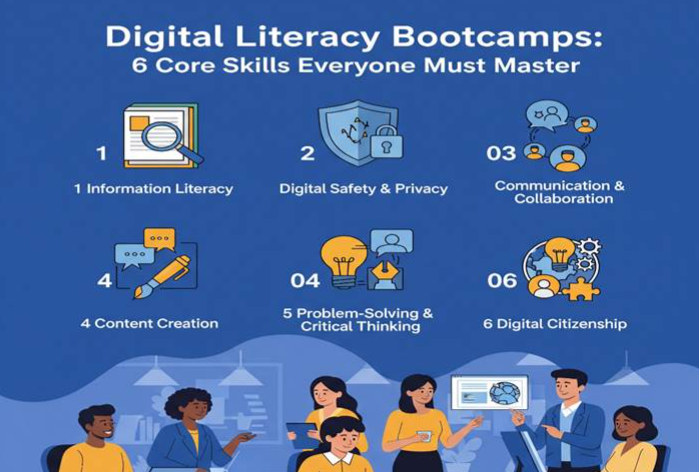
Digital literacy bootcamps are training programmes to provide digital literacy, online safety knowledge and practical application of theoretical knowledge. These programmes aim to facilitate the government’s Digital India campaign. In recent years, India has seen a digital transformation in the economy in terms of UPI payments and internet users. But only 38% of Indian households are digitally literate. So, it is raising concerns about cybersecurity scams in India. Digital literacy bootcamps cover basic computer knowledge, internet use and online safety and security measures. In NEP 2020, the government has made it compulsory to include coding and AI-related subjects as a part of the school curriculum.
Organisations/institutes should organise these digital literacy bootcamps for students to train them in coding and other AI-driven skills required in the workplace. These digital literacy bootcamps for students will give them a chance to have hands-on experience with skills that they learnt in class. Nowadays, the traditional education system is not sufficient for a student to land a desired job. There are some essential tech skills that both IT and non-IT professionals should have if they want to secure a job. Digital Literacy Pro, Microsoft Digital Literacy, Code Clubs or digital literacy bootcamps for students by Medha are a few examples of digital literacy bootcamps.
Medha is a great example of digital literacy bootcamp programmes, as it provides digital literacy training alongside career counselling to under-resourced college students to help them land their first job. Medha offers multiple bootcamps, each with a different scope and objective. Advanced technology is one of their bootcamps, which includes basic digital literacy skills like data entry, operating a computer and proficiency in Microsoft Office tools.
The programme costs 500 Indian rupees, which is subsidised by some colleges. The programme provides 60 hours of training to students and operates in 35 institutes with 35 students in each class. This programme is quite successful, as it provides training at college campuses and helps students in securing internships and jobs. It is affordable and less time-consuming.
6 essential tech skills required in 2025: mastering Digital literacy
- Programming languages: Learning JavaScript, Python, C++, or any other programming language is very important in the 21st century. As job requirements are changing with the evolution of AI, the future requires individuals to be well-versed in technology. As in the digital economy, these complex analytics models will help to handle large amounts of data.
- Data visualisation tools: SQL, Tableau, Python and Power BI are some powerful data analysis tools which are useful in every field, like finance, marketing or business analysis.
- Cyber Security skills: As working with data is increasing, this involves a high risk of leaking sensitive information about people. Nowadays, people have found digitally advanced methods to do illegal and unethical practices. So, there is a high demand for cybersecurity professionals in the market.
- Digital Marketing: In this digital era, digital marketing is the most essential skill. It comprises SEO, content marketing, email marketing and data analytics skills. Digital marketing will open various job opportunities in the future.
- Data-Driven Decision-Making: Now, collecting data, analysing and extracting meaningful information from data is a fundamental core skill. Using statistical tools like R programming, etc., and data visualisation tools like Power BI, etc., are must-learn skills for the future workforce.
- Data Science: Data-driven jobs are highly demanding, and paying jobs will be in demand in the years to come as businesses gain an edge by leveraging data for market analysis and product development.
Conclusion
Digital literacy bootcamps for students are essential in today’s digital era, as many big companies are planning on doing large layoffs of employees who are not adapting well to the current dynamics of the job market. Digital skill is not a choice anymore for the workforce but a mandatory skill to be successful in this digital era. There are some essential tech skills like machine learning, AI, cybersecurity, digital marketing, data-driven decision-making, statistical decision-making, etc.
There are already some digital bootcamps for literacy for students organised by various companies or NPOs in collaboration with institutes to help students develop hardcore skills and gain more practical knowledge than what college students are learning in class, like Code Club or Medha. As the domestic and international dynamics of India are changing rapidly, if we want India to be a $19 trillion economy by 2047 and create 900 million jobs by 2030, then the government should heavily invest in digital literacy and research bootcamps.
Reference
- “Digital Literacy Training to Non-IT Literate Citizens,” csdindia.org [online]. Available: https://www.csdindia.org/pdfs/Project-reports/Digital-Literacy-Report-2017.pdf.
- “Digital Literacy”, dtnbwed.cbwe.gov.in [online]. Available: https://dtnbwed.cbwe.gov.in/images/upload/Digital-Literacy_3ZNK.pdf.
- “Medha”, 1worldconnected.org [online]. Available: https://1worldconnected.org/project/asia_digitalskills_medhadigitalskillsindia/#:~:text=The%20area%20manager%20negotiates%20college,with%20securing%20internships%20and%20jobs.
- “Digital literacy and computing in India”, codeclub.org [online]. Available: https://codeclub.org/2023/07/11/digital-literacy-and-computing-in-india
- “Top Technical Skills All Employees Need in 2025”, www.eccu.ed [online]. Available: https://www.eccu.edu/blog/top-technical-skills-that-all-employees-need/
- “Top 10 most in-demand tech skills to acquire for 2024”, digitalwaffle.co [online]. Available: https://www.digitalwaffle.co/blog/top-10-most-in-demand-tech-skills-2024
- “The Top 10 Digital Skills Tech Companies Are Looking for Today”, digitalskillsglobal.com [online]. Available: https://digitalskillsglobal.com/blog/the-top-10-digital-skills-tech-companies-are-looking-for-today
FAQ
Q1. Why are essential tech skills so important in 2025?
Essential tech skills are important in 2025 because the workplace is no longer driven by manual processes but by digital ecosystems powered by AI, automation, and big data. For example, industries like banking rely on cybersecurity and data science, while healthcare uses data visualization and AI for diagnosis. Without future-ready digital skills, professionals risk being replaced by automation. Mastering these skills means staying employable, competitive, and innovative in a rapidly changing economy.
Q2. What programming languages should I learn to build future-ready tech skills?
Programming is the backbone of digital transformation. In 2025, essential programming languages include:
Python for AI, machine learning, and data science.
JavaScript for web and app development.
C++ for system programming, robotics, and gaming.
SQL for database management.
Example: A data analyst who knows Python and SQL can handle both data extraction and predictive modeling, giving them an edge over peers. Learning multiple languages makes you adaptable across industries.
Q3. How does data visualization support career growth?
Data visualization transforms raw numbers into easy-to-understand insights. Tools like Tableau, Power BI, and Python libraries (Matplotlib, Seaborn) help professionals present data effectively to stakeholders. For instance, a marketing manager can use Power BI dashboards to track customer trends, making faster decisions. In 2025, being skilled in visualization isn’t just an added benefit—it’s an essential tech skill that bridges the gap between data and decision-making.
Q4. Why is cybersecurity considered one of the top essential tech skills?
Cybersecurity is critical because cyberattacks are increasing globally. A single data breach can cost millions and ruin brand trust. Professionals with cybersecurity skills can design firewalls, detect threats, and prevent hacking attempts. For example, during the pandemic, phishing attacks increased by over 200%. In 2025, cybersecurity experts will not only safeguard businesses but also government and healthcare systems. This makes it one of the highest-paying and most secure career paths.
Q5. How does digital marketing fit into essential tech skills for 2025?
Digital marketing is one of the most versatile Virtual skills because every business needs an online presence. It covers:
SEO to improve search ranking.
Content marketing for brand building.
Email campaigns for lead nurturing.
Analytics tools like Google Analytics.
For example, small startups now reach global markets through targeted ads. By 2025, Virtual marketing will be a must-have skill for professionals in both business and creative fields.
Q6. What is the role of data-driven decision-making in the future workforce?
Data-driven decision-making means relying on analytics rather than assumptions. Professionals use statistical tools like R or visualization tools like Power BI to extract meaningful insights. For instance, an e-commerce company might analyze customer behavior data to decide which product to promote. In 2025, every professional—whether in management, healthcare, or education—will be expected to use this skill to increase efficiency and reduce risks.
Q7. How is data science different from general data analysis?
Data analysis interprets existing datasets to answer “what happened?”
Data science goes deeper—it uses machine learning, predictive models, and algorithms to answer “what will happen?” or “how can we improve?”
Example: A retail data analyst may report last month’s sales, while a data scientist predicts next quarter’s demand using AI. In 2025, companies will prefer employees with advanced data science skills, as they directly impact innovation and growth.
Q8. Which essential tech skills guarantee high-paying jobs?
Some of the highest-paying Virtual skills in 2025 include:
Data science (AI & predictive analytics).
Cybersecurity (threat detection & prevention).
Cloud computing (AWS, Azure).
Programming (Python, C++).
Example: According to reports, data scientists in India can earn up to ₹25 LPA, while cybersecurity specialists may cross ₹30 LPA with experience. Mastering multiple essential tech skills ensures long-term financial growth.
Q9. Can essential tech skills be learned without a tech background?
Yes. Many professionals from business, arts, and commerce backgrounds are learning tech skills through bootcamps and online platforms. For example, a commerce student can learn digital marketing and SQL for data analysis within months. Non-technical learners can start with beginner-friendly platforms like Coursera, Udemy, or freeCodeCamp. By focusing on real projects, even non-tech backgrounds can transition into future-ready jobs.
Q10. What tools are best for mastering data visualization?
Top tools for data visualization in 2025 include:
Tableau → Widely used for dashboards.
Power BI → Strong for corporate reporting.
Python Libraries → Flexible for coding solutions.
SQL → For handling large databases.
Example: A financial analyst using Tableau can present investment trends visually to clients, which is far more effective than sending spreadsheets. Employers value these tools as essential Virtual skills.
Q11. How does mastering digital marketing benefit non-technical careers?
For non-tech professionals like writers, teachers, or entrepreneurs, digital marketing is a powerful skill. A teacher can promote online courses using SEO, or a writer can reach global audiences via content strategy. By 2025, digital marketing will not just be about promotion—it will be about data-driven engagement, where even non-technical careers need it for growth.
Q12. Are essential tech skills relevant only for IT jobs?
No. Essential tech skills are used across industries:
Healthcare → Data science for medical research.
Finance → Cybersecurity for fraud detection.
Education → online platforms for teaching.
Marketing → Analytics for customer targeting.
By 2025, digital skills will be mandatory in all professions. For instance, even HR managers use data tools for talent analytics and employee performance tracking.
Q13. How do programming skills prepare students for the future workforce?
Programming teaches logical problem-solving and automation. For example, a student who knows Python can automate repetitive Excel tasks, saving hours of work. In industries like robotics and AI, programming is the foundation. By 2025, employers will expect students to bring coding knowledge to the table, making it one of the most future-proof essential tech skills.
Q14. What is the fastest way to gain essential tech skills in 2025?
The fastest methods are:
Bootcamps → Quick, project-focused training.
Online certifications → Google, Microsoft, AWS.
Hands-on projects → Building apps, dashboards, or campaigns.
For example, a 3-month data visualization bootcamp can give a student portfolio-ready projects that employers recognize immediately. Practical learning is the key to mastering these skills quickly.
Q15. How do essential tech skills contribute to India’s economic growth by 2047?
India is targeting a $19 trillion economy by 2047 and creating 900 million jobs by 2030. Essential tech skills like AI, cybersecurity, and Virtual marketing will power this transformation. For instance, startups in Bengaluru are already using AI for healthcare innovations, while financial companies in Mumbai rely on cybersecurity to protect online payments. A workforce trained in Virtualskills ensures global competitiveness and accelerates India’s growth story.
Penned by Manshika
Edited by Sneha Seth, Research Analyst
For any feedback mail us at [email protected]
Transform Your Brand's Engagement with India's Youth
Drive massive brand engagement with 10 million+ college students across 3,000+ premier institutions, both online and offline. EvePaper is India’s leading youth marketing consultancy, connecting brands with the next generation of consumers through innovative, engagement-driven campaigns. Know More.
Mail us at [email protected]