
Topics: Cross-Campus Hackathons, student hackathons, interdisciplinary collaboration, hackathon benefits for students, innovation competitions, innovation competitions
Innovation and creativity thrive best in a collaborative environment rather than in isolation. One way to foster the same is through the environment provided in academic environments, such as through cross-campus hackathons organised in universities and colleges. When talent is pooled from different disciplines and institutions, the diversity in skillset and ideas allows for collaborative competition that brings out the best in each individual. When varied communities come together to solve complex problems, various skills are brought to light as each individual is encouraged to think out of the box while simultaneously cultivating a spirit of teamwork and even entrepreneurship.
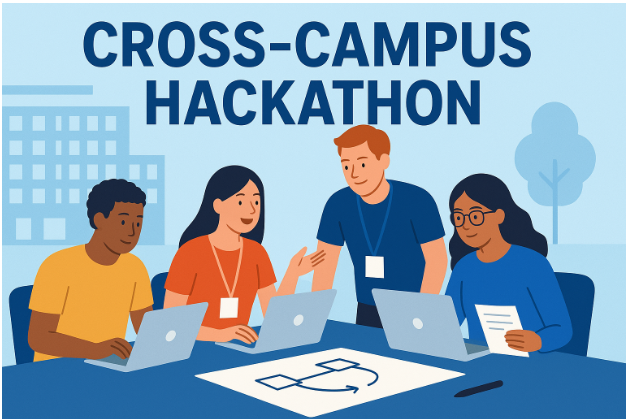
A hackathon is essentially an event where multiple people deliberate together to solve a collaborative engineering problem in a limited span of time. Unlike hackathons organised within a single institution, cross-campus hackathons widen the scope of students who are brought in to work together. This comes with a plethora of benefits.
2 Big Reasons Cross-Campus Hackathons Boost Student Growth
Hackathons as Launchpads: More Than Just Coding
- Collaboration
Interacting with an interdisciplinary pool of students one has not interacted with before broadens one’s ability to collaborate in a new team, equipping them with both leadership and teamwork abilities, as talent is pooled together not only in producing a solution but in effectively communicating with one another.
- Competition
The other side of the coin is that of competition, particularly the healthy kind. A hackathon is an adrenaline-packed event with tight deadlines and intensive problem-solving. This creates a spirit of competition where all students thrive to be the first to solve, which encourages them to think on their feet to deliver an effective solution in the shortest possible time.
- Networking
By diversifying the pool of students to include those outside of the peers one usually interacts with on a day-to-day basis, an excellent opportunity for networking is born. Through the various collaborative elements of a hackathon, one is exposed to students from differing backgrounds but commonality in interests and abilities. By doing so, lasting relationships can be forged, and by maintaining these connections, several doors of opportunity open up – whether it’s for friendship, collaboration on future projects in the engineering field, or career opportunities.
From Classrooms to Careers: Shaping Future Innovators
- Healthy stress
Studies show that minimal amounts of stress are actually beneficial to the individual experiencing it. As long as it does not cross the threshold where it becomes detrimental, light stress is actually proven to result in enhanced performance as ‘eustress, as psychologists call it, promotes a rush of hormones without any real threat or fear. This results in increased motivation to deliver a good performance.
- Career preparation
The hackathon essentially simulates a work environment, acting as a crash course for the same. Thrust into a high-energy energy high-stakes event involving delegation of tasks, collaboration on problem-solving and effective communication among new people – it’s a work day in a nutshell. This is especially useful for students who aim to get placed in high-profile companies, as they are already exposed to the various facets of an engineering or consulting career.
In essence, a cross-campus marathon is a goldmine for developing not only one’s resume but their personality, allowing them to thrive in an academic environment that bridges the gap between the classroom and the real world of complex problem-solving.
Conclusion
Among other things, cross-campus hackathons are co-curricular events, competitions, and expos rolled into one, where teamwork and career building meet and blend perfectly at the same time. By mixing different disciplines and institutions, they plant, grow, and harvest the best attributes of teamwork, collaborative competition, and relationships—long after the event has ended. Students not only expose their programming and logical thinking skills but also nurture the essential soft skills of the leadership group, adaptability, and communication.
On top of that, the slight stress of the competition usually puts the participants in a position where they perform as well as in real professional world situations. In a way, these hackathons are the stage for future innovators and entrepreneurs to rehearse their moves, thus aligning academic learning with the industry’s expectations. They are training students not only for their next project but also for the future work environment which is constantly changing and where collaborating and being creative are the two most important skills.
References
[1] E. Scott, “The Benefits of Good Stress,” Verywell Mind, Oct. 4, 2010. [Online]. Available: https://www.verywellmind.com/what-kind-of-stress-is-good-for-you-3145055. [Accessed: 26-Aug-2025].
FAQ: Cross-Campus Hackathons
Q1. What are Cross-Campus Hackathons?
They are student hackathons where participants from multiple universities and disciplines collaborate to solve problems within a limited time frame.
Q2. How are Cross-Campus Hackathons different from regular student hackathons?
Unlike single-campus events, they bring together diverse skillsets, fostering interdisciplinary collaboration and broader networking opportunities.
Q3. What are the main hackathon benefits for students?
They include skill development, networking, innovation exposure, and real-world career preparation.
Q4. Why is interdisciplinary collaboration important in hackathons?
It allows diverse teams to combine technical, creative, and strategic strengths to build more impactful solutions.
Q5. Do Cross-Campus Hackathons only focus on coding?
No. They also emphasize design, entrepreneurship, communication, and problem-solving beyond programming.
Q6. How do Cross-Campus Hackathons encourage innovation competitions?
By challenging students to think creatively under pressure, they inspire unique solutions and entrepreneurial ideas.
Q7. What role does collaboration play in student hackathons?
Collaboration enhances leadership, teamwork, adaptability, and the ability to integrate varied perspectives.
Q8. How does competition improve student growth in hackathons?
Healthy competition motivates students to push boundaries, manage stress, and perform at higher levels.
Q9. Can networking in Cross-Campus Hackathons help future careers?
Yes. They connect students with peers, mentors, and industry experts, opening doors to internships and jobs.
Q10. What kind of stress do students face in hackathons?
They experience “eustress,” a positive form of stress that boosts motivation and performance.
Q11. How do hackathons simulate real-world careers?
They mirror workplace dynamics like task delegation, teamwork, deadlines, and cross-functional collaboration.
Q12. Are Cross-Campus Hackathons only for engineering students?
No. Students from business, design, humanities, and sciences also contribute valuable perspectives.
Q13. What hackathon benefits for students extend beyond academics?
Soft skills like communication, leadership, adaptability, and entrepreneurship are developed.
Q14. How do innovation competitions at hackathons shape students?
They help students think outside the box, pitch ideas, and refine prototypes that can become startups.
Q15. Can Cross-Campus Hackathons improve resumes?
Yes. They demonstrate teamwork, creativity, and problem-solving—qualities employers value.
Q16. Do hackathons always produce usable projects?
Not always, but even prototypes show creativity, technical ability, and interdisciplinary collaboration.
Q17. How do hackathons bridge the classroom-to-career gap?
They give students hands-on practice that complements theoretical learning.
Q18. Are there long-term hackathon benefits for students?
Yes—lasting networks, entrepreneurial exposure, and transferable skills for professional life.
Q19. Do Cross-Campus Hackathons encourage entrepreneurship?
Yes. Many hackathon projects evolve into startups or inspire business ventures.
Q20. Why should universities support Cross-Campus Hackathons?
Because they nurture future innovators by blending education, competition, and career readiness.
Penned by Tapasmi Ray Chaudhuri
Edited by Shashank Khandelwal, Research Analyst
For any feedback mail us at [email protected]
Transform Your Brand's Engagement with India's Youth
Drive massive brand engagement with 10 million+ college students across 3,000+ premier institutions, both online and offline. EvePaper is India’s leading youth marketing consultancy, connecting brands with the next generation of consumers through innovative, engagement-driven campaigns. Know More.
Mail us at [email protected]