

Two words have now become so paramount in boardrooms across the country in the fast-evolving Indian corporate scene, risk register and compliance management. As India Inc. is going to be subject to more regulation in 2025, it is imperative that these two things are mastered for any business that gives importance to sustainability and integrity. With increased government control and cyber governance becoming more invasive, failure to handle risks or comply with the regulations has been catastrophic. Firms need strong systems integrating risk register systems and effective compliance management systems if they are to survive and prosper in this new regime.
A risk register is no longer an instrument by which a project manager works. It is a critical document defining the potential risks to business activity in terms of the classification of risks as severity and likelihood. In this way, compliance management allows an organisation to fulfil internal policy, external law, and industry regulation. Collectively, these processes form the backbone of a model of governance that is future-proof and agile should uncertainty increase.
The Regulational Landscape in 2025: Wake-Up Call
India’s business world is squeezed by an increasingly longer list of regulative obligations. The most significant compliance issues are ESG disclosures, data privacy, and anti-bribery practices, according to EY India (2025). The benchmark of ethical behaviour is growing sector by sector especially for companies in the financial, health, and technology industries. In that complicated context, a risk register keeps organisations ahead of the curve by identifying and following areas of high risk. That increased alertness enables prevention instead of firefighting fix-its.
The KPMG 2024/25 report also indicates the need for timely compliance. They have identified cyber resilience, cross-border compliance, and third-party risk as major challenges. Indian companies, particularly the MSMEs, may not have a systematic process in addressing these, thereby converting compliance management into a major differentiator for companies in the extremely competitive market. Companies that do not react to the shift in requirement would soon be in the eye of court cases or published scandals.
Building a Culture of Accountability
Compliance culture within a company begins with excellent leadership and communications. Compliance does not have to be checked down but involves a continuous process associated with each business function. An open risk register will allow management to assign ownership for each category of risk and develop an escalation matrix that holds them responsible. It also encourages cross-functional working, which is required when law, finance, operations, and IT departments must come together to deal with multi-dimensional threats.

An effective compliance management system integrates staff training, whistleblower hotlines, and regular audits into the fabric of the culture. Governance procedures such as policy portals and modules offering e-learning enable organisations to roll out compliance all over the globe without sacrificing control. This disciplined, technology-supported culture creates transparency and trust, among employees and externally from outsiders.
Digital Transformation: Double-Edged Sword
Digitalisation is transforming compliance infrastructure at a breakneck pace. Automatic regulatory filings and real-time fraud detection using artificial intelligence are becoming the new norm in various industries. Digital platforms, however, are not without weaknesses either. Failure to build a dynamic risk register may leave firms unaware of evolving cyber dangers, regulatory technology breakdowns, or data governance threats.
Compliance platforms are now being supplied with dashboards to track audit readiness, policy adherence, and risk heatmaps. Yet, if those platforms are not designed to meet India-specific regulation like the Digital Personal Data Protection Act or future SEBI regulation, then the risk of non-compliance comes into the mix. Digitisation must be followed by localisation and customisation to be potent and meaningful.
Case Insight: A Tale of Two Companies
Consider two mid-cap manufacturing firms. The first has a quarterly-updated risk register to national and international standards. It offers yearly compliance training, in-real-time policy changes, and pseudo-audits. The second firm believes that compliance is something the legal department does and hasn’t updated the risk matrix in over a year.
When suddenly an ESG disclosure rule is announced, the first company responds in weeks and does not lose its investor confidence. The second company does not know the change in the rule and does not have a compliance process and receives a penalty and suffers reputational loss. It indicates the value of compliance management if combined with an existing risk register.
The Road Ahead: Regulatory Readiness as a Competitive Advantage
Within a couple of years, organisations that recognise compliance as strategic business will be way ahead. Bringing in a master risk register is not only a better method for crisis preparation but also for overall day-to-day business success as well. Proactive compliance management can, at the same time, achieve advantages like easier market access, improved mergers and acquisitions, and more stakeholder trust.
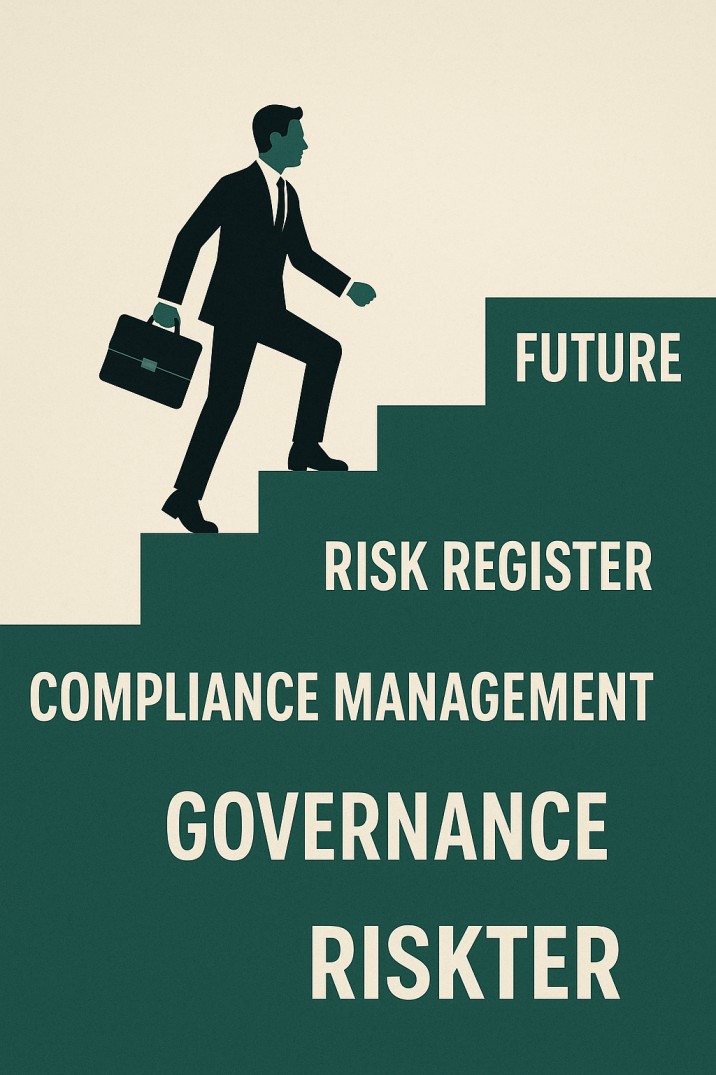
Boards need to place these systems atop a high-priority list in their long-term strategy. Training, technology, and third-party risk management are no longer luxuries, they are areas of mandatory investment to remain in the game. With the Indian regulatory environment also set to be tightened up, scope for error will shrink further. Time for dawdling is over. Firms need to catch up with themselves to get ready, change, and propel.
Conclusion: The Future is for the Compliant and the Watchful
In order to survive in 2025 and beyond, Indian businesses must embrace the attitude of possessing a current risk register, combined with effective compliance management systems. They are no longer back-office exercises but forces for growth, reputation, and longevity. Businesses that recognise compliance as a central business process, rather than something that must be bolted on, will be best equipped to handle uncertainty.
As the watchdog agencies begin to get involved and public accountability bites, companies that have taken some time to spend money on an immaculately bolstered risk register and living compliance management techniques will not only avoid fines, they will be building legacies. The future belongs to those who are always ready and determined to do things right even when there is no one watching.
References
- EY India (Jan 2025) – Top Regulatory Compliance Challenges Facing India Inc.
https://www.ey.com/en_in/insights/forensic-integrity-services/top-regulatory-compliance-challenges-facing-india-inc-in-2025 - EY India (May 2025) – Governance and Privacy Services
https://www.ey.com/en_in/services/assurance/information-governance-and-privacy-services - KPMG (2024/25) – Ten Key Regulatory Challenges of 2025
Ten Key Regulatory Challenges of 2025
FAQs on Compliance and Risk Register
1. What is a risk register and why is it important for businesses in 2025?
A risk register is a structured document that records potential risks an organisation might face, along with their severity, likelihood, and mitigation strategies. In 2025, with stricter compliance rules and cyber governance, a risk register is vital because it helps companies proactively identify risks and prepare responses before they escalate.
2. How does a risk register connect to compliance management?
A risk register is central to compliance management because it ensures that risks related to regulations, policies, and laws are tracked systematically. By linking risks to compliance obligations, businesses can prevent violations, maintain transparency, and safeguard their reputation in highly regulated industries.
3. What are the main elements of a risk register?
The key elements of a risk register include the risk description, category, impact, likelihood, risk score, mitigation plan, ownership, and review date. These elements give management a clear view of risks and create accountability within the organisation.
4. How often should a risk register be updated?
Ideally, a risk register should be updated quarterly, or whenever a new regulation, policy, or business threat emerges. Regular updates ensure that risks are not only documented but also monitored, keeping businesses aligned with evolving compliance demands.
5. What are the common types of risks listed in a risk register?
A risk register can include financial risks, operational risks, legal and compliance risks, reputational risks, data security risks, and third-party risks. Classifying risks helps in prioritisation, ensuring that critical threats receive immediate attention.
6. How does a risk register support decision-making?
A well-maintained risk register provides leadership with data-driven insights into where vulnerabilities lie. By seeing the severity and likelihood of each risk, boards and executives can allocate resources wisely, make informed decisions, and strengthen governance strategies.
7. Can a risk register prevent compliance penalties?
Yes. By systematically identifying compliance-related risks, a risk register enables companies to take corrective actions before regulators intervene. Firms that keep their risk register updated are less likely to face penalties, lawsuits, or reputational damage.
8. What role does technology play in managing a risk register?
Technology supports risk registers through digital dashboards, automated monitoring tools, and AI-driven analytics. These platforms help track risks in real time, provide audit trails, and align compliance activities with Indian-specific regulations like the Digital Personal Data Protection Act.
9. How does a risk register benefit small and medium-sized enterprises (SMEs)?
For SMEs, resources are often limited, making compliance a challenge. A risk register acts as a cost-effective tool to organise risks, set priorities, and avoid sudden financial or legal shocks. It levels the playing field with larger companies in terms of regulatory readiness.
10. What is the difference between a project risk register and an enterprise risk register?
A project risk register tracks risks specific to a project’s goals, timelines, and resources. An enterprise risk register, on the other hand, looks at risks affecting the entire organisation, including compliance, governance, and reputation. In 2025, enterprises must prioritise the latter.
11. Who is responsible for maintaining the risk register?
Responsibility usually lies with risk officers, compliance managers, or governance teams. However, accountability should be distributed across departments. Each function—legal, IT, finance, operations—must own its risks and update the risk register regularly.
12. How does a risk register promote a culture of accountability?
By assigning ownership for each risk, a risk register makes individuals and departments responsible for monitoring and mitigating risks. This culture of accountability ensures compliance is not seen as a back-office task but as a shared responsibility.
13. What challenges do companies face while maintaining a risk register?
Common challenges include lack of leadership support, outdated data, fragmented communication across departments, and over-reliance on manual processes. Without a robust compliance culture, the risk register can become a static document instead of a living tool.
14. Can a risk register help with ESG and sustainability compliance?
Absolutely. As ESG disclosures are becoming mandatory in India, a risk register can track environmental, social, and governance risks. This helps businesses meet sustainability requirements, reduce reputational risks, and build trust with stakeholders.
15. What is the future of the risk register in corporate governance?
The future of the risk register lies in its integration with compliance management systems, AI-based predictive analytics, and real-time monitoring tools. Businesses that treat the risk register as a strategic asset rather than an obligation will gain a competitive advantage in governance and long-term sustainability
Penned by Gargi Garg
Edited by Sneha Seth, Research Analyst
For any feedback mail us at [email protected]
Transform Your Brand's Engagement with India's Youth
Drive massive brand engagement with 10 million+ college students across 3,000+ premier institutions, both online and offline. EvePaper is India’s leading youth marketing consultancy, connecting brands with the next generation of consumers through innovative, engagement-driven campaigns. Know More.
Mail us at [email protected]