INTRODUCTION
Procurement is certainly not just the art of negotiating the best price or securing a delivery ahead of time anymore. In today’s market, a business is required to penetrate past the surface — into the social, ethical, and environmental aspects of the purchased items. Thus, it can be said that sustainable procurement checklists are the most influential tool that exists. They not only let companies envision and plan but also ensure that they make wise as well as responsible choices when they are dealing with vendors.
This change is a sign of a positive trend in the eyes of clients done by ESG vendor selection. It is proof that their partners take into account the issue of accountability and are, in fact, not only concerned about profits. In reality, client procurement works that are effective have become the main factors for building trust and long-term cooperation. In effect, these checklists are in many respects not related to paperwork only, but more about living the values through deeds.
Why Sustainability Matters
Procurement shapes each and every decision and brings along the consequences that are greater or smaller in size. Choosing suppliers that do not abide by labor laws and use unsustainable materials may be a way to slash prices in the short run, but, on the other hand, it can cause the company to lose its good name, receive sanctions, and even alienate its clients. Conversely, sustainability moves would create the strength, decrease the risks, and quite often result in money-saving as well, with the passage of time.
Currently, the sustainability issue is not viewed as an option but rather as a must. The clients and regulators together require a tangible demonstration that companies are purchasing responsibly. A procurement checklist that is well thought out serves as an instrument for keeping organizations true to their words and showing that they are fair and consistent in making these pledges.
What Goes Into a Checklist
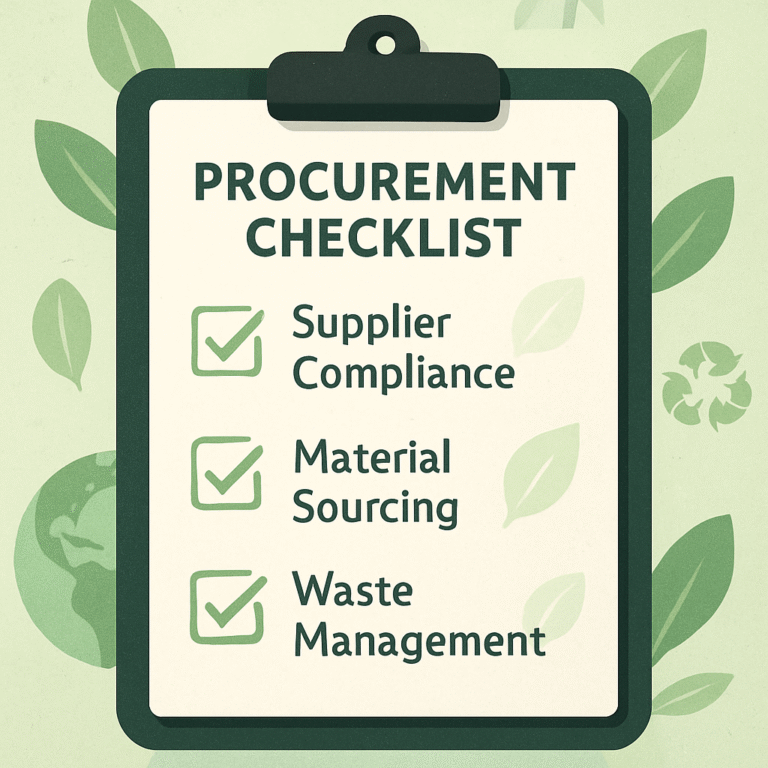
A checklist that is commendable for its goals and design is simple, logical, and user-friendly. Through such a document, procurement officers are provided with a base that they can use to measure the qualities of their suppliers without making the procedure too difficult. The checklist may contain the following elements:
Checklist Element | Why It Matters |
Supplier Compliance | Confirms suppliers respect labor laws, human rights, and environmental standards. |
Material Sourcing | Encourages renewable, recycled, or locally produced goods to reduce footprint. |
Energy & Waste | Pushes for energy-efficient products and responsible waste practices. |
The way the structure is designed ensures that sustainability is not treated as the last option – it becomes a part of every buying decision.
Making It Work in Practice
- Just owning a checklist is not enough. The true consequence occurs when firms actualize it. That entails:
- Listening to client priorities and tailoring the checklist accordingly.
- Talking with suppliers before the procurement to set the expectations right from the start.
- Piloting the initiative with small steps, first applying it to high-value or high-risk purchases, and then growing the area of application.
- Changing rules and client expectations constantly, hence reviewing and updating regularly.
- When transformed like this, the checklist ceases to be just a compliance burden and turns into a decision-making tool that is more helpful.
Different Perspectives
According to the client, a sustainable procurement checklist is like a certificate of quality. It also indicates that the business partner is open, in compliance, and least likely to cause any kind of reputational or regulatory anxieties.
The viewpoint of a supplier would be that it was just another thing to worry about. However, these suppliers who have successfully met the criteria usually receive the advantage of winning long-term contracts and gaining the trust of international markets where environmental concerns are greatly taken into account in doing business.
Both clients and suppliers, through their perspectives, eventually become winners — clients gain assurance, and suppliers obtain opportunities.
THIS WILL INCLUDE ESG VENDOR SELECTION.
Mistakes to Avoid
While committing good deeds, companies can still fall into the trap and use procurement checklists in the wrong way. Some of these mistakes are:
- Making the checklist overly broad and failing to tailor it to the needs of clients.
- Considering it as a single event instead of treating it as a continuous process.
- Their main focus would be on the environment, and they would neglect the labor or social aspects of the issue.
- The staff is not trained on the use of the checklist.
These errors, when properly corrected, will increase the importance of the sustainable procurement checklist, and it will not only be a mere exercise in ticking boxes.
Conclusion
Nowadays, the business world is no longer revolving around cost and efficiency only, and thus, these do not necessarily lead to the formation of long-term partnerships. Clients ask companies to be responsible in every deal they make. Sustainable procurement checklists are exactly what makes the difference. They are how the values of ethics, fairness, and accountability are integrated in the daily purchase of goods.
If combined with open customer procurement activities, they become not just a tool to eliminate or lessen the risks but also a means of trust building among businesses, suppliers, and consumers. This trust then turns into a competitive advantage, allowing companies to be more visible, obtain more long-term contracts, and realize true impact.
Ultimately, procurement is not simply about the products or services a company buys, but about the process of buying. Communal support, environmental preservation, and relationship enhancement are but a few of the benefits that can be derived from every transaction. These are the companies that will be leading the pack in the future when they realize the significance of this fact and implement the sustainability agenda in their purchasing activities.
SOURCES
https://www.ivalua.com/blog/sustainable-procurement-sourcing-strategies-for-a-greener-future
https://practicegreenhealth.org/sustainableprocurementguide
https://sievo.com/en/resources/sustainable-procurement-101
FAQs on Sustainable Procurement Checklist
1. What is a sustainable procurement checklist?
A sustainable procurement checklist is a structured tool that organizations use to evaluate suppliers and purchasing decisions based on environmental, social, and governance (ESG) factors. Instead of focusing only on cost and speed, the checklist ensures that every procurement choice supports ethical labor practices, eco-friendly materials, and long-term business value.
2. Why should companies use a sustainable procurement checklist?
Companies use a sustainable procurement checklist to reduce risks, avoid reputational damage, and align with client and regulatory expectations. By doing so, they demonstrate accountability, build trust, and strengthen long-term supplier partnerships.
3. What are the main elements of a sustainable procurement checklist?
The key elements typically include supplier compliance with labor laws, sourcing of sustainable materials, energy and waste management practices, fair pricing, and transparency in reporting. Each item ensures suppliers align with ethical and environmental standards.
4. How does a sustainable procurement checklist benefit clients?
For clients, a sustainable procurement checklist is proof of responsible purchasing. It shows that a company’s decisions are not purely profit-driven but also consider ethical and environmental responsibilities, creating greater trust and confidence in the business relationship.
5. How can suppliers prepare for a sustainable procurement checklist?
Suppliers can prepare by ensuring compliance with international labor laws, adopting eco-friendly production methods, using renewable or recycled materials, and documenting their sustainability practices. Those who meet checklist standards often gain long-term contracts and access to global markets.
6. Is a sustainable procurement checklist only about the environment?
No, a sustainable procurement checklist goes beyond environmental issues. It also addresses human rights, fair wages, workplace safety, anti-corruption practices, and diversity in the supply chain. This holistic approach ensures comprehensive sustainability.
7. How does a sustainable procurement checklist align with ESG vendor selection?
A sustainable procurement checklist complements ESG vendor selection by providing measurable criteria to assess suppliers. It ensures vendors meet environmental standards, demonstrate social responsibility, and operate with transparent governance.
8. Can small businesses implement a sustainable procurement checklist?
Yes, small businesses can and should adopt a sustainable procurement checklist. They may start with simple measures like checking supplier compliance, choosing local sources, or reducing packaging waste. Over time, they can scale their checklist to include more advanced ESG practices.
9. How often should a sustainable procurement checklist be updated?
A sustainable procurement checklist should be reviewed regularly, at least annually. As sustainability standards, client expectations, and regulations evolve, companies must adjust their checklist to remain compliant and relevant.
10. What mistakes do companies make when using a sustainable procurement checklist?
Common mistakes include making the checklist too broad, ignoring social aspects like labor rights, treating it as a one-time task instead of an ongoing process, and failing to train staff on how to apply it effectively.
11. How does a sustainable procurement checklist reduce risk?
By enforcing ethical and environmental standards, a sustainable procurement checklist reduces risks of legal penalties, supply chain disruptions, and reputational damage. It also helps identify reliable suppliers who can support long-term goals.
12. Can a sustainable procurement checklist save money?
Yes. While sustainable products or processes may cost more initially, a sustainable procurement checklist often leads to long-term savings. Energy-efficient products, reduced waste, and reliable suppliers lower overall operational costs over time.
13. How do clients view a sustainable procurement checklist?
Clients view a sustainable procurement checklist as a sign of transparency and quality. It reassures them that their business partners are committed to ethical sourcing, environmental responsibility, and regulatory compliance.
14. What role does technology play in a sustainable procurement checklist?
Technology tools such as digital dashboards, supplier management platforms, and ESG compliance software can make a sustainable procurement checklist easier to implement. These tools help automate tracking, reporting, and verification.
15. How does a sustainable procurement checklist build trust?
A sustainable procurement checklist builds trust by showing clients, regulators, and stakeholders that an organization lives up to its sustainability promises. It transforms procurement into a values-driven process that strengthens relationships across the supply chain.
Penned by Gaatha
Edited by Hamid ali, Research Analyst
For any feedback mail us at [email protected]
Transform Your Brand's Engagement with India's Youth
Drive massive brand engagement with 10 million+ college students across 3,000+ premier institutions, both online and offline. EvePaper is India’s leading youth marketing consultancy, connecting brands with the next generation of consumers through innovative, engagement-driven campaigns. Know More.
Mail us at [email protected]