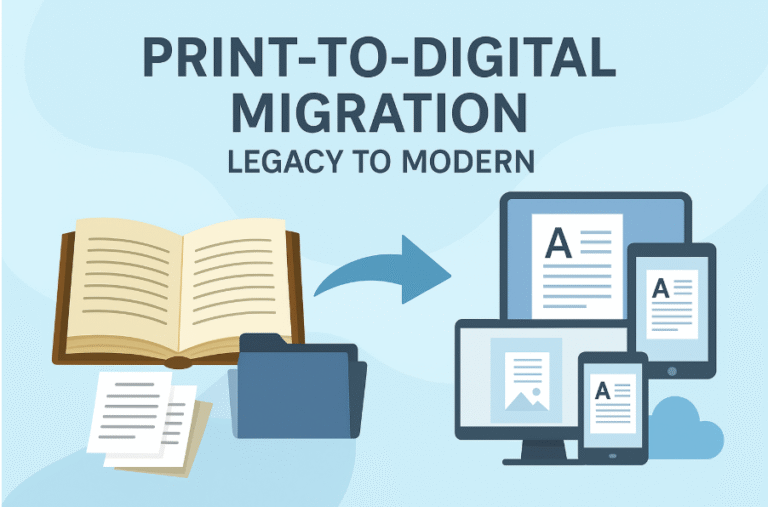
The print-to-digital transformation involves the complete conversion of material from physical copies into digital formats. It encompasses a great diversity of materials, including books, newspapers, corporate records, legal documents, and historical manuscripts. There are two reasons for this conversion: to ensure long-term preservation of the valued knowledge and to make it easily accessible on devices and platforms.
Hardly any organization, let alone a library, is unwilling or unable to change for such a reason. Demand for ready access has turned into a necessity for business efficiencies and fast document retrieval. Such features as keyword searches, hyperlinks, and metadata tagging, impossible affordances of the printed material, are opened by it.
4 Challenges of Migrating Legacy Systems:
Generally, the conversion of legacy to modern digital repositories is punishing. Most of the bottlenecks in the transition from print to digital come from:
- Volume of data to be handled: In big organizations, thousands of boxes with archives might require careful scanning and cataloguing.
- Quality assurance: Guarantee accuracy in digitization with no loss of data in conversion.
- Technological hurdles: Sometimes, particular old formats require special machines to be able to digitize them.
- Compliance and confidentiality: Archiving strategies, usually legally and regulatorily compliant, would be invoked for sensitive materials.
With that consideration comes an investment in the digital infrastructure for overcoming such hurdles. Thus, digitizing research libraries sees universities go beyond best formats; they also include searchable databases and copyright protection for that content.
4 Advantages of Modern Digital Migration
Although the route presents challenges, the benefits of print-to-digital transformation far outweigh the disadvantages. Modern digital repositories offer the following:
- Global Access: Any archive digitized is accessible through the Internet.
- Preservation: Effectively archived digital copies have, once and for all, solved the paper degradation issue.
- Efficiency: Speed of search, retrieval, and friendly sharing on a digital platform.
- Integration: New-age systems allow the interlinkage of digital archives and analytical instruments, making them priceless to research and decision-making.
These gains will eventually translate into decreased operational charges as well as course changes and data security maintenance for enterprises. For cultural institutions, digitization guarantees the survival and awareness of heritage documents.
Looking forward, print-to-digital transformation will differentiate itself through automation and advanced technologies. AI is influencing OCR, metadata tagging, and predictive archiving at this point. The ongoing evolution of cloud storage solutions will also arm users with suitable and scalable archiving strategies.
Blockchain technology also has a potential enabling role to play in authentication and acts as a guard against tampering of digital archives. Movement in both libraries and organizations adopting such innovations will, hence, change from migration to sustainable evolution concerning legacy systems.Conclusion
The way from legacy print collections to modern digital repositories can be much more than a question of technology, from an old culture to being truly modernized. An effective strategy for archiving will assure organizations that their print-to-digital transformation will become smooth, secure, and ready for future changes.
The ever-growing digital-first approach adopted by the institutions progressively leads towards diminishing the gulf even further between preservation and innovation. What remains agnostic is adherence to the creed of preserving knowledge while making it freely accessible to all. In this light, print-to-digital migration is more than a purely technological change: it is a rethinking of much of the nature of future information storage.References
[1] S. Ross and M. Hedstrom, Preservation and Access in the Digital Age: Strategies for Cultural Heritage Institutions. London, U.K.: Facet Publishing, 2018.
[2] M. Conway, “Digital transformations and the archiving of legacy print materials,” Archival Science, vol. 21, no. 2, pp. 145–167, 2021.
[3] A. J. Gilliland, “Archiving strategies for digital libraries: Balancing preservation and accessibility,” Library Trends, vol. 68, no. 3, pp. 345–362, 2020.
Penned by Tanjal kapoor
Edited by Reeya Kumari, Research Analyst
For any feedback mail us at [email protected]
Transform Your Brand's Engagement with India's Youth
Drive massive brand engagement with 10 million+ college students across 3,000+ premier institutions, both online and offline. EvePaper is India’s leading youth marketing consultancy, connecting brands with the next generation of consumers through innovative, engagement-driven campaigns. Know More.
Mail us at [email protected]