
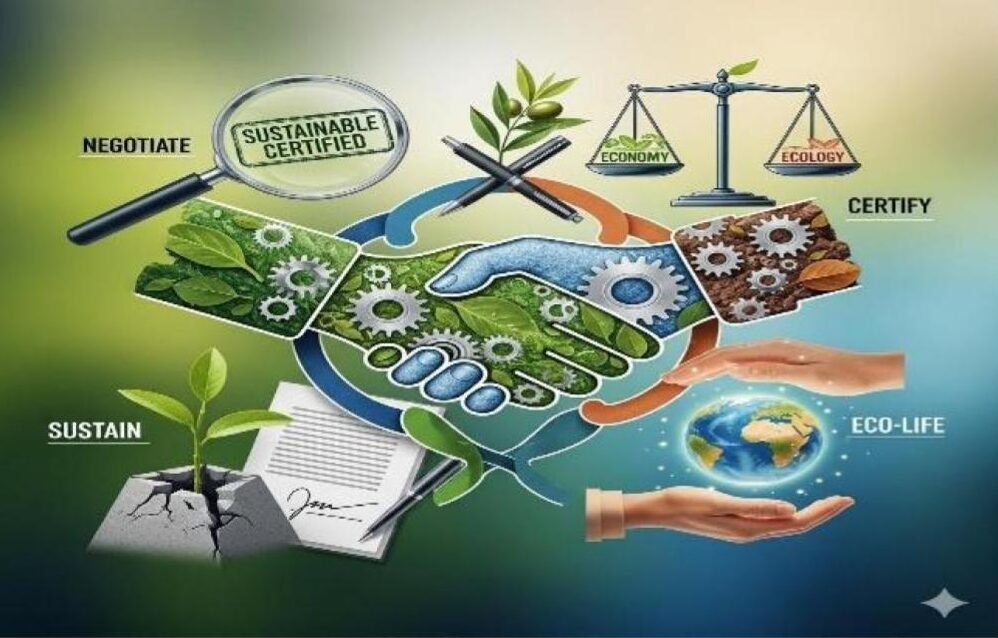
Topic: Sustainability Certifications
Negotiation for sustainable certifications does not involve only the rules and the paperwork, but the blending of the art of negotiation with the ethics of the negotiation and every decision affecting the environment. This will maximize negotiation with sustainable living and embrace empowered conscious consumers.
The Starting Point Sustainability certification is like a passport for the eco-conscious marketplace. Each certification- ISO 4001 is credible with eco-sensitive consumers. Certification means negotiation in time, cost, and compliance standard, which some people think is a negotiation deadlock.
By “passport process” negotiation, the companies not only collect stamps, but they also narrate a remarkable story of responsibility and innovation. The company’s strategic innovation must be challenged to meet the ECO standards on SUSTAINABILITY to obtain certification.
Consumers are like detectives on any product that has a sustainability stamp. This trend will only increase with the certification credibility. Envision a proposal where your guide illustrates how your eco-practices align with consumer values. This proposal closes the divide between corporate strategy and consumer ethics. It is a win-win situation.
5 POWERFUL STRATEGIES FOR THE ART OF NEGOTIATION IN SUSTAINABLE CERTIFICATIONS AND ECO LIFE
Building collaborative partnerships
Negotiation is no longer a battlefield; it’s a garden to cultivate. Collaborative negotiations in sustainability are about shared growth rather than competition. Companies approaching certification bodies as partners rather than gatekeepers can offer improvements in processes step by step.
Visualize it as tending to a bonsai tree. Small, calculated changes can provide stability and beauty in the long run. This method ensures compliance and, importantly, the creation of trust.
Leveraging data and evidence
Data is the magic ingredient in sustainability negotiations. It is the story of energy saved, waste avoided, and responsible sourcing. Showing these metrics to certifiers is like offering a treasure map. It highlights their commitment.
Lifecycle assessments and environmental audits provide proof where previously there were only claims, bolstering your negotiation position and resonating with eco-minded consumers.
Weighing Cost vs. Value: Sustainability certification
It can feel like scaling a mountain: you pay taxes at a steep cost, but at the top of that mountain, you get perspective, recognition, and a great return. Certain negotiators might encourage their clients to see certification as an investment rather than a cost.
To highlight the broader value – brand trust, market differentiation, and operational efficiencies. Inclusive philosophies turn “cost” into “opportunity” in the negotiation process, creating win-win scenarios for the company, certifiers, and the environment alike.
Authenticity and Integrity in Communication
For eco-negotiation, authenticity is the glue. Overpromising, or misrepresenting your ideas, efforts, or work, is like building a sandcastle at high tide…you know at some point it is going to fall in the ocean and be gone forever. So, authentic communication around current capabilities, challenges, and plans for improvements can build trust with certifiers and consumers alike.
The Role of Continual Improvement and Feedback
Negotiating at the level of sustainability is not a “one-shot deal,” it has river-like tendencies to flow and be born from changes and learning experiences. The feedback variable leads to continual monitoring, re-assessing, and any needed changes or adaptations to ensure performances of longer durations are achievable in the future. Iterating on improvements means companies can reiterate in negotiations and respond more effectively to changing the game of conditions.
Conclusion
Negotiating in achieving sustainable certifications is a complex set of strategies, storytelling, and an ethical dimension. When organizations have fundamental understandings of the certification standard, measuring their level of understanding through their consumer guides, foster collaborations, use data to their advantage, weigh cost versus value, be transparent, and ensure continuous improvements, they can achieve meaningful and authentic sustainability.
References
[1] ISO, ISO 14001: Environmental Management Systems — Requirements with Guidance for Use, International Organization for Standardization, 2015. [Online]. Available: https://www.iso.org/standard/60857.html
[2] U.S. Green Building Council, LEED v4 for Building Design and Construction, 2020. [Online]. Available: https://www.usgbc.org/leed/v4
[3] J. R. Ehrenfeld, Sustainability by Design: Subversive Strategy for Transforming Our Consumer Culture. New Haven, CT, USA: Yale University Press, 2008. [Online]. Available: https://yalebooks.yale.edu/book/9780300137491/sustainability-by-design/
[4] M. Peattie and A. Crane, “Green marketing: legend, myth, farce or prophesy?,” Qualitative Market Research: An International Journal, vol. 8, no. 4, pp. 357–370, 2005. doi: 10.1108/13522750510619733. [Online]. Available: https://doi.org/10.1108/13522750510619733
[5] D. A. Aaker, Strategic Market Management, 10th ed. Hoboken, NJ, USA: Wiley, 2017. [Online]. Available: https://www.wiley.com/en-us/Strategic+Market+Management%2C+10th+Edition-p-9781119335572
FAQ
Q1. What is sustainability certification?
Sustainability certification is a formal recognition that a company follows eco-friendly standards, such as ISO 14001 or LEED. It builds credibility with consumers and demonstrates commitment to environmental responsibility.
Q2. Why is sustainability certification important for businesses?
Sustainability certification provides trust, global recognition, and competitive advantage. Companies that earn it are more likely to attract eco-conscious customers and strengthen their conscious consumer guide strategy.
Q3. How does negotiation play a role in sustainability certification?
Negotiation is vital in sustainability certification because it balances costs, timelines, and compliance. Effective strategies ensure companies meet eco-standards without compromising transparency or integrity.
Q4. What is a conscious consumer guide in sustainability?
A conscious consumer guide helps eco-minded customers understand what a sustainability certification means, why it matters, and how it reflects a brand’s ethical practices.
Q5. What are examples of global sustainability certifications?
Examples include ISO 14001 for environmental management, LEED for green buildings, and Fairtrade certification for ethical sourcing. These align with the conscious consumer guide to promote eco-responsible choices.
Q6. How do companies use data to support sustainability certification?
Data like lifecycle assessments, carbon savings, and waste reduction reports strengthen negotiations with certifiers and assure conscious consumer guide readers of genuine impact.
Q7. What are the costs versus benefits of sustainability certification?
While costs can be high, the benefits of sustainability certification include brand trust, operational efficiency, and long-term consumer loyalty guided by conscious consumer principles.
Q8. How can authenticity help in sustainability certification?
Authentic communication avoids greenwashing and builds long-term trust. Companies that openly share challenges in their conscious consumer guide gain more credibility with certifiers and customers.
Q9. How does continual improvement affect sustainability certification?
Sustainability certification is not one-time. Ongoing improvements and transparent updates assure certifiers and conscious consumer guide followers that the company is committed to long-term eco goals.
Q10. What challenges do companies face in earning sustainability certification?
Challenges include high compliance costs, resistance to change, and complex paperwork. A conscious consumer guide highlights these issues while showing how firms overcome them.
Q11. How does sustainability certification impact consumer behavior?
Products with sustainability certification appeal more to eco-aware buyers. When explained through a conscious consumer guide, these certifications influence purchasing decisions.
Q12. What is the future of sustainability certification?
The future of sustainability certification will involve stricter global standards, technology integration like blockchain, and consumer-driven transparency through conscious consumer guides.
Penned by Riya Bharti
Edited by Reeya Kumari, Research Analyst
For any feedback mail us at [email protected]
Transform Your Brand's Engagement with India's Youth
Drive massive brand engagement with 10 million+ college students across 3,000+ premier institutions, both online and offline. EvePaper is India’s leading youth marketing consultancy, connecting brands with the next generation of consumers through innovative, engagement-driven campaigns. Know More.
Mail us at [email protected]