
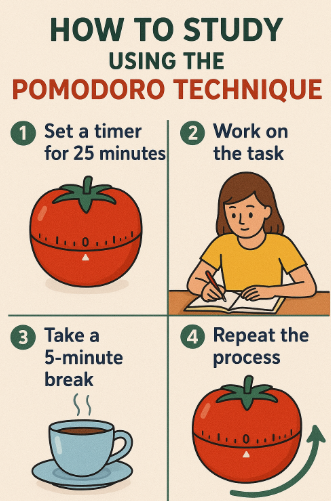
The Pomodoro Technique is a time management system that enables people to break their work efforts into 25-minute intervals of focused, dedicated work increments followed by short breaks. By shifting focus in this way—rather than allowing oneself to become fatigued over time or working beyond a provided mental capacity—the Pomodoro Technique increases productivity while maintaining mental wellness. By working with time and the clock instead of against it, the Pomodoro champions a mindset of urgency while simultaneously reinforcing built-in respite opportunities.
How to Execute Pomodoro Steps
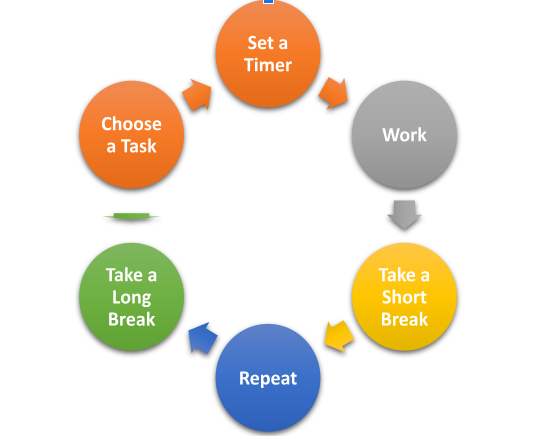
Choose a Task
What task will you accomplish? This can be anything from writing a paper to cleaning your room; generally, one single task with a defined outcome is the best way to start.
Set a Timer
The timer is set for 25 minutes during which you will focus exclusively on the task at hand. You must put every effort into this task and pay absolute attention without a distraction. The goal is to avoid distractions at all costs, so turn off your phone, put on noise-cancelling headphones, walk away from your computer if you use social media, don’t speak to your roommates—nothing.
Work
When the timer goes off, work only on your assigned task until the timer rings.
Take a Short Break
When the timer does ring, immediately stop working and take a short 5-minute break. During this break, do something not related to work such as stretching, getting a snack, or resting your eyes.
Repeat
After your short break, start again with a new 25-minute timer and get back to work.
Take a Long Break
After four pomodoros, take a longer break of 15-30 minutes. This is important for resetting your mind before engaging back in the process.
Students’ Benefits
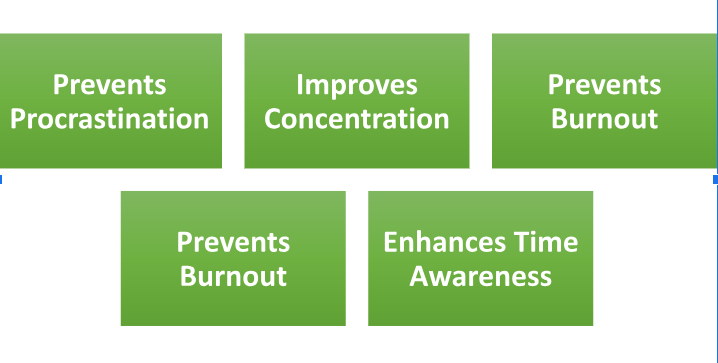
These might be of special interest to students, since some common study problems are targeted:
Prevents Procrastination
Working on something large sounds “too much” to handle. The Pomodoro Technique breaks down a large task into gentler chunks of 25 minutes each, making it less intimidating and more approachable to start.
Improves Concentration
With small intervals allotted to focus on one thing at a time, the brain learns to sharpen its concentration so that the urge to multitask fades away, and entering a “flow” state comes within reach.
Prevents Burnout
With built-in regular breaks, you never get into the mental exhaustion that comes with long study sessions without breaks. So you can do good work for a long time.
Enhances Time Awareness
As you keep tabs on your pomodoros, you start to get an accurate picture of how long certain tasks take. This helps you become better at planning and scheduling your assignments and exams in the future. Essentially, the Pomodoro Technique is more than just a time-tracking system; it is really an entire philosophy of productivity that encourages focused work and deliberate periods of rest. Thus, for anyone curious about improving their study habits, time management, and achievement of academic goals, the method is a true friend.
Conclusion
The Pomodoro Technique offers a practical, balanced approach to time management that not only increases productivity but also safeguards mental well-being. By breaking study sessions into manageable intervals, students can overcome procrastination, stay focused, and avoid burnout, all while developing a better understanding of how they use their time. This method doesn’t just help with studying—it builds lifelong habits of discipline, concentration, and efficiency. For learners seeking to maximize their academic potential, the Pomodoro Technique serves as a simple yet powerful strategy to work smarter, not harder.
References
- Cirillo, F. (2006). The Pomodoro Technique.
Retrieved from https://francescocirillo.com/pages/pomodoro-technique - MindTools. (n.d.). The Pomodoro Technique: Taking Regular Breaks to Improve Productivity.
Retrieved from https://www.mindtools.com - University of Illinois at Urbana-Champaign. (2020). Study Strategies: Pomodoro Technique.
Retrieved from https://citl.illinois.edu - Trello Blog. (2022). How to Use the Pomodoro Technique to Master Your Time Management.
Retrieved from https://blog.trello.com
FAQs About Pomodoro Technique for Students
1. What is the Pomodoro Technique for Students?
The Pomodoro Technique for students is a time management method where study sessions are divided into 25-minute focused intervals called “Pomodoros,” followed by short breaks. This helps students maintain high concentration levels, manage study time effectively, and reduce fatigue during long academic tasks.
2. How does the Pomodoro Technique help students study better?
The Pomodoro Technique for students helps improve study efficiency by promoting focused, distraction-free learning periods. It prevents burnout and procrastination, allowing learners to retain information better while keeping their mind refreshed through regular breaks.
3. How many Pomodoros should a student complete in one study session?
A student can complete around four Pomodoros—each lasting 25 minutes with 5-minute breaks in between—before taking a longer 15–30-minute rest. This structured rhythm helps students balance intense focus with relaxation, maximizing productivity using the Pomodoro Technique for students.
4. Can the Pomodoro Technique reduce procrastination among students?
Yes, the Pomodoro Technique for students is particularly effective against procrastination. By breaking overwhelming tasks into smaller, timed intervals, it removes the fear of starting large projects and helps students take consistent action with less mental resistance.
5. What are the benefits of the Pomodoro Technique for students?
Key benefits of the Pomodoro Technique for students include improved focus, time awareness, motivation, and reduced stress. It helps learners work smarter by encouraging a disciplined yet flexible study routine that aligns with natural attention spans.
6. Can the Pomodoro Technique be used for subjects that require deep thinking?
Absolutely. The Pomodoro Technique for students can be adapted for deep study subjects like math, programming, or research. Students can adjust intervals—using longer Pomodoros (40–50 minutes) if needed—to sustain deeper concentration while still including rest breaks.
7. How does the Pomodoro Technique prevent burnout in students?
By integrating regular breaks, the Pomodoro Technique for students ensures mental rest and recovery. Instead of long, uninterrupted study marathons, students work in cycles, which reduces fatigue, supports memory retention, and prevents burnout over time.
8. What tools or apps support the Pomodoro Technique for students?
There are several Pomodoro timers and apps like Focus Booster, TomatoTimer, and Forest that assist in implementing the Pomodoro Technique for students. These apps track time automatically, record progress, and help students stick to a disciplined study schedule.
9. Is the Pomodoro Technique suitable for group study?
Yes, the Pomodoro Technique for students can also work for group study sessions. When students agree on Pomodoro intervals and break times, it fosters accountability and synchronized focus, making collaborative study more productive and less distracting.
10. How can students track progress using the Pomodoro Technique?
Students can log the number of Pomodoros completed for each subject or topic. Tracking progress helps them understand how much time each task takes, making future study plans more accurate. Over time, using the Pomodoro Technique for students builds strong time awareness and consistency.