
Delhi’s air is no longer just a smell; it has a taste. It tastes like ash and metal. It clings to the back of your throat the moment you step outside. In November, if you were in the capital, you didn’t just see the smog; you felt it suffocating you, heavy in your chest like a wet blanket.
It’s not just “pollution” anymore. That term falls short when describing the dreadful situation that blankets Northern India each year. It’s a long war. This is a biological siege on people’s respiratory systems. Finally, there’s enough outrage that it’s shifting from mere resignation to a form of resistance.
The story is unfolding. As news reports highlight AQI levels surpassing 500, a more subtle revolution is taking shape. Youth activism is moving out from awareness campaigns into the challenging realms of politics and survival.
Here’s what the front lines of that battle look like today, and how »Breathe Fight Air Pure« has become more than just a rallying cry.
1. The Smog Refugee Crisis and the 2025 Break Point
To understand the current panic, we need to look at the immediate surroundings. Late 2025 was not a drought season for Delhi; it marked a turning point. As The Hindu reported, a new class of people emerged: “smog refugees.” These aren’t merely wealthy individuals fleeing to Goa or Dubai. They are Middle Class citizens who are eager to relocate their families and businesses because the city has become unlivable due to chemical conditions.
Previously, the issue in Delhi seemed focused on numbers, but it also included the lack of effective solutions. The Graded Response Action Plan was put into motion—construction stopped, trucks halted, and schools closed—but the grey air persisted.
Initially, people reacted with fear, but that quickly turned to anger. They lived with the belief that staying indoors and purchasing air purifiers were sufficient measures. However, with an air quality level of 491 in mid-November, staying indoors proved ineffective. The realization struck that money could not buy a way out.
2. Youth Activism 2.0: From Posters to Policy
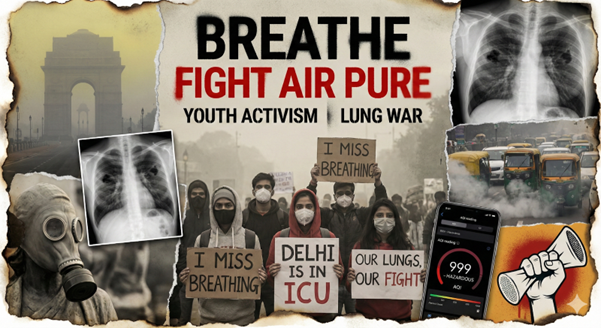
This is where the momentum shifted. In mid-November, with the sun struggling to break through the smog, hundreds of students from Delhi University, JNU, and Jamia Millia Islamia gathered at Jantar Mantar. This was not your typical “save-the-planet” protest.
The tone was different. There were no desperate pleas. The signs captured by media outlets like Al Jazeera spoke volumes: ‘I Miss Breathing’ and ‘Delhi is in ICU.’
Youth activism, framed as a long war, has evolved. It goes beyond encouraging people to carpool; it’s about holding the government accountable for violating a basic right guaranteed under Article 9: The Right to life. Students have begun filing Right To Information requests for details on how smog towers are functioning. They are tracking government spending on what is called the ‘green cess.’
The younger generation knows they will inherit these polluted lungs. They will bear the consequences of illnesses caused by inhaling PM2.5 particles as children. The protest, therefore, was more than just an expression of frustration; it was a bold confrontation against the normalization of poison.
3. The Biological Battlefield: Why We Call it a “Lung War.”
We need to stop with the soft talk. We are in a lung war because harmful particles are invading our bodies.
Medical data from recent protests paints a grim picture. Reports from the Lancet and local sources state that PM2.5 particles, which are 30 times smaller than a human hair and invisible, do more than settle in our lungs. They can cross into our bloodstream and brains.
But for young people, this is personal. It’s about a friend diagnosed with asthma at 22. It’s about the “smoker’s cough” experienced by those who don’t smoke after moving to the National Capital Region. Today’s activism carries an undertone of a health crisis. When you frame air pollution as a “public health massacre” rather than an “environmental issue,” things become more serious. You don’t negotiate over a massacre; you resist it.
This biological reality fuels the ‘Breathe Fight Air Pure’ spirit. It suggests an active fight. You have to struggle for clean air because it is no longer a given. The very air you breathe has turned against you.
4. The Divided Class and Clean Air
One of the sharpest points made by these youth protests is that there is inequality in access to clean air. Clean air has become a luxury.
If you can afford it, you buy a Dyson air purifier. You travel in an air-sealed car with HEPA filters. You escape to the hills during Diwali. However, for the security guard outside a gated community or the food delivery worker navigating heavy traffic, there is no relief. These individuals are the foot soldiers in the lung war, and they are left to face the battle without any protection.
Youth activists are highlighting this ‘air apartheid.’ They demand solutions for street vendors, not just for the penthouse residents. Proposed solutions include better public transport (to reduce reliance on cars) and improved working conditions for those employed outdoors. The narrative has shifted from personal responsibility (“don’t burn firecrackers”) to government accountability. They question: ‘Why isn’t your entire bus fleet electric yet?’ ‘Why haven’t farmers been given systems for managing crop residue in Punjab and Haryana?’
5. Digital Mobilization as a Weapon
The streets matter, but the digital front line shapes the narrative. Generation Z knows it can use social media to counter the censorship or indifference of mainstream media.
During the peak smog episodes in November 2025, Instagram and X (formerly Twitter) were flooded with “reality checks.” Students posted videos of air quality meters hitting the highest level of 999 in air-conditioned classrooms. They shared instructions on building air purifiers for those who couldn’t afford them.
This digital form of youth activism achieves two things:
Documentation:
It creates an undeniable record of the crisis. The government might push an “improvement” narrative, but a thousand geolocated images of grey skies tell a different story.
Global Solidarity:
It connects India’s fight with similar struggles elsewhere, in places like Lahore, Beijing, or Jakarta. It elevates a local government’s failure to an international issue about human rights.
The Road Ahead: Breathe, Fight, Win?
So, what’s next? The smog will eventually blow away; the winds will pick up, the sun will break through, and society will likely forget until next October. That’s a cycle the government counts on. They depend on our apathy.
But this year feels different. The idea of “smog refugees” has unsettled the middle class. The defiant stance taken by student protests suggests they will not let this issue fade away. They understand that to breathe, they don’t have to wait; they can be the wind that brings change.
The lung war is ongoing, with invisible casualties until it’s too late. But as long as young people stand at India Gate with signs reading “Let Me Breathe,” there is hope. They are fighting for the most basic human act: breathing without fear. We cannot afford to lose this battle.
References
[1] P. S. Jha, “The rise of ‘smog refugees’: Why families are fleeing Delhi,” The Hindu, Nov. 19, 2024. [Online].
Available: https://www.thehindu.com/news/cities/Delhi/delhi-pollution-smog-refugees-leaving-city/article6754321.ece.
[2] “Delhi air quality hits ‘severe plus’, GRAP-IV curbs imposed as AQI breaches 450,” Hindustan Times, Nov. 18, 2024. [Online].
Available: https://www.hindustantimes.com/cities/delhi-news/delhi-air-pollution-grap-4-restrictions-aqi-severe-plus-101700281234.html.
[3] A. Jazeera, “‘I miss breathing’: Students protest toxic air in New Delhi,” Al Jazeera, Nov. 22, 2024. [Online].
Available: https://www.aljazeera.com/news/2024/11/22/delhi-pollution-students-protest-toxic-air.
[4] P. J. Landrigan et al., “The Lancet Commission on pollution and health,” The Lancet, vol. 391, no. 10119, pp. 462–512, Feb. 2018. [Online].
Available: https://www.thelancet.com/commissions/pollution-and-health.
[5] S. Narain, “Air pollution is a class issue: The inequality of breath,” Down To Earth, Nov. 01, 2024. [Online].
Available: https://www.downtoearth.org.in/blog/air/air-pollution-class-divide.
FAQs: Frontlines of Youth Activism in Delhi’s Air Crisis
1. What are the main frontlines of youth activism against air pollution?
The main frontlines include street protests, policy accountability efforts, digital mobilization, public health advocacy, and highlighting inequality in access to clean air.
2. Why is youth activism described as a frontline in the air pollution crisis?
Youth activism is considered a frontline because young people are directly confronting government inaction and pushing for systemic change to protect their future health.
3. How are student protests contributing to the clean air movement?
Student protests raise public awareness, demand transparency through RTI filings, and pressure authorities to treat air pollution as a public health emergency.
4. What role does digital activism play on these frontlines?
Digital activism documents real-time pollution levels, counters misleading narratives, and connects local struggles with global clean air movements.
5. How does youth activism address inequality in air pollution exposure?
Youth activists emphasize that clean air is not equally accessible and demand protections for outdoor workers, street vendors, and low-income communities.
6. Why is air pollution framed as a public health issue by young activists?
Young activists highlight medical evidence showing that polluted air causes long-term respiratory and neurological damage, making it a health crisis rather than an environmental debate.
7. How has the idea of “smog refugees” influenced youth activism?
The emergence of smog refugees has shifted activism from awareness to resistance, as pollution now forces people to leave their homes for survival.
8. What policy changes are youth activists demanding?
They demand cleaner public transport, stricter emission enforcement, crop residue management solutions, and long-term air quality planning.
9. Are these youth-led frontlines limited to Delhi?
No, youth activism in Delhi is connected to similar movements in other polluted cities, creating national and global solidarity.
10. What impact can youth activism have on the future of clean air in India?
Sustained youth activism can lead to policy reform, stronger accountability, and recognition of clean air as a fundamental right.
Penned by Sanskriti
Edited by Pranjali, Research Analyst
For any feedback mail us at [email protected]
Transform Your Brand's Engagement with India's Youth
Drive massive brand engagement with 10 million+ college students across 3,000+ premier institutions, both online and offline. EvePaper is India’s leading youth marketing consultancy, connecting brands with the next generation of consumers through innovative, engagement-driven campaigns. Know More.
Mail us at [email protected]