
Topics: Ransomware Detection, Lateral Movement
Introduction: The New Neighborhood Watch
This Initiative
“Secure” might have simply been locking the front door of your office building. But with ransomware, the attacker is like a burglar who not only steals your furniture but also changes the locks on every door in your house, charging you an arm and a leg for the new set of house keys.
Since the digital burglars are only getting quicker, we can no longer simply protect ourselves with the “front door lock” (viruses). We now require the “neighborhood watch” within the building. “Detecting strategies are the tools and habits we use to identify the burglar while he or she is still walking down the hall and before he or she enters the apartment to change the locks.
Why the Old Ways Don’t Work?
In the early days, computer protection programs were like a “Most Wanted” poster. It had a list of “bad” files. If it saw one, it would stop it. This method of detection is called “signature detection.”
What’s the Problem?
Ransomware is a chameleon. Each time it moves, its shape changes. Even better, attackers also incorporate “Living Off The Land” attacks. Imagine this. The burglar uses building facility equipment (think ladder or screwdriver) to break in. The equipment is owned by the building; thus, alarm systems won’t go off. This is exactly why we must also look at activity, not just files.
Using Precaution #1:
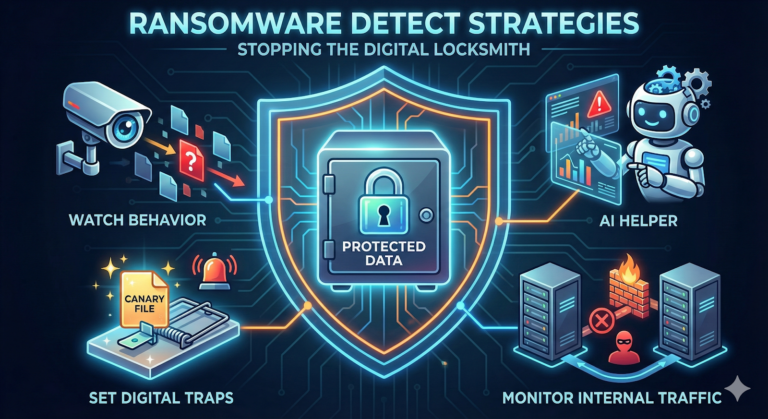
The best way to trap ransomware is to understand what “normal” looks like. If the average user typically views five documents on their computer each day, and then tries to view and modify 5,000 files in three minutes, it would raise a gigantic red flag.
“Modern solutions” (or “EDR” for “Endpoint Detection and Response”), in the style of the smart security camera, doesn’t just record activity; it “thinks” and asks questions. “Why is the accountant’s computer trying to connect with the server in a different country at midnight?” By identifying these “weird” patterns early, we can “unplug” the compromised computer before the virtual locks are changed.
2. Setting “Digital Mouse”
One of the most sly methods for catching a burglar is described as “Deception Technology.” One way of thinking of this might be as follows: Imagine setting up an empty box made of shiny material inside an empty room and labeling it as “jewels.”
“In a computer network, we use these ‘Canary Files’ or ‘Honeypots.’ We set up a file with Company_Passwords_2025.txt or Private_Bank_Details.xlsx. Nobody in our company needs anything to do with these files. As soon as anyone or anything tries to glance at these files, an alarm starts sounding immediately. This alerts us exactly where the attacker is without them realizing we are on to them.”
3. East-West Traffic Observation
The main emphasis of the security measures is on the “North-South” traffic (internet incoming data or outgoing data). However, ransomware has a virus-like nature that aims at replication. Its entry in a particular computer translates to the aim to move to the next computer sitting next to it. Lateral movement is the process.
If we observe the “hallways” in our own network, it becomes clear if the computer is attempting to “whisper” to other computers it shouldn’t be communicating with. If the printer begins to attempt to “log in” to the CEO’s laptop, there’s obviously a problem.
4. What the Experts are Saying (Web Reports)
The following are recent findings from the biggest names in the security industry that show why these protective detection methods are vital:
The Clock is Ticking:
“A report by the Google Mandiant team showed attackers have been able to move much quicker. They can take control of a whole network in less than 10 days in most cases. This means our detection systems need to be operating 24/7.”
The Human Element:
The Verizon Data Breach Report also tells us that most attacks or “break-ins” involve this simple trick: email (phishing). Detection tactics have to address people who now have “super-user” powers who didn’t yesterday.
“The Cost of Waiting”:
IBM research indicates that firms employing intelligent, automated tools for discovering attacks incur approximately $1.76 million less in losses than firms that do all their tasks manually. Waiting, it appears, costs millions of dollars.
5. Leveraging AI as a Helper
We produce so much information daily that it cannot be viewed by a human being. It is where Artificial Intelligence (AI) steps in. You can think of AI as an endless security officer who has memorized the activities of every employee.
“If the computer begins to act only 1% out of the ordinary, the AI program can point out the computer to the human to examine. The job doesn’t replace the human; it only provides the “Neighborhood Watch” with a high-powered telescope.”
Conclusion
Staying One Step Ahead
What is so frightening about ransomware is that it is invisible until it is too late. What gives us power over this is to simply utilize some methods of detection—to look for strange activity, set traps, and track our internal flow of data. We do not have to be smarter than someone trying to pick our locks; we simply have to be quicker.
References
[1] Mandiant (Google Cloud), “M-Trends 2024: Special Report on Cybersecurity Trends,” Google LLC, Mountain View, CA, USA, Tech. Rep., Apr. 2024. [Online].
Available: https://www.mandiant.com/resources/reports/m-trends-2024
[2] Verizon, “2024 Data Breach Investigations Report (DBIR),” Verizon Communications Inc., New York, NY, USA, Tech. Rep., May 2024. [Online].
Available: https://www.verizon.com/business/resources/reports/dbir/
[3] Sophos, “The State of Ransomware 2024,” Sophos Ltd., Abingdon, UK, White Paper, Apr. 2024. [Online].
Available: https://assets.sophos.com/X24WTUEQ/at/c949g7633gr659g939d39/sophos-state-of-ransomware-2024-wp.pdf
[4] IBM Security, “Cost of a Data Breach Report 2023,” IBM Corporation, Armonk, NY, USA, Tech. Rep., Jul. 2023. [Online].
Available: https://www.ibm.com/reports/data-breach
FAQs
Q1. How can students learn ransomware detection basics?
Colleges teach Ransomware Detection by identifying unusual file activity and blocking threats before damage begins, preventing network misuse through Lateral Movement awareness.
Q2. What is the biggest sign of ransomware on a campus system?
A spike in encrypted files or mass edits is a key Ransomware Detection alert, especially if paired with unauthorized internal spread via Lateral Movement across devices.
Q3. How does lateral movement connect to ransomware attacks?
Ransomware spreads internally using Lateral Movement, so monitoring internal traffic is essential for Ransomware Detection and stopping rapid network compromise.
Q4. Which tools help detect ransomware movement early?
EDR and anomaly tracking support Ransomware Detection by spotting odd internal communication caused by Lateral Movement, enabling early isolation of infected endpoints.
Q5. Why do colleges need 24/7 ransomware detection systems?
Digital campuses produce huge data. Continuous Ransomware Detection helps block identity misuse and internal spread caused by Lateral Movement threats.
Q6. Can student networks track lateral movement without experts?
Students can learn to observe internal spread signs, but serious Lateral Movement risks still need SOC support alongside trained Ransomware Detection frameworks.
Q7. Does ransomware detection training improve cybersecurity culture?
Yes. Training strengthens Ransomware Detection knowledge and helps students understand internal risks like Lateral Movement, building proactive cyber safety habits.
Q8. What happens if lateral movement is ignored in campus security?
Ignoring Lateral Movement allows ransomware to replicate silently. That weakens Ransomware Detection success and delays response, increasing impact.
Q9. How should colleges respond to lateral movement alerts?
By isolating devices instantly, reviewing internal traffic, and applying strict Ransomware Detection steps to block unauthorized Lateral Movement across the network.
Q10. What is the future of ransomware detection in Indian campuses?
AI analytics, 24/7 monitoring, and behavioral tracking will enhance Ransomware Detection and stop identity misuse and ransomware spread via Lateral Movement faster.
Penned by Tushar
Edited by Pranjali, Research Analyst
For any feedback mail us at [email protected]
Transform Your Brand's Engagement with India's Youth
Drive massive brand engagement with 10 million+ college students across 3,000+ premier institutions, both online and offline. EvePaper is India’s leading youth marketing consultancy, connecting brands with the next generation of consumers through innovative, engagement-driven campaigns. Know More.
Mail us at [email protected]