
From Protectionism to Partnership: How India’s Trade Policy Has Transformed Under Modi
Published: June 21, 2026
Key Strategy Takeaways
- Shift from protectionism to strategic global partnerships.
- Focus on boosting manufacturing through Make in India and Atmanirbhar Bharat.
- Use trade agreements to increase exports and attract investment.
- Expand India's influence and competitiveness in the global economy.
How India Changed Its Global Trade Approach in Recent Years
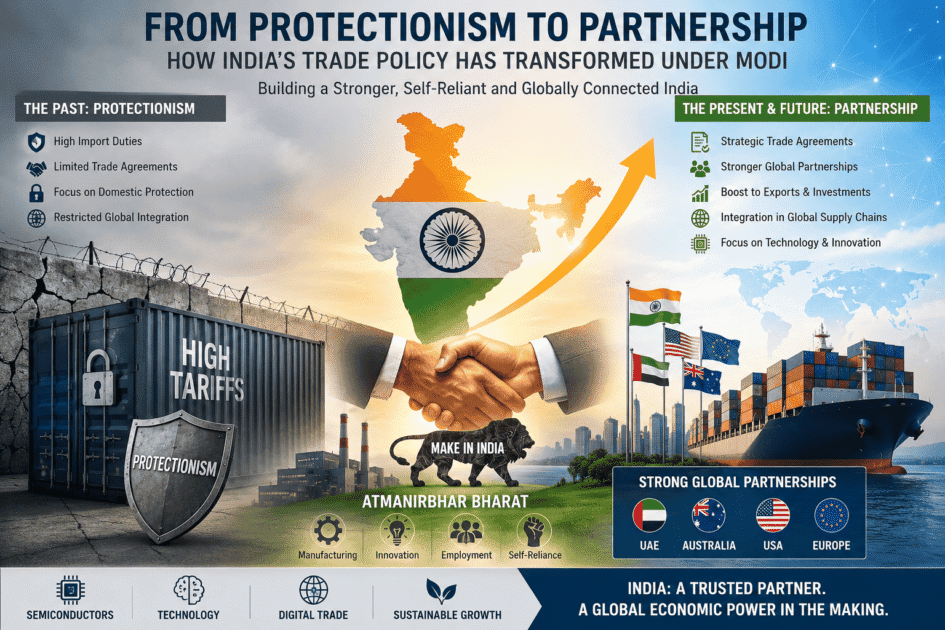
India’s trade policy has changed a lot during the last decade. In the past the country was usually seen as more protective of its domestic industries and careful while making international trade agreements. The focus was mainly on protecting local businesses from foreign competition. But things have changed slowly under PM Modi’s government, and India is now focusing more on trade partnership with fellow countries rather than only protecting local markets.
India has also done trade agreements with different countries. These deals are helping India to increase their exports, attract investments, and improve business partnerships with other countries. India is also becoming a stronger manufacturing and supply chain partner globally, rather than depending more on imports. Most of the time, India followed policies that mainly focused on protecting domestic industries. Import taxes on foreign goods were very high, and the government remained careful about opening markets too quickly. The idea behind this strategy was as simple as to localise businesses and industries that needed protection from strong international competition.
After Narendra Modi Ji became Prime Minister in 2014, India slowly started changing its trade and investment plans. Campaigns like Make in India or Made in India focused on improving manufacturing, grow foreign investment, and increasing exports, and Atmanirbhar Bharat focused on supporting local industries at the same time improved international trade relations. India also focused more on semiconductor production and technology partnerships with the Netherlands and Australia.
India also started making stronger economic relationships with the UAE, Australia, the United States, and European nations. Trade deals and business partnerships are becoming important in India’s global economic plans. This shows that India’s policy shift was not completely about free trade or complete protectionism. Instead, it became a mix of economic security and global cooperation. India’s economic relationship with Australia has become better over time.
India is becoming a topic of big discussions related to technology, manufacturing, semiconductors, and digital trade. Global Leaders believe that global companies now see India as an important economic partner because of its growing market and manufacturing potential.
Honestly, trade policy is now discussed much more openly in India than before. This government is focusing more on exports, investment, manufacturing growth, and international economic support, and trying to protect domestic industries.
Many people still have mixed opinions about these trade changes, but India is planning to grow its role in global trade and investment partnerships, some challenges are still there. India’s changing trade strategy is helping the country become a more active and influential player in the global economy.
Frequently Asked Questions
What was India’s traditional trade policy?
India mainly focused on protecting domestic industries through higher import duties and cautious trade agreements.
What is the goal of Make in India?
To boost manufacturing, attract investment, and increase exports.
Has “Indian protectionism” been completely abondoned under Modi?
No. India continues to protect certain strategic sectors while simultaneously expanding trade partnerships and global economic cooperation.
Why are trade agreements important for India?
They help increase exports, attract foreign investment, and improve economic cooperation.
How is India strengthening its manufacturing sector?How is India strengthening its manufacturing sector?
By encouraging investment, improving infrastructure, and promoting local production.
Why is India focusing on semiconductors and technology trade policy?
To become a key player in advanced industries and global supply chains while strengthening India protectionism in critical sectors.
Is India following complete free trade policy?
No, India follows a balanced approach that combines global cooperation with protection of strategic domestic sectors.
Which countries have become important trade partners for India?
Australia, the UAE, the United States, and several European countries.
What is Atmanirbhar Bharat in the context of trade policy?
A policy initiative aimed at strengthening domestic industries and reducing strategic dependencies which is central to India protectionism and self-reliant trade policy.
What is the long-term vision of India’s trade policy strategy?
To make India a major global economic, manufacturing, and investment hub.
What makes India an attractive trade partner under its current trade policy?
Its large market, skilled workforce, growing economy, and manufacturing potential, backed by a balanced trade policy with India protectionism.
Citations & References
1. Articles related to India’s trade policy and global partnerships
2. Reports on Make in India and Atmanirbhar Bharat
3. Research studies on international trade agreements
4. Economic and business news related to India’s foreign trade
Transform your brand
Drive massive brand engagement with over 10 million college students across 3,000+ premier institutions, both online and offline. EvePaper is India’s leading youth marketing consultancy, connecting brands with the next generation of consumers through innovative, engagement-driven campaigns.
Mail us at: [email protected]
Connect Your Brand with Gen-Z
Unlock high-impact youth marketing strategies with EvePaper.
Book Strategy Call