
From ₹686 Crore to ₹23,622 Crore: The Staggering Rise of India’s Defense Exports and What It Means for Investors
Published: June 22, 2026
Key Strategy Takeaways
- India's defense export growth demonstrates the long-term impact of consistent policy support and strategic self-reliance initiatives.
- Atmanirbhar Bharat and Make in India have transformed India from a major defense importer into an emerging global exporter.
- Export diversification across more than 85 countries reduces dependence on a few buyers and strengthens geopolitical relationships.
- High-value indigenous platforms such as BrahMos, Tejas, and advanced artillery systems are becoming key drivers of export growth.
- Increasing private-sector participation alongside public-sector defense companies is accelerating innovation and production capacity.
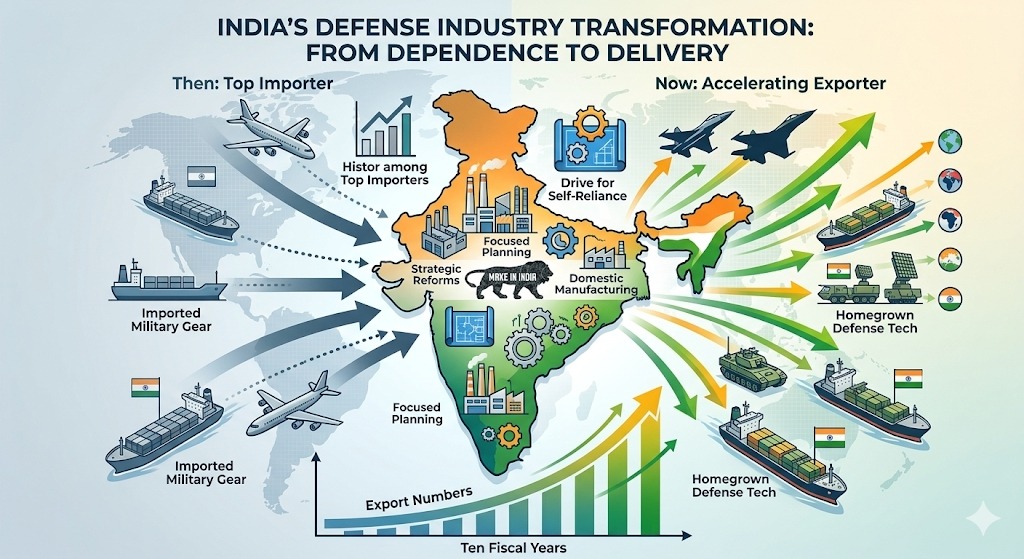
India’s defense exports have witnessed a staggering
I. Introduction :
Once known mainly for buying weapons, India now ships them abroad at an accelerating pace. Top buyer just years ago, it stood firmly among the planet’s five largest importers of military gear. A national drive toward self-reliance quietly changed that course. Fuelled by strategic reforms, export numbers leapt more than thirtyfold across ten fiscal years. Domestic factories began delivering advanced systems while foreign governments started placing orders. What was once an imbalance has turned into outbound reach – equipment made here now lands on distant shores. Growth did not happen overnight; steady investment and focused planning laid the groundwork. Confidence in homegrown tech rose alongside global interest. From dependence to delivery, the pattern reversed step by deliberate step.
II. Policy Drivers: Atmanirbharta and Make in India :
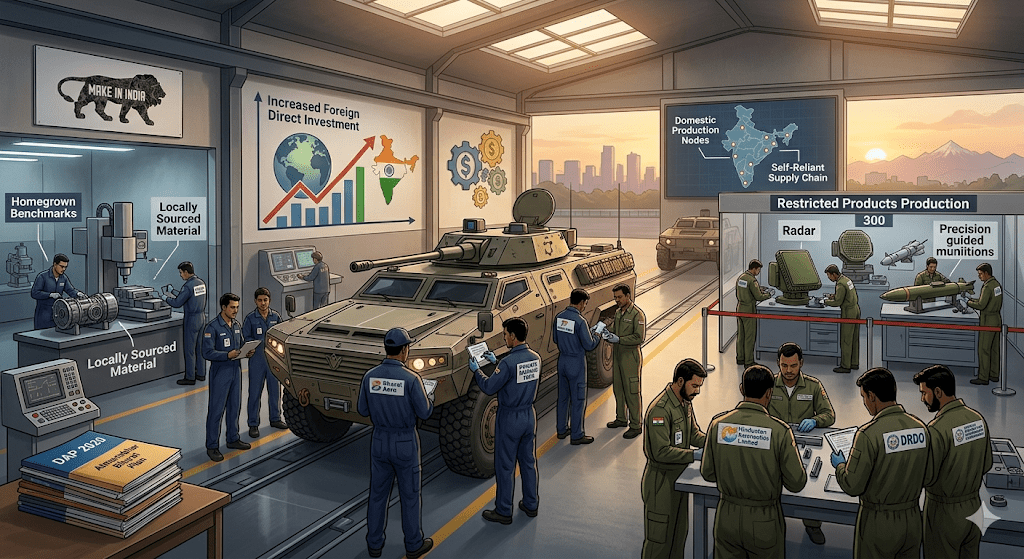
Starting fresh, the Atmanirbhar plan took shape via DAP 2020, setting homegrown benchmarks for every type of purchase. Local material rules became mandatory, more than three hundred military products were moved to a restricted list so they’d be made locally instead, while foreign ownership limits jumped to 74%, approved without special permission. Because of these shifts, private companies began operating on more even ground compared to state-run defense units. A new balance emerged where both could take part in building defences at home.
III. Export Landscape and Key Platforms :
Over eighty-five countries now receive Indian-made military gear. Advanced light choppers head the list, along with big guns used in field battles. Small navy ships built for coastal watch duties also ship out regularly. Rocket launcher units that fire in rapid bursts are another top item moving overseas. Electronic tools designed to jam enemy signals form part of the mix too. Among buyers, Armenia stands out, alongside island neighbours like Mauritius and Sri Lanka. Southeast Asian partners make up a large chunk of ongoing deals. A homegrown combat plane called HAL Tejas plays an important role abroad. So does a lightning-fast cruise missile named BrahMos. That missile reached its first foreign customer – the Philippines – just two years ago.
IV. Investor Implications :
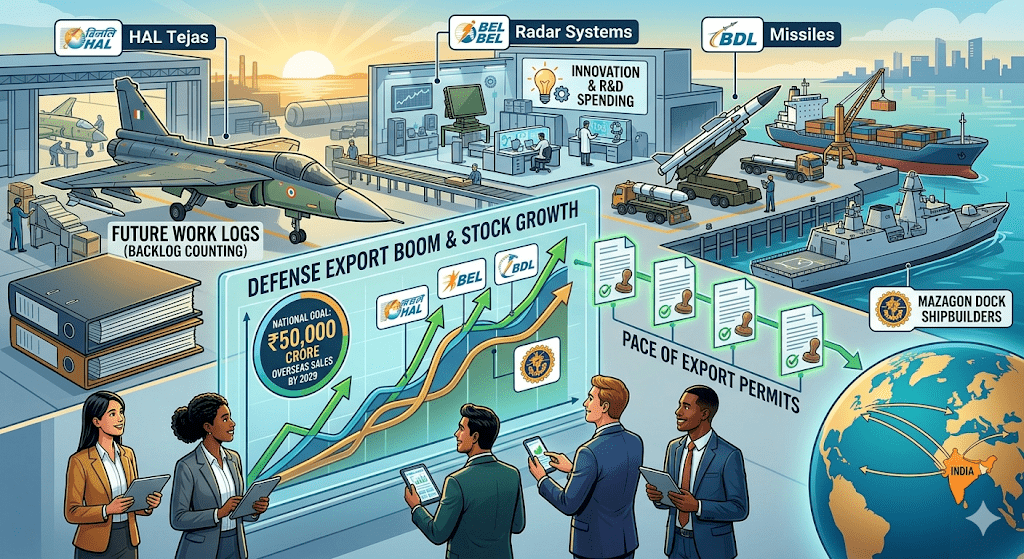
Boom times in defense exports are opening solid doors for stock market participants. Firms like HAL, BEL, BDL, along with Mazagon Dock Shipbuilders, have seen clear upward shifts in value lately. Backing this rise is a national goal – hitting ₹50,000 crore in overseas military sales before 2029 rolls around. Watching how full their future work logs appear matters now more than ever. So does tracking spending on innovation. Then there’s the pace at which export permits get cleared – another quiet but strong signal shaping worth. Growth here isn’t just expected – it’s being built step by deliberate step.
V. Conclusion :
India’s defense exports are now a fact, not wishful thinking. Thanks to self-reliance goals, rising homegrown tech skills, and shifting global alliances, India stands as a trusted arms provider worldwide. Investors see steady government backing, multi-year deals, and deep-rooted expansion here – this space holds strong promise across the coming years.
Key takeaways :
- From just ₹686 crore, India’s defence sales abroad jumped sharply – to hit ₹23,622 crore. A clear shift marks this rise – driven by changing roles on global stages.
- Now building its own weapons, India once bought most of its military gear abroad. Today, nations elsewhere are buying Indian-made systems instead. A quiet shift happened over years, not overnight. Equipment tested at home now travels overseas. From reliance on others, New Delhi sends hardware abroad. This turn caught few by surprise – yet changed how militaries see South Asia.
- Private firms got more involved because of stronger local production demands along with greater overseas funding – now allowed up to 74 percent.
- From India, military gear reaches more than eighty-five nations. Helicopters fly out alongside missiles, some heading west, others south. Warships leave ports bound for distant coasts. Missile systems move too, piece by piece. Trade grows, quietly, without fanfare.
- Missiles like BrahMos lead India’s arms exports, followed by the HAL Tejas fighter jet – artillery systems also make up a big part of overseas military sales.
- From far-off places such as Armenia to island nations like Sri Lanka, governments have turned to India for military hardware. Some Southeast Asian states, including the Philippines, rely on New Delhi’s arms industry. Island democracies in the Indian Ocean, say Mauritius, also place orders regularly. These nations find value in what Indian defense makers offer. Distance does not stop them from building strong procurement ties.
- Fresh interest flows into firms such as HAL, BEL, BDL – Mazagon Dock, among them, as stability draws capital their way. While not every player grabs headlines, steady progress keeps wallets turning toward these names. Quiet momentum builds where contracts meet reliability, pulling attention without fanfare.
- By 2028–29, India aims to reach ₹50,000 crore in defence exports – a goal that pushes beyond past performance. Reaching it means building more at home while finding buyers abroad. Progress will depend on steady production, smart partnerships, and consistent quality. Each year adds pressure to deliver results faster than before.
Thanks to backing from officials and rising interest overseas, selling military gear abroad is turning into a solid bet over time. Though it moves slowly, the path forward seems steady when you look at who’s buying and what’s being made. With policies shifting in favor of trade, companies in this space find more room to grow than before. Not flashy, yet consistent, the sector draws attention without loud promises. What once seemed niche now holds weight across years, not just seasons.
Frequently asked questions :-
1. What are defense exports?
Defense exports refer to the sale of military equipment, weapons systems, aircraft, missiles, naval vessels, and related technologies from one country to another.
2. How much have India’s defense exports grown in recent years?
India’s defense exports have increased from around ₹686 crore to ₹23,622 crore over the past decade, making the country one of the fastest-growing defense exporters in the world.
Citations & References
- [1] Ministry of Defence, Government of India, “Annual Report 2023–2024,” New Delhi, 2024.
- [2] Stockholm International Peace Research Institute (SIPRI), “Trends in International Arms Transfers,” SIPRI Fact Sheet, 2024.
- [3] Defence Research and Development Organisation (DRDO), “Export Achievements,” New Delhi, 2023.
- [4] Bharat Electronics Limited, “Annual Report 2023–2024,” Bangalore, 2024.
- [5] Department for Promotion of Industry and Internal Trade (DPIIT), “Foreign Direct Investment Statistics,” New Delhi, 2024
Connect Your Brand with Gen-Z
Unlock high-impact youth marketing strategies with EvePaper.
Book Strategy Call