
3D Printed Reactionware and the Future of Laboratory Chemistry
Published: June 22, 2026
Key Strategy Takeaways
- 3D Printed Reactionware helps laboratories create customized equipment quickly and affordably.
- Additive Manufacturing reduces waste and production costs.
- Scientists can improve research efficiency using customized laboratory tools.
- The technology supports innovation in chemistry, medicine, and education.
- 3D Printed Reactionware has strong future potential despite current limitations.
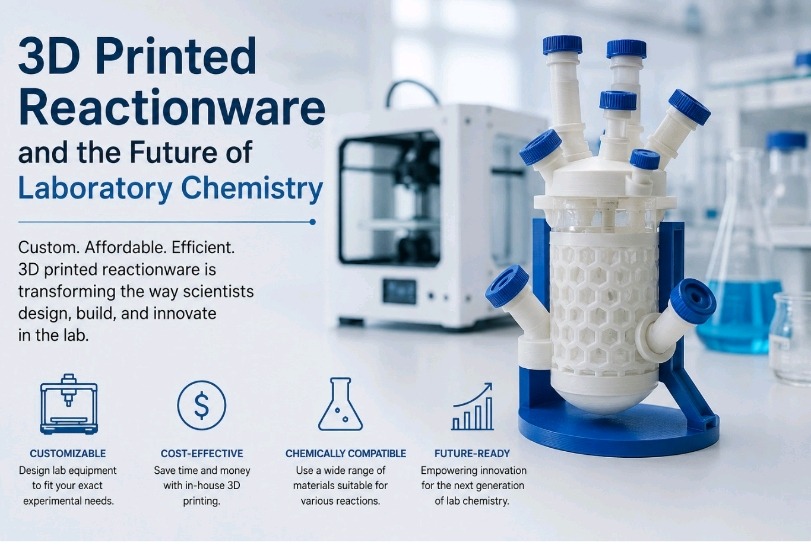
“3D Printed Reactionware is transforming laboratory chemistry through innovative Additive Manufacturing solutions.”
Science and technology are enhanced very fast in this time and laboratories are also changing with new inventions. One important innovation is 3D Printed chemical equipment. This technology is helping scientists make laboratory equipment faster, cheaper, and easier than before because technology improving.
3D Printed is made using engaging Manufacturing a process where objects are made layer by layer with the help of a 3D printer Instead of buying expensive laboratory tools scientists can now print customized equipment according to their needs.
1. What is 3D Printed Reaction ware?
Reaction ware is equipment used in laboratories to perform chemical reactions. Before laboratories mostly used glass containers and traditional tools. But now with 3D printing technology, scientists can create special reaction devices in different shapes and sizes.
These printed tools can help in mixing chemicals, controlling reactions, and improving experiment results. The best part is that they can be designed quickly on a computer and printed within a short time.
2. Role of Additive Manufacturing
Additive Manufacturing is becoming very useful in laboratory chemistry. It helps reduce waste because only the needed material is used during printing so that’s why it reduces wastage. Traditional manufacturing methods often waste extra material and take more time.
With this technology, laboratories can:
Make custom laboratory equipment
Reduce production cost
Save time
Improve experiment accuracy
Test new designs easily
Because of these benefits several researchers are showing interest in 3D printing technology.
3. Benefits of 3D Printed Reaction ware
One major advantage of 3D Printed Reaction ware is low cost. Small laboratories and colleges can create useful equipment without spending too much money and which help the country.
Another benefit is also had that is adaptability. Scientists can change the design whenever needed and print a new version fast. This helps researchers perform experiments more efficiently.
The technology is also useful because printed devices are lightweight and easy to carry.
4. Problem of This Technology
Even though 3D Printing technology is growing very fast there are still some problems. Some 3D printed materials may not handle strong chemicals or high temperatures properly.
Advanced 3D printers can also be expensive for smaller laboratories. In some cases, printed equipment may not be as strong as traditional laboratory tools
5. Future of Laboratory Chemistry
Experts believe that 3D Printed chemical research equipment will become more popular in the future. Labs might start printing Personalized equipment instead of buying expensive ready-made products.
This technology helps scientific research and medicine and education by making laboratory work faster and more affordable.
CONCLUSION
3D Printed Reaction ware is changing the future of laboratory chemistry. With the help of Additive Manufacturing, scientists can create low-cost and customized laboratory equipment easily. Although there are some challenges, this technology has the potential to improve scientific research and make laboratory work more efficient in the coming year.
Frequently Asked Questions
1. What is 3D Printed Reactionware?
3D Printed Reactionware refers to laboratory equipment created using 3D printing technology to perform chemical reactions and experiments.
2. How does 3D Printed Reactionware help scientists?
It helps scientists create customized laboratory equipment quickly, efficiently, and at a lower cost than traditional manufacturing methods.
3. What is Additive Manufacturing?
Additive Manufacturing is a production process in which objects are created layer by layer using a 3D printer.
4. Why is Additive Manufacturing important in laboratory chemistry?
It reduces material waste, lowers production costs, and allows laboratories to create customized equipment for specific experiments.
5. What are the main benefits of 3D Printed Reactionware?
The main benefits include cost savings, customization, faster production, reduced waste, and improved research efficiency.
6. Can 3D Printed Reactionware replace traditional laboratory equipment?
While it can replace some laboratory tools, traditional equipment is still needed for certain complex and high-temperature applications.
7. What materials are commonly used in 3D Printed Reactionware?
Various plastics, polymers, and specialized chemical-resistant materials are commonly used depending on the laboratory requirements.
8. What challenges does 3D Printed Reactionware face?
Challenges include material limitations, equipment durability concerns, and the high cost of advanced 3D printers.
9. Which industries can benefit from 3D Printed Reactionware?
Research laboratories, pharmaceutical companies, educational institutions, and chemical industries can benefit from this technology.
10. What is the future of 3D Printed Reactionware in laboratory chemistry?
Experts believe it will become increasingly popular, enabling laboratories to produce affordable, customized, and efficient equipment for scientific research.
To learn more about research and innovation trends, visit EvePaper https://evepaper.com
Citations & References
Research articles on Additive Manufacturing and laboratory chemistry.
Scientific publications related to 3D printing technology.
Industry reports on 3D Printed Reactionware applications.
TRANSFORM YOUR BRAND’S ENGAGEMENT WITH INDIA’S YOUTH
Drive massive brand engagement with 10 million+ college students across 3,000+ premier institutions, both online and offline. EvePaper is India’s leading youth marketing consultancy, connecting brands with the next generation of consumers through innovative, engagement-driven campaigns. Know More.
Mail us at [email protected]
Connect Your Brand with Gen-Z
Unlock high-impact youth marketing strategies with EvePaper.
Book Strategy Call