
Reciprocal Tariff Reduction on Indian Goods
Published: August 31, 2026
Key Strategy Takeaways
- Focus on export markets where reciprocal tariff reductions provide the greatest price advantage.
- Adjust pricing strategies to pass part of the tariff savings to customers while maintaining profitability.
- Strengthen branding and product quality to improve competitiveness in international markets.
- Target high-demand product categories that benefit most from lower tariffs.
- Expand distribution channels and partnerships in countries with favorable trade agreements.
- Promote "Made in India" products through digital marketing and trade fairs.
- Continuously monitor changes in trade policies and competitor pricing.
- Diversify export destinations to reduce dependence on a single market.
- Ensure compliance with international quality and regulatory standards to maximize market access.
- Leverage government export promotion schemes to support global expansion.
Introduction
ky Reciprocal Tariff Reduction on Indian Goods is a trade policy Reciprocal Tariff Reduction on Indian Goods is a trade policy that reduces import duties between partner countries, helping Indian exporters compete globally. that helps reduce import tariffs between countries, making Indian products more competitive in global markets. This policy lowers export costs, increases trade opportunities, and supports economic growth by improving market access for Indian businesses.
The trade dynamics between India and United States have undergone a significant transformation, evolving from a period of high tariff escalations in mid-2025 toward a structured interim trade agreement framework in early 2026. This strategic de-escalation aims to stabilize economic relations and safeguard crucial export industries.
ky Reciprocal Tariff Reduction on Indian Goods is a trade policy that reduces import duties between partner countries, helping Indian exporters compete globally.
1. From 50% Duties to Strategic De-escalation
For several months in late 2025, Indian exporters were confronted with unprecedented tariff barriers in the U.S. market. The initial friction commenced in mid-2025 when the United States implemented a 25% reciprocal tariff on Indian exports.
The Escalation Peak
Trade tensions escalated significantly in August 2025 when Washington imposed an additional 25% penalty tariff linked to India’s continued procurement of discounted Russian crude oil. This secondary duty pushed cumulative tariffs on a variety of Indian goods up to nearly 50%. It severely impaired price competitiveness.
ky Reciprocal Tariff Reduction on Indian Good
The Interim Accord
In February 2026, bilateral talks between Indian Prime Minister and U.S. President resulted in a formal interim trade agreement framework. Under the terms , Washington immediately suspended the 25% Russian oill related penalty tariff and agreed to reduce its reciprocal tariff on Indian goods from 25% down to 18%.
2. Sectoral Impact and Market Competitiveness
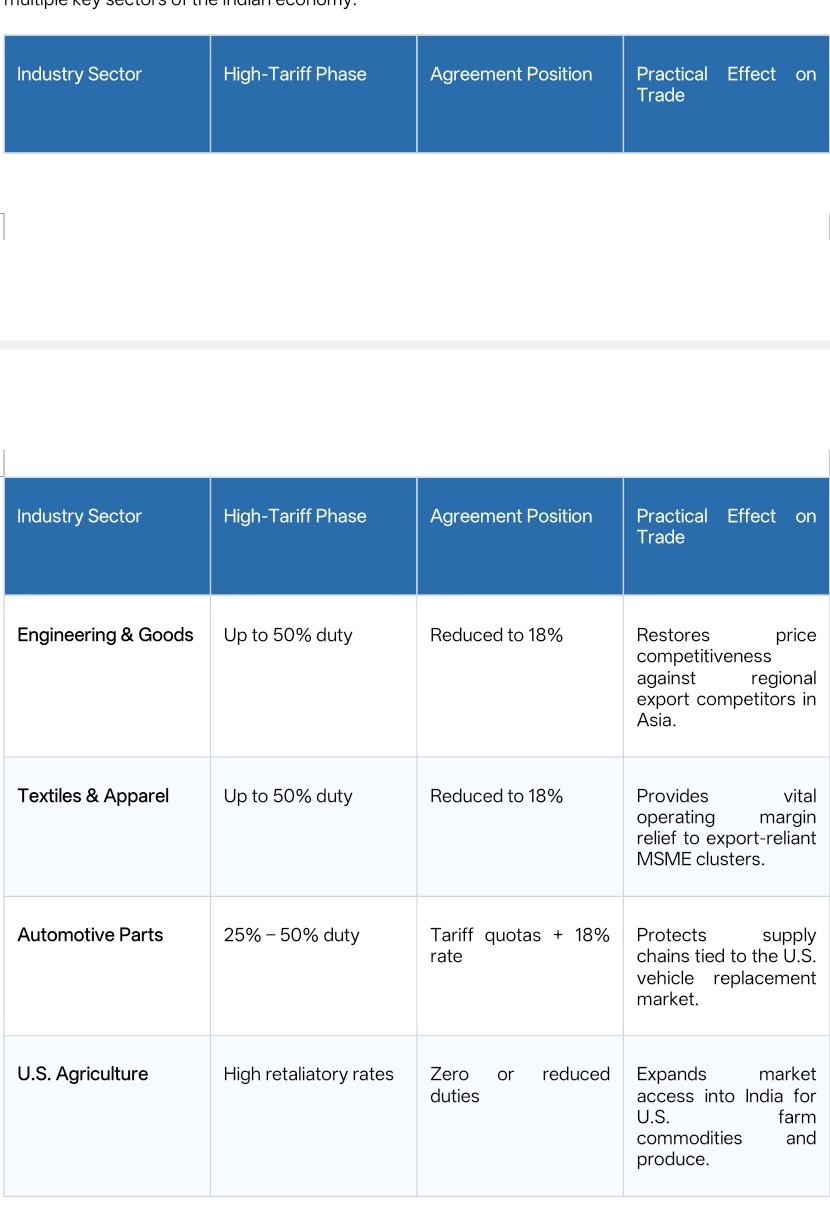
The reduction of effective tariffs from a peak of 50% down to 18% provides substantial relief across multiple key sectors of the Indian economy.
Businesses benefit from ky Reciprocal Tariff Reduction on Indian Goods by increasing sales and expanding into new countries.
3. Future Outlook
The regulatory landscape surrounding bilateral commerce remains in transition as negotiations continue toward a formal, treaty backed Bilateral Trade Agreement (BTA).
Next Steps Toward a Bilateral Trade Agreement (BTA)
Negotiators from both countries are addressing non-tariff barriers, digital economy regulations and stringent rules of origin.
ky Reciprocal Tariff Reduction on Indian Goods refers to mutual tariff cuts that promote trade and boost exports.
Conclusion
The 2026 U.S.-India interim trade agreement demonstrates that economic interdependence can be sustained through strategic negotiation rather than prolonged tariff escalation. By replacing uncertainty with structured ky tariff reductions, both nations have laid the groundwork for long-term economic partnership.
ky Reciprocal Tariff Reduction on Indian Goods strengthens India’s export competitiveness and supports long-term economic growth.Key Takeaways
Substantial Tariff Rollback: Total effective U.S. tariffs on Indian exports decreased from nearly 50% to 18%, following the suspension of the 25% Russian oil penalty tariff .
Sectoral Relief: Labor-intensive export industries including textiles, footwear, apparel, and engineering goods, acheived price competitiveness in North American markets.
Long-Term Strategic Alignment: Both nations continue negotiations toward a formal Bilateral Trade Agreement (BTA) to address non-tariff barriers and digital trade frameworks.
References
Thompson Hine SmarTrade: Overview of U.S.-India Interim Trade Agreement & IEEPA Tariff Updates
KPMG Corporate Services Report: U.S. Tariff Shifts & Bilateral Implications for Indian Exports
Drishti IAS Trade Analysis: India–US Trade Deal 2026 & Sectoral Impact Assessment
Frequently Asked Questions
What is a reciprocal tariff reduction?
It is a mutual agreement where two countries reduce import tariffs on each other’s goods.
How does tariff reduction benefit Indian exporters?
It lowers export costs and improves price competitiveness.
Which sectors benefit the most from tariff reductions?
Manufacturing, textiles, agriculture, pharmaceuticals, and automotive sectors
Does reciprocal tariff reduction increase exports?
Yes, lower tariffs generally encourage higher export volumes.
How does it affect product pricing?
Reduced tariffs can lower final prices for international buyers.
What is the impact on consumers?
Consumers gain access to more affordable imported and exported products.
Can small businesses benefit from tariff reductions?
Yes, they gain easier access to international markets at lower costs.
Are there any challenges despite tariff reductions?
Yes, businesses still face quality, logistics, and regulatory compliance requirements.
Citations & References
Thompson Hine SmarTrade: Overview of U.S.-India Interim Trade Agreement & IEEPA Tariff Updates
https://www.wto.org/
KPMG Corporate Services Report: U.S. Tariff Shifts & Bilateral Implications for Indian Exports
Drishti IAS Trade Analysis: India–US Trade Deal 2026 & Sectoral Impact Assessment
Drive massive brand engagement with 10 million+ college students across 3,000+ premier institutions, both online and offline. EvePaper is India’s leading youth marketing consultancy, connecting brands with the next generation of consumers through innovative, engagement-driven campaigns. Know More.
Mail us at [email protected]
Connect Your Brand with Gen-Z
Unlock high-impact youth marketing strategies with EvePaper.
Book Strategy Call