
5 Winning Secrets of Study Environment for Powerful Focus Improvement in 2026
Published: August 30, 2026
Key Strategy Takeaways
- Create a dedicated study environment that signals your brain that it is time to learn and focus.
- Keep your study area minimal by removing unnecessary gadgets, gaming devices, and other distractions.
- Manage digital distractions by disabling notifications, using website blockers, and keeping your phone away while studying.
- Optimize lighting and posture by using natural light where possible and maintaining a comfortable desk and chair setup.
- Control background sounds by choosing silence or consistent white noise and avoiding music with distracting lyrics.
- Use visual cues such as goals, formulas, and progress trackers to stay motivated and focused.
- Make technology work for you by using online mock tests, AI-powered resources, and educational portals without letting them become sources of distraction.
- Review your study environment regularly and remove anything that negatively affects your concentration.
- Focus on consistency rather than expensive equipment—an effective study environment depends more on organization and distraction control than fancy furniture.
- Build better focus habits so that your environment supports longer, more productive study sessions and better exam preparation.
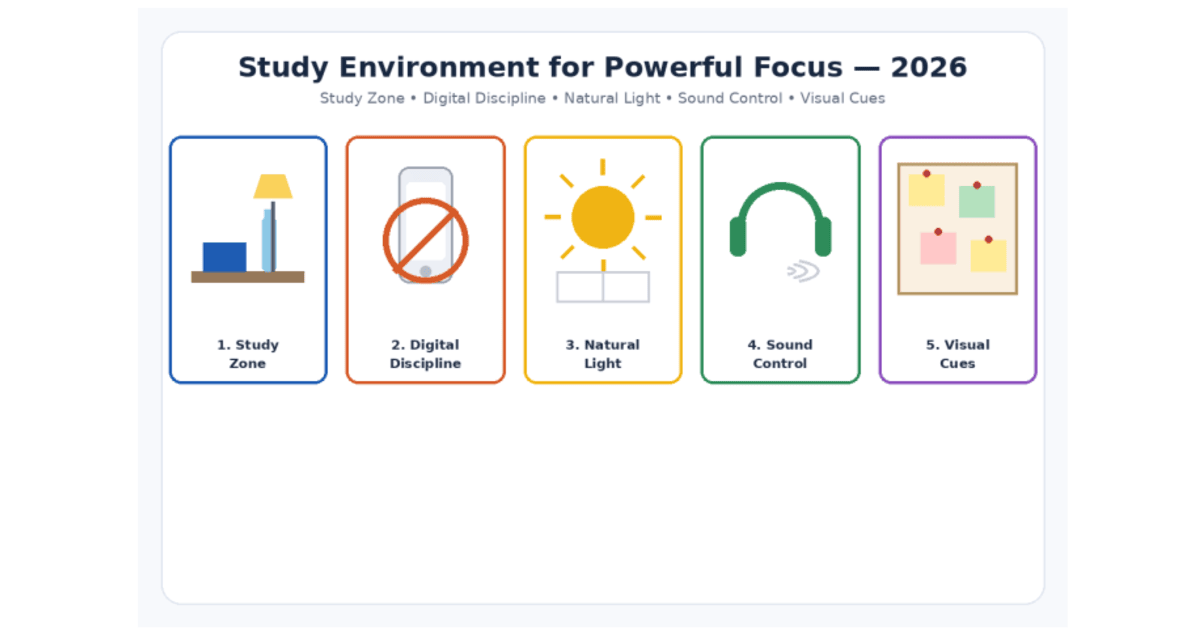
Key Strategy Takeaways
- Create a dedicated study environment that signals your brain that it is time to learn and focus.
- Keep your study area minimal by removing unnecessary gadgets, gaming devices, and other distractions.
- Manage digital distractions by disabling notifications, using website blockers, and keeping your phone away while studying.
- Optimize lighting and posture by using natural light where possible and maintaining a comfortable desk and chair setup.
- Control background sounds by choosing silence or consistent white noise and avoiding music with distracting lyrics.
- Use visual cues such as goals, formulas, and progress trackers to stay motivated and focused.
- Make technology work for you by using online mock tests, AI-powered resources, and educational portals without letting them become sources of distraction.
- Review your study environment regularly and remove anything that negatively affects your concentration.
- Focus on consistency rather than expensive equipment—an effective study environment depends more on organization and distraction control than fancy furniture.
- Build better focus habits so that your environment supports longer, more productive study sessions and better exam preparation.
Education in 2026 is witnessing a paradigm shift. With government practice portals, AI-integrated
mock tests, and digital NCERT resources, students from tier-2 and tier-3 towns have
unprecedented access to quality resources. However, many students find it challenging to
achieve the desired focus despite having easy access to resources. The trick lies in designing a
superior study environment.
Focus is not a function of resources alone; the study environment also plays a crucial role in
ascertaining a student’s performance. Here are 5 winning secrets of study environment for
powerful focus improvement for students.
1. Designate a Study Zone:
Students who try to study on a bed, sofa, or dining table confuse their brains into thinking that
studying is something they do everywhere. Instead, you need to set up a study zone so that your
brain identifies this particular space as a place solely for learning.
The study space should be minimalistic. Only keep the following items on the study table:
• Books & Notes
• Bottle of water
• Pen & Highlighter
• Laptop/Tablet (if required)
Avoid keeping video gaming consoles, unnecessary gadgets, and junk food nearby. Even a
small area in your room can become a study zone with minimal requirements.
2. Manage Digital Distractions:
Students using online mock tests, government practice portals, and other digital resources for
exam prep have to deal with an additional challenge of managing digital distractions.
Here is how students can optimize their focus improvement:
• Disable social media notifications and install website blockers.
• Keep mobile phones on silent mode and in another room.
• Only open relevant tabs for the subjects under study.Students must use technology only as an enabler for their preparation.AI-integrated practice resources can help students improve their scores substantially. However,
distractions undermine the benefits of such a useful tool.
3. Make the Most of Natural Light:
Natural light is the best source of illumination for students. If a student cannot access enough
natural light, he or she should use bright white light bulbs for the best results.
Students should also keep their chairs and desks at elbow level so that they do not have to strain
while sitting for long hours. Maintaining a healthy posture is essential to prevent back pain and
other ailments.
A healthy study environment is crucial if students want to optimize their long hours of NCERT
revisions, online practice tests, and mock exams.
4. Harness the Power of Sound:
Some students perform better when there is total silence, whereas some need ambient sounds
to get into the right mindset. Students can choose between total silence and soft music while
avoiding unpredictable noises like TV and chatter.
A good option would be to use either total silence or white noise to block out unwanted external
sounds. Students should also avoid music with lyrics, as it can derail one’s focus.
TV programmes and unanticipated sounds distract the brain from concentrating on studies.
Thus, a controlled sound environment can contribute significantly to focus improvement in
students.
5. Use Visual Cues to Stay Focused:
A well-furnished room with several objects can actually worsen a student’s performance. Instead,
students should use visual cues as a way of staying motivated and on task. A student can stick a
vision board on the wall with daily, weekly, and monthly goals.
Similarly, students can also stick relevant information on the wall, such as scores from online
practice tests, important formulae, and mock test performance stats.
This is one of the best focus improvement hacks for students who are preparing through online
resources and self-study.
Why Study Environment Matters Most in 2026?
In a year where access to information has become ubiquitous, the value of execution has grown
exponentially. The student who scores more in online mock tests, government portals, and
AI-integrated practice exams will improve his or her performance more than the competitor whoprepares through traditional methods.
Similarly, even among students who use the same online resources, the one who focuses better
will improve more than the others.
This is because the study environment plays a critical role in eliminating distractions, enabling
longer practice test sessions, and reducing stress.
It has been noticed time and again that students following proper digital study environments
achieve better results than their counterparts.
Thus, the study environment is a critical differentiator for students, especially those from tier-2
and tier-3 cities, who have to compete with students from premier institutes.
Conclusion:
A decent study environment is a must if students want to achieve their goals in the competitive
exam world of 2026. A superior study environment is not about fancy furniture but rather having a
dedicated space, managing digital distractions, and optimizing natural light. Students can also
use a visual system to stay motivated while practicing through online portals.
The students who master the art of focus management will eventually benefit in the long run.
References
[1] IBU, “Hidden Factors That Improve Your Study Environment,” IBU Blog, Apr. 2026. [Online]. Available:
https://ibu.ca/blog/hidden-factors-that-improve-your-study-environment/
[2] TechRxiv, “The Impact of Study Environment on Students’ Academic Performance: An Experimental
Research Study,” TechRxiv Preprint, 2023. [Online]. Available:
https://www.techrxiv.org/doi/10.36227/techrxiv.170250911.12566888
[3] Learn Do Grow, “How to Focus on Studying (and Actually Remember What You Learn),”
LearnDoGrow.org, May 2026. [Online]. Available:
https://www.learndogrow.org/post/how-to-focus-on-studying-and-actually-remember-what-you-learn
[4] Poemlafz, “50 Powerful Study Habits for Students in 2026,” Poemlafz.com, May 2026. [Online].
Available: https://poemlafz.com/50-powerful-study-habits-for-students-in-2026/
[5] Athenify, “Study Environment: Create the Perfect Space for Deep Focus,” Athenify.io. [Online].
Available: https://athenify.io/study-environment
[6] MDPI, “Environmental Conditions and Their Impact on Student Concentration and Learning in
University Environments: A Case Study of Education for Sustainability,” Sustainability, vol. 17, no. 3, p.
1071, Jan. 2025. [Online]. Available: https://www.mdpi.com/2071-1050/17/3/1071
Frequently Asked Questions
1. Why is a study environment important for students?
A well-organized study environment can reduce distractions, improve concentration, and help students maintain consistent study habits.
2. How can I create a good study environment at home?
Choose a quiet, dedicated area, keep your desk organized, remove unnecessary items, and ensure proper lighting and comfortable seating.
3. What should a good study environment include?
A good study environment should include essential books and notes, stationery, water, suitable lighting, and a comfortable desk and chair.
4. Can a study environment improve focus while studying?
Yes. A distraction-free space can make it easier to concentrate for longer periods and complete study tasks more efficiently.
5. How can I reduce digital distractions while studying?
Turn off unnecessary notifications, keep your phone away from your desk, use website blockers, and open only the tabs required for studying.
6. Is natural light useful in a study environment?
Natural light can make a study area more comfortable and reduce the need for artificial lighting during the day. If it is unavailable, use suitable indoor lighting.
7. Should I study in complete silence?
It depends on your preference. Some students concentrate better in silence, while others may prefer consistent background sounds such as white noise.
8. Is listening to music while studying a good idea?
Music can work for some students, but songs with lyrics may become distracting. If music affects your concentration, consider silence or white noise instead.
9. How can I make a small room suitable for studying?
You do not need a large room. A small, dedicated corner with a clean desk, proper lighting, and minimal distractions can work effectively.
10. Can visual cues help improve concentration?
Yes. Goal charts, study schedules, formulas, and progress trackers can remind students of their priorities and help them stay on task.
11. Does an organized study environment help with exam preparation?
An organized space can make study materials easier to access and reduce unnecessary interruptions, helping students maintain a more consistent preparation routine.
12. Do I need expensive furniture to create a good study environment?
No. A practical study space does not require expensive furniture. Organization, comfort, adequate lighting, and distraction control are more important.
13. How can I use technology without getting distracted?
Use technology only for relevant educational activities such as online practice tests, digital textbooks, and learning resources, while limiting access to entertainment apps.
14. How often should I change my study environment?
There is no fixed schedule. Review your study space whenever you notice recurring distractions, discomfort, or reduced productivity and make the necessary adjustments.
15. What is the best study environment for competitive exam preparation?
The best study environment is quiet, organized, comfortable, well-lit, and free from unnecessary digital and physical distractions. It should support focused and consistent preparation.
Citations & References
[1] IBU, “Hidden Factors That Improve Your Study Environment,” IBU Blog, Apr. 2026. [Online]. Available:
https://ibu.ca/blog/hidden-factors-that-improve-your-study-environment/
[2] TechRxiv, “The Impact of Study Environment on Students’ Academic Performance: An Experimental
Research Study,” TechRxiv Preprint, 2023. [Online]. Available:
https://www.techrxiv.org/doi/10.36227/techrxiv.170250911.12566888
[3] Learn Do Grow, “How to Focus on Studying (and Actually Remember What You Learn),”
LearnDoGrow.org, May 2026. [Online]. Available:
https://www.learndogrow.org/post/how-to-focus-on-studying-and-actually-remember-what-you-learn
[4] Poemlafz, “50 Powerful Study Habits for Students in 2026,” Poemlafz.com, May 2026. [Online].
Available: https://poemlafz.com/50-powerful-study-habits-for-students-in-2026/
[5] Athenify, “Study Environment: Create the Perfect Space for Deep Focus,” Athenify.io. [Online].
Available: https://athenify.io/study-environment
[6] MDPI, “Environmental Conditions and Their Impact on Student Concentration and Learning in
University Environments: A Case Study of Education for Sustainability,” Sustainability, vol. 17, no. 3, p.
1071, Jan. 2025. [Online]. Available: https://www.mdpi.com/2071-1050/17/3/1071
Know more
Connect Your Brand with Gen-Z
Unlock high-impact youth marketing strategies with EvePaper.
Book Strategy Call