Essential Scholarship Application Common Mistakes to Avoid
Published: August 30, 2026
Key Strategy Takeaways
- Carefully checking eligibility requirements can prevent students from spending time on applications they cannot qualify for.
- Following document requirements exactly helps avoid unnecessary disqualification over missing signatures, incorrect formats, or incomplete files.
- Meeting the correct deadline and submission requirements is essential because different programs may use different rules for receiving applications.
- A personalized essay that addresses the specific program can be more effective than a generic statement reused across multiple applications.
- Choosing recommenders who genuinely know your academic or professional work can lead to stronger recommendation letters.
- Providing recommenders with relevant information about your achievements and projects can help them write more detailed recommendations.
- Proofreading the complete application can catch grammar, formatting, and other errors before submission.
- Applying to fewer opportunities with carefully customized applications can be more effective than sending identical applications to many programs.
- A final review of eligibility, documents, essays, recommendations, and deadlines can help students avoid common scholarship application mistakes.
Key Strategy Takeaways
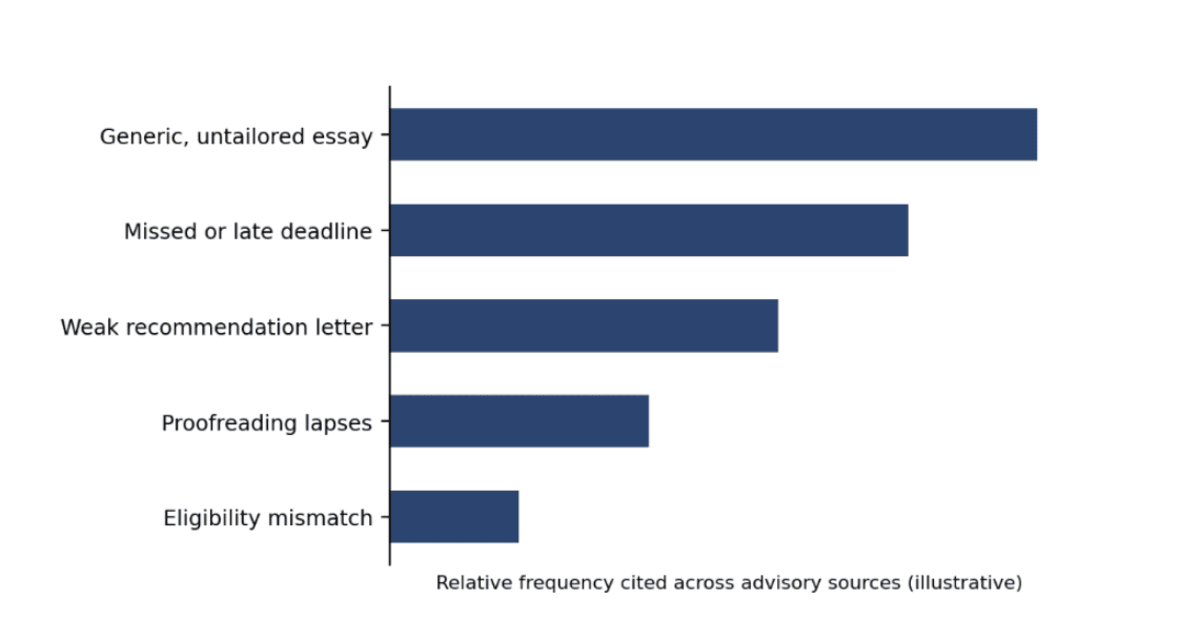
- Scholarship application mistakes can be avoided by checking eligibility, following deadlines, submitting correct documents, customizing essays, choosing strong recommenders, and proofreading the application carefully.
- Carefully checking eligibility requirements can prevent students from spending time on applications they cannot qualify for.
- Following document requirements exactly helps avoid unnecessary disqualification over missing signatures, incorrect formats, or incomplete files.
- Meeting the correct deadline and submission requirements is essential because different programs may use different rules for receiving applications.
- A personalized essay that addresses the specific program can be more effective than a generic statement reused across multiple applications.
- Choosing recommenders who genuinely know your academic or professional work can lead to stronger recommendation letters.
- Providing recommenders with relevant information about your achievements and projects can help them write more detailed recommendations.
- Proofreading the complete application can catch grammar, formatting, and other errors before submission.
- Applying to fewer opportunities with carefully customized applications can be more effective than sending identical applications to many programs.
- A final review of eligibility, documents, essays, recommendations, and deadlines can help students avoid common scholarship application mistakes.
I. IT IS RARELY ABOUT TALENT
Committees typically face massive loads of applications per cycle, from hundreds to thousands. This way, reviewers are constantly hunting for a justification to eliminate a candidate. A signature that is missing (if such has been required) or a certificate file submitted in the wrong format does exactly the trick; it is a disqualifier just like a poor academic transcript; no matter how much other parts of the profile could impress the committee, it would not outweigh these reasons.
II. DEADLINES AND ELIGIBILITY
One issue some programs face is that they do not give the arrival date but the postmark date. Others think that, for example, all pieces- transcripts, forms, letters- should be delivered at the time of sending; one delayed document that is an otherwise complete file is the only reason that an application would be rejected. In fact, most systems will automatically filter by GPA and major residence before any human being gets to see an essay; that is why going through the eligibility sections first is the only way you minimize the wasted effort.
III. THE GENERIC ESSAY PROBLEM
Reviewers see dozens of essays a month, and it would not surprise them if they were able to know if an essay had been written for their program or just copied from somewhere else, within two paragraphs. A detailed description of a given project or a decision will be more impressive than an all-around statement about wanting to help people. Usually, applying to a few schools really well is a smarter idea than sending out a lot of applications which are similar to each other.
IV. WEAK LETTERS AND SKIPPED PROOFREADING
A recommender who has hardly any acquaintance with the applicant tends to write a short, unhelpful recommendation letter, no matter how grand their title is. If we give the recommender a resume as well as a reminder of a particular project, the response will probably be very different. Proofreading usually gets rid of the remaining issues: reading aloud will uncover some errors that one would miss when reading without speaking out or even if one’s silent reading, whereas a second reader will usually be able to find something a fifth author cannot anymore.
V. BEFORE SUBMITTING
All this cannot be fixed by an impressive GPA or spotless CV. It needs the same level of attention that a reader applies when going through it: verify eligibility, customize your essay, coach your recommenders, and have somebody other than yourself review the file before submitting.
REFERENCES
[1] DCCU, Four Common Scholarship Application Mistakes and How to Avoid Them, 2024.
[2] Varsity Resource, Common Scholarship Application Mistakes to Avoid, 2026.
[3] Prodigy Finance, Common Mistakes to Avoid When Applying for Scholarships, 2026.
[4] Mastercard Foundation, 9 Common Scholarship Application Mistakes, 2025.
Frequently Asked Questions
1. What are the most common scholarship application mistakes?
Common errors include missing documents, incorrect file formats, missed deadlines, weak essays, unsuitable recommenders, and failing to check eligibility requirements.
2. Why should students check eligibility before applying for a scholarship?
Checking eligibility first helps students avoid spending time on applications for which they do not meet essential requirements such as GPA, field of study, residency, or academic background.
3. Can a missing document cause a scholarship application to be rejected?
Yes. If a required document, signature, form, or certificate is missing, the application may be considered incomplete and rejected.
4. Why is submitting a scholarship application before the deadline important?
Submitting early provides time to correct unexpected issues and ensures the application reaches the institution within its specified submission window.
5. How can students avoid making mistakes with scholarship deadlines?
Students should record every deadline and carefully check whether the program uses an online submission deadline, arrival date, postmark date, or another specific requirement.
6. What makes a scholarship essay effective?
An effective essay is specific to the program and uses concrete experiences, projects, achievements, and goals rather than relying only on broad statements.
7. Should students use the same essay for every scholarship?
It is better to customize each essay. Reusing a generic essay can make the application feel less relevant to the specific scholarship.
8. How important is proofreading a scholarship application?
Proofreading is important because small spelling, grammar, formatting, or factual errors can make an otherwise strong application appear careless.
9. Who should students choose as scholarship recommenders?
Students should generally choose people who know their academic, professional, research, leadership, or project work well enough to provide specific examples.
10. How can students help their recommenders write better letters?
Providing a resume, relevant achievements, project details, goals, and information about the scholarship can help recommenders create a more detailed and relevant letter.
11. Is a high GPA enough to win a scholarship?
Not always. Many scholarships consider multiple factors, including eligibility, essays, recommendations, achievements, experience, and how well the applicant follows instructions.
12. Is it better to apply for many scholarships or a few?
Quality matters. Applying to several suitable opportunities with carefully prepared applications can be more effective than submitting many rushed or identical applications.
13. What should students check before submitting an application?
They should verify eligibility, deadlines, required documents, file formats, essay requirements, recommendation letters, and all other instructions provided by the program.
14. How can students avoid common scholarship application mistakes?
Using a checklist, starting early, customizing essays, communicating with recommenders, and getting someone else to review the final application can significantly reduce avoidable errors.
15. Why do scholarship committees reject otherwise qualified applicants?
An applicant can be academically strong but still lose an opportunity because of incomplete documentation, ineligibility, missed deadlines, weak application materials, or failure to follow instructions.
16. Should someone else review a scholarship application before submission?
Yes. A second reader can identify unclear sentences, grammatical errors, missing information, and inconsistencies that the applicant may overlook.
Citations & References
[1] DCCU, Four Common Scholarship Application Mistakes and How to Avoid Them, 2024.
[2] Varsity Resource, Common Scholarship Application Mistakes to Avoid, 2026.
[3] Prodigy Finance, Common Mistakes to Avoid When Applying for Scholarships, 2026.
[4] Mastercard Foundation, 9 Common Scholarship Application Mistakes, 2025.
Connect Your Brand with Gen-Z
Unlock high-impact youth marketing strategies with EvePaper.
Book Strategy Call