
Why Financial Literacy Keeps Failing Young Adults
Published: August 30, 2026
Key Strategy Takeaways
- Financial literacy helps young adults make informed decisions about saving, spending, credit, debt, and financial risk.
- Schools and families should provide more practical money education before students become financially independent.
- Social media can provide financial information, but young adults should verify advice through reliable sources.
- Hands-on learning can be more effective than lectures because students practice real-world financial decisions.
- Mentorship can help learners understand financial concepts according to their individual needs and circumstances.
- Effective programs should cover real-life topics such as student loans, gig income, budgeting, credit, and buy-now-pay-later services.
- Continuous guidance and practice can make financial education more useful than a single workshop or lesson.
- The goal should be to help young adults apply financial knowledge confidently in everyday life.
Key Strategy Takeaways
- Financial literacy helps young adults make informed decisions about saving, spending, credit, debt, and financial risk.
- Schools and families should provide more practical money education before students become financially independent.
- Social media can provide financial information, but young adults should verify advice through reliable sources.
- Hands-on learning can be more effective than lectures because students practice real-world financial decisions.
- Mentorship can help learners understand financial concepts according to their individual needs and circumstances.
- Effective programs should cover real-life topics such as student loans, gig income, budgeting, credit, and buy-now-pay-later services.
- Continuous guidance and practice can make financial education more useful than a single workshop or lesson.
- The goal should be to help young adults apply financial knowledge confidently in everyday life.
I. A GENERATION BEHIND
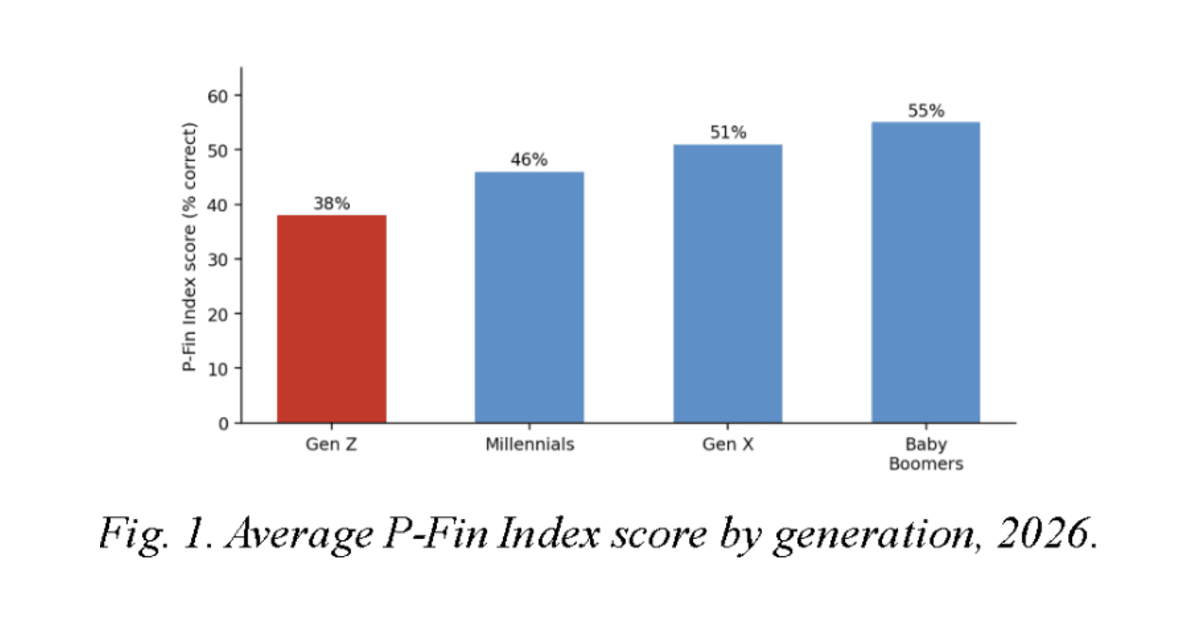
The average score for Gen Z based on the 2026 P-Fin survey was only 38 percent, marking the lowest score any generation has posted since the survey’s start. All Millennials, Gen X, and Baby Boomers have scores at least 10 points higher on average. The inability to understand risk is clearly the biggest weakness across all age groups, even though this skill has diminished the most among those aged 18 to 26. Bank of America’s new data shows that up to 42% of Gen Z are now living paycheck to paycheck. It is proof that the gap carries a real cost.
II. WHERE THE GAP COMES FROM
Most states still do not require a standalone personal finance course before graduation, and where one exists, it is often one semester, taught by a non-specialist, tested with multiple choice. Families rarely close the gap either. There are just a few kids who talk about money with their parents. As a matter of fact, one-third of Gen Z claims social media as their source of financial information. If you look at it in a broader way, most of the information is dependent on sponsorships, collaborative work with brands, and the ongoing trends in the market. The valuable and legit information is rare and not fancy.
III. WHAT ACTUALLY MOVES THE NEEDLE
Programs built around practice beat programs built around lectures. FDIC’s Money Smart for Young Adults walks teenagers through opening an account and reading a paycheck instead of defining terms on a worksheet. Operation HOPE pairs coaching with real market data over a ten-year relationship, not a single course. 3rd Decade matches participants with one-on-one mentors, an approach that works because two students in the same room can start from very different places. These youth finance programs share one habit: they replace theory with a decision the participant has to live with.
IV. WHAT A GOOD PROGRAM NEEDS
Every program they use, besides quizzes, is the decisions that are in touch with their dingers. There should be a timeline of more than one session, where a mentor somewhere in the process should guide the students on the traits that would be more beneficial than the quizzes themselves. The content should be built around how young adults actually use money, like student loans, gig income, and now, pay later, rather than a generic budget template written for salaried workers. Programs including the right lessons tend to raise awareness more than just a generic base template for everyone.
V. CONCLUSION
None of this needs inventing from scratch. Every piece already exists somewhere. The real task is assembling the right combination, and doing it before a costly mistake happens rather than after one already has. Young adults using financial knowledge as a skill are closing the real gap.
REFERENCES
[1] TIAA Institute and Global Financial Literacy Excellence Center, A Decade of Tracking Financial Literacy in America, 2026 P-Fin Index Report.
[2] Bank of America, 2026 Better Money Habits : Gen Z and the Cost of Adulting, Bank of America Institute, 2026.
[3] Federal Deposit Insurance Corporation, Youth Financial Education and Its Impact on Adult Financial Decisions, FDIC Consumer Resource Center, 2026.
[4] Operation HOPE, Financial Literacy for All, 2026.
[5] 3rd Decade, Free Financial Literacy Course for Young Adults, 2026
Frequently Asked Questions
1. What is Gen Z financial literacy?
Gen Z financial literacy refers to the ability of young adults to understand and manage money, including budgeting, saving, credit, debt, investing, and financial risk.
2. Why is financial literacy important for Gen Z?
It helps young adults make informed decisions about spending, borrowing, saving, employment income, and other financial responsibilities as they enter adulthood.
3. Why do many young adults struggle with financial decisions?
Limited financial education, lack of practical experience, family communication gaps, and unreliable information online can make money management more difficult.
4. Where does Gen Z get financial information?
Young adults increasingly use social media, online resources, family members, educational programs, and financial institutions to learn about money.
5. Is social media a reliable source of financial advice?
It can provide useful information, but students should verify financial claims through trustworthy sources because online content may be sponsored, promotional, or incomplete.
6. How can schools improve financial education?
Schools can introduce practical lessons involving budgeting, bank accounts, paychecks, credit, loans, taxes, and other decisions students are likely to face.
7. Why is practical financial education more effective?
Hands-on activities allow students to apply concepts to realistic situations instead of only memorizing definitions or completing theoretical quizzes.
8. What should a financial literacy program teach young adults?
A useful program can cover budgeting, saving, credit, debt, student loans, income, taxes, investing basics, financial risk, and responsible spending.
9. How does mentorship improve financial education?
A mentor can provide personalized guidance and help learners understand how financial decisions apply to their individual circumstances.
10. How can parents help improve financial literacy among young adults?
Parents can discuss everyday financial decisions, budgeting, saving, responsible borrowing, and the consequences of spending choices.
11. Should financial literacy be taught in college?
Yes. College students often begin managing income, loans, credit cards, subscriptions, and living expenses, making practical financial education particularly relevant.
12. What financial challenges are common among Gen Z?
Young adults may face challenges involving living costs, student debt, irregular income, credit, saving, and managing financial independence.
13. Can financial literacy prevent financial mistakes?
Better financial knowledge can help people recognize risks and make more informed decisions, although knowledge alone cannot eliminate every financial problem.
14. How long should financial education programs last?
Programs that provide continued learning, practice, and mentorship can offer more opportunities for application than a single short session.
15. What is the main goal of financial literacy education?
The goal is to help young adults develop the knowledge, judgment, and practical skills needed to make responsible financial decisions.
Citations & References
[1] TIAA Institute and Global Financial Literacy Excellence Center, A Decade of Tracking Financial Literacy in America, 2026 P-Fin Index Report.
[2] Bank of America, 2026 Better Money Habits : Gen Z and the Cost of Adulting, Bank of America Institute, 2026.
[3] Federal Deposit Insurance Corporation, Youth Financial Education and Its Impact on Adult Financial Decisions, FDIC Consumer Resource Center, 2026.
[4] Operation HOPE, Financial Literacy for All, 2026.
[5] 3rd Decade, Free Financial Literacy Course for Young Adults, 2026.
Connect Your Brand with Gen-Z
Unlock high-impact youth marketing strategies with EvePaper.
Book Strategy Call