
Killer Study Strategies for Multiple Overlapping Exams: A Dual-Preparation Approach
Published: August 30, 2026
Key Strategy Takeaways
- Implement time-blocking to divide focus between different subjects.
- Prioritize high-weightage topics using the dual-preparation approach.
- Utilize active recall and spaced repetition for maximum retention.
Key Strategy Takeaways
- Implement time-blocking to divide focus between different subjects.
- Prioritize high-weightage topics using the dual-preparation approach.
- Utilize active recall and spaced repetition for maximum retention.
Frequently Asked Questions
How do I decide which exam to study for first?
Killer Study Strategies for Multiple Overlapping Exams: A Dual-Preparation Approach
Abstract
Preparing for multiple competitive examinations, including CAT exam within the same period can become difficult when their syllabi, patterns, and deadlines overlap. Keywords—Overlapping Exam Study, Dual Preparation, Competitive Examinations, Time Management, Integrated Learning, Mock Tests, Revision Strategy. The growing number of entrance and recruitment examinations has made dual preparation an important skill for students. Instead of preparing separately for every examination, aspirants can identify common topics, divide preparation according to exam priorities, and use targeted practice. This article examines practical strategies for managing overlapping examinations while maintaining consistency, reducing unnecessary workload, and improving performance.
/table of contents
- Introduction
Competitive-exam preparation is no longer limited to one examination for many students. Aspirants may simultaneously prepare for examinations such as JEE and board examinations, CUET and university entrance tests, CAT exam and other management examinations, or CLAT and AILET. When examination dates fall close together, the major challenge is not simply studying for longer hours but deciding what to study, when to study it, and how much attention each examination deserves.
Recent education reporting has highlighted the difficulty of preparing for examinations scheduled in close succession. Hindustan Times has noted that students preparing for boards alongside competitive examinations need structured planning, revision, and practice tests.
- Research Analysis
- Build a Common-Syllabus Map
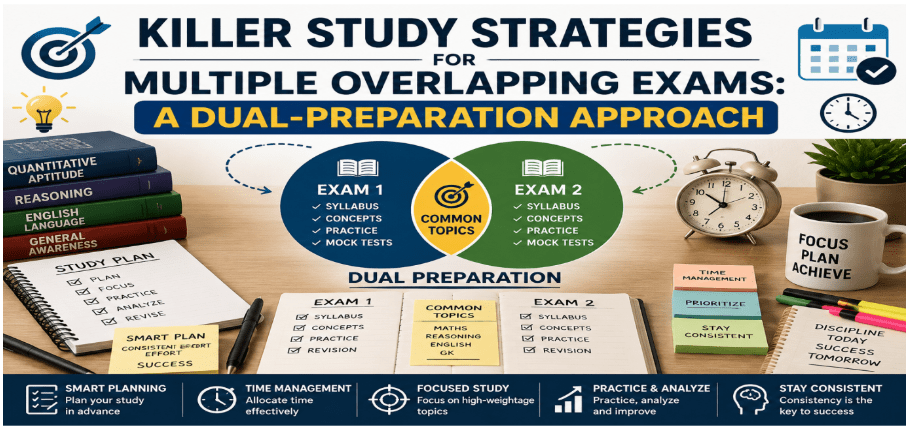
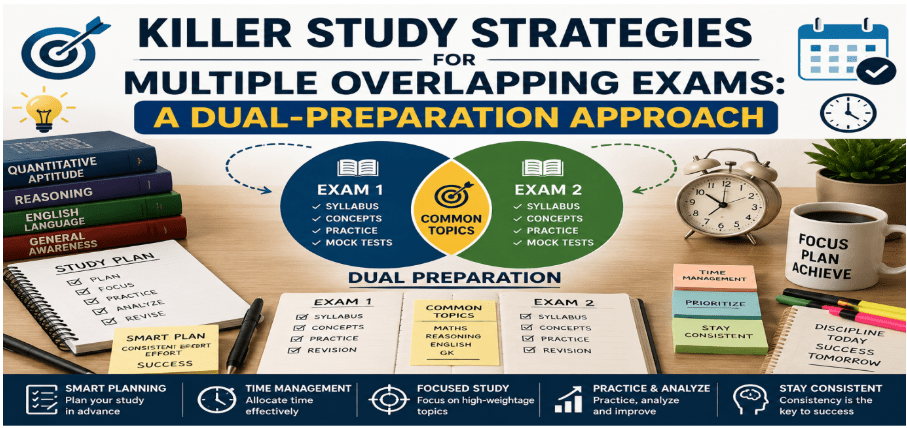
The first step in dual preparation should be identifying overlapping topics. Students should create a simple table containing the syllabus of every examination and mark topics as Common, Exam-Specific, or Low-Priority.
This prevents duplication. For example, when two examinations test similar quantitative, reasoning, reading, or subject-based concepts, one strong preparation cycle can support both examinations. The Indian Express has similarly highlighted syllabus overlap as an opportunity for integrated preparation when students manage board examinations and CUET together.
- Use the 70:30 Preparation Rule
A practical strategy is to spend approximately 70% of study time on common subjects and 30% on exam-specific requirements. The ratio can change as an examination approaches.
During the foundation stage, common concepts should receive greater attention. In the final weeks, the balance should shift toward the nearest examination, its question pattern, mock tests, and revision requirements.
- Prepare Through Time Blocking
Instead of maintaining an unrealistic timetable with long study hours, students should divide the day into focused blocks. A morning session could be dedicated to quantitative or conceptual preparation, while an evening session could focus on reading, reasoning, or examination-specific practice.
Recent CAT preparation guidance published by the Indian Express recommends time-blocking and emphasizes that consistent, focused study can be more useful than simply increasing study hours.
- Make Mock Tests the Common Weapon for the CAT exam Mock tests are particularly valuable when preparing for multiple examinations. They reveal weaknesses, improve speed, and familiarize students with different examination patterns.However, simply taking tests is not enough. Each mock should be followed by an error analysis session. Questions should be classified as conceptual mistakes, calculation errors, time-management problems, or careless errors. This creates a feedback loop between testing and improvement.Recent guidance for competitive examinations has also stressed mock testing, revision, and time management as important components of effective preparation.
- Switch Strategy near the Exam The final phase should not be treated like the preparation phase. As the examination approaches, students should reduce new learning and increase revision, sectional tests, and full-length mocks.Recent JEE Advanced preparation guidance similarly recommends shifting from excessive content accumulation toward revision, accuracy, and execution during the final stage.
III. ConclusionOverlapping examinations do not necessarily require double the workload. They require smarter integration of preparation. A common-syllabus map, time-blocked schedule, controlled allocation of study hours, and systematic mock-test analysis can help students prepare for more than one examination without losing direction.The strongest dual-preparation strategy is therefore not to treat every examination as a completely separate project. Instead, students should build a common academic foundation and then add exam-specific preparation where necessary. Consistency, flexibility, and timely revision can turn overlapping examination schedules from a source of pressure into an opportunity for efficient preparation.
- Key Takeaways
- Identify common topics before creating separate study plans.
- Use integrated preparation to avoid studying the same concepts repeatedly.
- Allocate greater time to the examination with the closest deadline.
- Combine time-blocking with realistic daily targets.
- Analyse every mock test instead of focusing only on scores.
- Shift from learning new topics to revision and execution near the examination.
- Maintain sleep, breaks, and recovery to prevent preparation fatigue.
- Treat dual preparation as a strategy problem rather than simply a workload problem.
- Authentic Resources
- The Indian Express—Balancing CAT preparation with college/work: Indian Express Education
- The Indian Express—CUET and board-exam preparation: Indian Express Education
- Hindustan Times—Preparing for boards and competitive exams together: Hindustan Times Education
- Hindustan Times—JEE Advanced preparation strategy: Hindustan Times Education
- Times of India—Competitive-exam time-management strategies: Times of India Education
Table of Contents
Allocate greater time to the examination with the closest deadline while keeping a common academic foundation for both.
What is the 70:30 preparation rule?
It involves spending approximately 70% of your study time on common subjects shared between the exams and 30% on exam-specific requirements.
How can I identify which topics to focus on for multiple exams?
Build a Common-Syllabus Map by creating a table of the syllabi and marking topics as Common, Exam-Specific, or Low-Priority.
Is it better to study for long hours when preparing for two exams?
No, it is better to prepare through time-blocking, dividing your day into focused blocks rather than maintaining an unrealistic timetable with long hours.
How should I use mock tests for dual preparation?
Use them to reveal weaknesses, improve speed, and familiarize yourself with different exam patterns, followed by a thorough error analysis session.
What should I do in the final weeks before an exam?
Shift the balance toward the nearest examination, focusing on its question pattern, revision requirements, sectional tests, and full-length mocks instead of learning new topics.
How do I analyze a mock test effectively?
Classify your mistakes into conceptual mistakes, calculation errors, time-management problems, or careless errors to create a feedback loop for improvement.
What should my study schedule look like using time-blocking?
You could dedicate a morning session to quantitative or conceptual preparation, and an evening session to reading, reasoning, or exam-specific practice.
Can integrated preparation reduce my workload?
: Yes, by identifying common topics and using a strong preparation cycle for similar concepts, you avoid studying the same concepts repeatedly.
How do I prevent burnout while studying for overlapping exams?
Maintain your sleep schedule, take regular breaks, and ensure proper recovery to prevent preparation fatigue.
Citations & References
The Indian Express—Balancing CAT preparation with college/work: Indian Express Education
The Indian Express—CUET and board-exam preparation: Indian Express Education
Hindustan Times—Preparing for boards and competitive exams together: Hindustan Times Education
Hindustan Times—JEE Advanced preparation strategy: Hindustan Times Education
Times of India—Competitive-exam time-management strategies: Times of India Education
Connect Your Brand with Gen-Z
Unlock high-impact youth marketing strategies with EvePaper.
Book Strategy Call