
How Winning Student Competitions Can Strengthen a College Portfolio
Published: September 18, 2026
Key Strategy Takeaways
- Highlight career value – Show how competition experience can contribute to internships, jobs, and higher-education applications.
- Focus on differentiation – Encourage students to build profiles that demonstrate skills beyond grades and standard certifications.
- Promote practical learning – Emphasize opportunities to apply classroom knowledge to real-world problems.
- Showcase measurable achievements – Encourage students to mention awards, placements, projects, roles, and outcomes clearly.
- Build a diverse portfolio – Combine academic achievements with competitions, projects, research, leadership, and practical experiences.
- Develop transferable skills – Highlight problem-solving, teamwork, communication, public speaking, time management, and adaptability.
- Use competition experience strategically – Encourage students to select competitions aligned with their academic interests and career goals.
- Turn participation into stories – Help students explain what they did, what their role was, what challenge they faced, and what they achieved.
- Promote quality over quantity – Encourage meaningful participation rather than collecting certificates from unrelated competitions.
- Position achievements effectively – Teach students to present competition results clearly on CVs, portfolios, LinkedIn profiles, scholarship applications, and interviews.
Key Strategy Takeaways
- Highlight career value – Show how competition experience can contribute to internships, jobs, and higher-education applications.
- Focus on differentiation – Encourage students to build profiles that demonstrate skills beyond grades and standard certifications.
- Promote practical learning – Emphasize opportunities to apply classroom knowledge to real-world problems.
- Showcase measurable achievements – Encourage students to mention awards, placements, projects, roles, and outcomes clearly.
- Build a diverse portfolio – Combine academic achievements with competitions, projects, research, leadership, and practical experiences.
- Develop transferable skills – Highlight problem-solving, teamwork, communication, public speaking, time management, and adaptability.
- Use competition experience strategically – Encourage students to select competitions aligned with their academic interests and career goals.
- Turn participation into stories – Help students explain what they did, what their role was, what challenge they faced, and what they achieved.
- Promote quality over quantity – Encourage meaningful participation rather than collecting certificates from unrelated competitions.
- Position achievements effectively – Teach students to present competition results clearly on CVs, portfolios, LinkedIn profiles, scholarship applications, and interviews.
College is not merely about attending classes and securing good grades. Students are also offered a chance to participate and compete in debates, quizzes, case competitions, hackathons, business competitions, cultural fairs, etc.
While such experiences are indeed valuable, winning competitions may give an additional boost to the students’ profile, certifying that they have the ability to apply the knowledge they gained in the actual workplace and reach certain goals despite some resistance along the way.
For students who are looking to get an internship, pursue higher education, or advance in their careers, winning competitions can be a valuable addition to their experience and a great way to highlight their skills and talents.
Below are several reasons why such achievements can make a difference in the students’ profiles.
1. It makes your profile stand out
Students may often have similar qualifications. High grades, certificates or college degrees may be common, but they may not necessarily differentiate one from another.
A win in a competition, however, provides a more specific distinction.
For example, success in a case study competition reflects one’s problem-solving abilities, whereas success in a hackathon reveals the technical and collaborative abilities of an individual. This becomes a distinctive aspect that attracts the attention of the recruiters/admission panel.
2. It shows practical skills
One of the ways to prove that one has mastered the material taught in the class is to participate in competitions and fulfill the tasks imposed on them.
A student who demonstrates their knowledge of marketing principles and theories in the classroom can learn to develop a specific idea and implement it further in the marketing competition. An economics student who shows a general understanding of the subject can be asked to solve a concrete case during the case competition.
This actualization of knowledge can serve as an additional learning process that will make the participants more confident in applying their skills.
3. It can strengthen internship applications
When completing an application for the position, one is usually asked to describe their experience and the outcomes they have achieved through their work.
The experience gained from participating in the competitions can be used as an example of successful task completion. Instead of giving abstract examples of one’s experience, such as the ability to work in a team, one can demonstrate their knowledge and skills by showing how they applied their abilities and what results they have achieved during the competition.
4. It can support higher education applications
Competition achievements can also be useful for applications to master’s programmes, scholarships or other purposes. They are not a substitute for good grades, of course, but they can also show the student has interests beyond their studies. Research competitions, academic quizzes, case studies and innovation challenges can be especially valuable to students applying to programmes related to these fields.
5. Students gain confidence
While winning competitions is an important goal, the process itself can also prepare them well for future challenges.
They learn to formulate arguments, answer questions, defend their positions, manage time and accept criticism. After a few competitions, public speaking and tight deadlines stop being such a burden.
In fact, this can improve their performance on many occasions: interviews, presentations and classroom discussions.
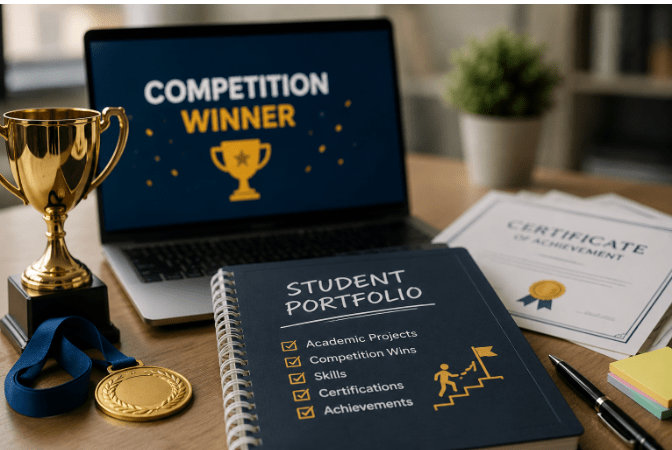
6. It adds depth to a student portfolio
A strong portfolio should not be built solely from certifications. The content of the file should reflect the quality of experience the student has had.
A student who has competed in a debate, won a case competition and worked on a research project has a more diverse set of skills and attributes than one whose achievements are limited to their academic results.
Moreover, the achievements allow the student to talk more about their interests and strengths to a particular authority.
7. Competitions can demonstrate persistence
While a win in one competition itself is quite an accomplishment, many more wins show that the individual is capable of performing well consistently. This can be attributed to certain traits such as perseverance, readiness to learn something new, and constant improvement through each competition experience.
For instance, if someone has begun competing in college-level events, he or she might proceed to compete on the intercollegiate or even national level.
What matters beyond the win?
It might seem that only the word “winner” on a certificate brings any value. However, the experiences from the competition might be more important. Thus, students should reflect on what they did, their role in the competition and the experience they gained from it. In the case of a team competition, one should clearly define their role in the winning team.
Moreover, even if one did not manage to achieve any victory, any competition can be a great experience, and it is worth mentioning in a portfolio. In addition, victory, finalist entry or special mention in a competition can be a great asset if the field of the competition matches the area of future work. However, one should not go overboard trying to collect as many certificates as possible.
How to include competition wins in your portfolio
However, when referring to different competitions in a CV or portfolio, there are some simple recommendations that should be kept in mind by the students.
The name of the award and the organization that gave it, the year it took place, and your participation in reaching that result should be indicated clearly. Also, if it was a project, it might be useful to mention its aim. Instead of simply indicating “Winner – Business Competition”, one might want to put more details and describe the task, for instance, developing a business strategy for a 3-member team.
Conclusion
Student competitions can benefit students not by providing a reward or certificate, but by allowing them to apply their knowledge, collaborate and problem-solve under specific conditions.
A competition, therefore, might be a great addition to the student portfolio, as it displays the student’s skills and provides him or her with the relevant experience needed for future internships, jobs at the university or interviews.
However, a student should not aimlessly accumulate trophies and rewards from random events, but instead take part in competitions in line with their interests and extract valuable knowledge from the experience. A victory in a competition does not take much space on a resume, but it demonstrates to a future employer that a student has the ability to accomplish challenging tasks and has the necessary skills for a given job.
Frequently Asked Questions
How can winning student competitions strengthen a college portfolio?
Competition achievements can demonstrate practical skills, initiative, problem-solving, teamwork, and the ability to achieve results.
Are competition wins useful for internship applications?
Yes. They can provide concrete examples of how you applied your skills and completed challenging tasks.
Do competitions matter for college or university applications?
They can add context to an application by showing interests and achievements beyond academic grades.
Can competition achievements help with scholarship applications?
They may strengthen an application by demonstrating initiative, achievement, and involvement in activities related to the student’s interests.
Do competitions matter more than good grades?
They serve different purposes. Competition achievements can complement academic performance rather than replace it.
What skills can students develop through competitions?
Students can develop problem-solving, communication, teamwork, time management, research, leadership, and presentation skills.
Which types of competitions are valuable for students?
Debates, quizzes, hackathons, case competitions, research challenges, business competitions, innovation contests, and academic competitions can all provide useful experiences.
Should students only participate in competitions they can win?
No. Participation itself can provide learning and experience, even when it does not result in an award.
Should I include every competition on my CV?
It is usually more useful to highlight competitions that demonstrate relevant skills or connect with your academic and career interests.
How should I mention a competition win on my resume?
Include the competition name, awarding organization, year, achievement, and a brief description of your contribution or project.
Should I mention my role in a team competition?
Yes. Clearly explaining your individual contribution helps show what skills you personally developed or applied.
How can I describe a competition without simply saying “Winner”?
Explain the challenge, your role, the solution or project you worked on, and the outcome.
Can being a finalist be included in a portfolio?
Yes. Finalist positions, special mentions, and other notable achievements can be included when they are relevant.
Are participation certificates useful?
They can demonstrate involvement, but their value depends on the relevance and quality of the competition and the experience gained.
Should I collect as many competition certificates as possible?
Quantity alone is not the goal. Meaningful experiences that align with your interests can provide more useful material for a portfolio.
Citations & References
References
[1] Athena Education, “How Competitions Strengthen College Applications”.
[2] Student Competitions, “How Competitions Fuel Student Growth, Confidence, and Career Success”, November 06, 2024.
[3] Pathivy, “Stand Out for Top Colleges: The Power of Academic Competitions”.
Connect Your Brand with Gen-Z
Unlock high-impact youth marketing strategies with EvePaper.
Book Strategy Call