
5 Warning Signs Your Business Growth Is Scaling Faster Than It Can Handle
Published: September 22, 2026
Key Strategy Takeaways
- Balance business growth with healthy cash flow to avoid financial pressure.
- Monitor cash flow closely as business growth accelerates.
- Ensure sales growth does not outpace your working capital.
- Forecast cash flow before making major business growth decisions.
- Maintain sufficient cash reserves to support rapid business growth.
- Review payment terms to improve cash flow during expansion.
- Negotiate better supplier terms to protect cash flow.
- Invest in systems that can handle increasing business growth.
- Track rising operational costs alongside business growth.
- Protect product and service quality as business growth increases.
- Hire strategically to prevent employee burnout during business growth.
- Identify operational bottlenecks before they restrict business growth.
- Monitor customer support capacity as business growth accelerates.
- Keep unit economics visible to ensure business growth remains sustainable.
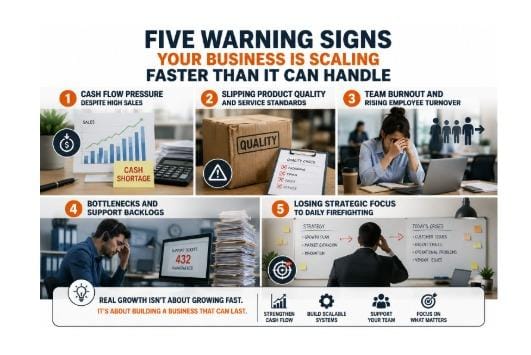
Five Warning Signs Your Business Growth Is Scaling Faster Than It Can Handle
Expansion is what most business owners dream about. Breaking sales records, landing clients, entering markets these all seem like signs that your plan is working. Growth can turn into a problem when it moves fast. When your sales climb faster than your systems, your cash and your team can’t handle your business starts to overtrade.
This means it’s growing quickly because of its structure, and that can lead to trouble.If you catch these warning signs early, leaders can fix things before they get worse. You can adjust how things run, keep your cash flow steady, and build a base for the future. Here are five signs that your business is moving fast.
- Constant Cash Flow Pressure Despite High Sale
It’s confusing when a company looks like it’s making lots of money but still struggles to pay its bills. Revenue shows up on the books when you finish a sale. The actual cash doesn’t arrive for weeks or even months. To meet the rise in orders, you must spend money away—on stock, supplies, and worker wages. The money you need to pay these bills comes in later. This gap between cash going out and cash coming in creates a cash gap. If your team is constantly working to pay payroll and your sales are at record highs, then your growth is using up all your working capital.
- Slipping Product Quality and Service Standards
When demand spikes suddenly, your internal systems are pushed beyond their limits. Employees feel pressure to meet deadlines. They skip quality checks, cut corners, and rush to finish work. The end result is poor quality. Deliveries arrive late, software updates have bugs, and customer service feels rushed and impersonal. Over time, customers get unhappy. They ask for refunds, leave reviews, and lose trust in your brand.
A business can’t keep growing if the quality that brought people to you in the first place starts to fall apart.
- Team Burnout and Rising Employee Turnover
Your team is usually the first to feel the weight of growth. When workloads double with no staff or better tools, workers must work longer hours to keep up. People might push through for a time. When this goes on for months, exhaustion sets in. Morale drops. People get burned out.
They start to leave. Losing staff during an expansion causes damage. The people who stay must take on work. Leadership spends time hiring and training people instead of focusing on strategy. If your key team members are leaving or losing interest, your business is growing faster than your people can keep up.
- Bottlenecks and Support Backlogs
As your customer base grows, your support and operations systems are the first to break. Email inboxes fill up with messages. Response times stretch from hours to days. Simple mistakes in order fulfillment start to happen. Support teams spend all their time putting out fires, helping customers, and not being proactive. When normal tasks start slipping through the cracks, it means your software, your workflows, and your communication systems are no longer enough. They’ve outgrown their capacity.
- Losing Strategic Focus to Daily Firefighting
In times of growth, leaders get pulled away from long-term planning. They spend their days solving problems and making strategic choices. Decisions are made quickly without analysis. Important metrics get ignored. Long-range goals fall behind. In the chaos, it’s easy to lose sight of unit economics. You might not notice that some of your products or services are actually losing money once you include all the costs of growth. When your business shifts from strategy to crisis management, it risks losing its sense of direction.Finding Balance for Growth
Growing is a problem many businesses face. It doesn’t have to be a disaster. When you see these signs, strong leadership means being willing to slow down. You can space out sales efforts, tighten credit policies, ask vendors to change payment terms, and invest in your systems. Real success isn’t about growing. It’s about building a business that can stay strong and steady for years to come.
Key Strategy Takeaways
- Balance business growth with healthy cash flow to avoid financial pressure.
- Monitor cash flow closely as business growth accelerates.
- Ensure sales growth does not outpace your working capital.
- Forecast cash flow before making major business growth decisions.
- Maintain sufficient cash reserves to support rapid business growth.
- Review payment terms to improve cash flow during expansion.
- Negotiate better supplier terms to protect cash flow.
- Invest in systems that can handle increasing business growth.
- Track rising operational costs alongside business growth.
- Protect product and service quality as business growth increases.
- Hire strategically to prevent employee burnout during business growth.
- Identify operational bottlenecks before they restrict business growth.
- Monitor customer support capacity as business growth accelerates.
- Keep unit economics visible to ensure business growth remains sustainable.
Frequently Asked Questions
1. How does business growth affect cash flow?
2. Why can business growth cause cash flow problems?
3. How can a business maintain healthy cash flow during growth?
4. What are the warning signs of cash flow problems during business growth?
5. How can cash flow management support sustainable business growth?
Connect Your Brand with Gen-Z
Unlock high-impact youth marketing strategies with EvePaper.
Book Strategy Call