
How Businesses Can Use Financial Data to Make Better Strategic Decisions
Published: September 22, 2026
Key Strategy Takeaways
- Use financial information as a guide for future decisions, not just a record of past performance.
- Focus on the numbers that directly support your current business goals.
- Invest resources in areas that demonstrate measurable returns.
- Compare customer acquisition costs with the value customers generate over time.
- Use margin data to understand whether pricing decisions are sustainable.
- Study customer purchasing patterns before making major pricing changes.
- Maintain sufficient cash reserves to handle unexpected challenges.
- Prepare financially for events such as product launches or lost clients.
- Track expenses to identify unnecessary spending and operational waste.
- Connect spending patterns with specific activities and business outcomes.
- Monitor customer lifetime value to evaluate the quality of growth.
- Measure returns from major investments before committing additional resources.
- Keep track of how long available cash can support operations.
- Watch profit margins as sales increase.
- Connect sales, payment, and accounting information for a clearer picture.
- Use early indicators to identify potential financial problems sooner.
- Replace fixed assumptions with forecasts that can change with market conditions.
- Give department leaders access to useful financial information.
- Limit reporting to a small number of meaningful performance indicators.
- Avoid collecting data simply because it is available.
- Combine numerical evidence with feedback from employees and customers.
- Consider market changes instead of assuming previous patterns will continue.
- Turn financial findings into specific actions and measurable goals.
- Make sure spending decisions support the company's broader direction.
- Balance short-term financial needs with long-term growth plans.
- Use financial trends to identify changing customer behaviour.
- Monitor working capital to maintain healthy day-to-day operations.
- Share useful insights across departments instead of keeping them within finance teams.
- Build a continuous feedback process so decisions improve over time.
- Use financial insights to become more proactive, adaptable, and confident in decision-making.
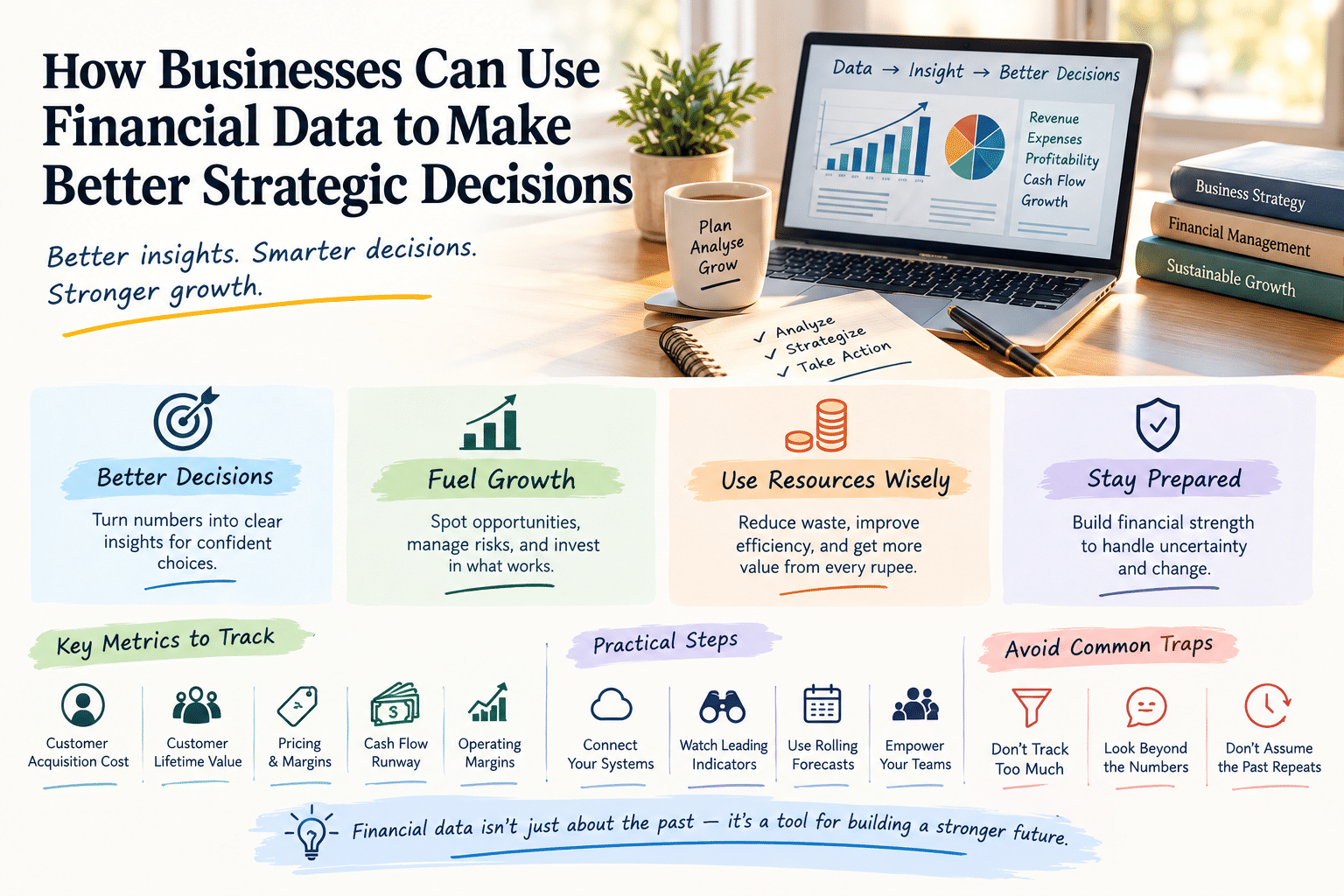
How Businesses Can Use Financial Data to Make Better Strategic Decisions
When you run a business,it feels easy to treat data like a rearview mirror. You end up looking at a pile of papers every month that show where your money went after you already spent it.
I think modern leaders should look at data differently. Leaders should treat metrics like a steering wheel rather than just a scorecard. When leaders really look at statements, leaders can see market changes early. This helps leaders invest with confidence and make choices based on what’s actually happening instead of just guessing.
Where Financial Data Makes the Biggest Impact
Using metrics to guide business is not about worrying over every cent. Business is about watching the parts of business that actually make business move forward.
- Smart Capital Allocation: Business needs to know which parts of business bring in money so you do not waste cash on projects that do not work. Comparing how much business costs to get a customer to how much that customer spends helps business decide if business should push a product or stop.
- Strategic Pricing: When adding a bit to costs try to price based on value. To do this business must look at unit margins. Look at what people’re buying. Financial data shows if customers will leave when you change prices and where profit can be made.
- Risk. Runway: To grow without crashing risk needs cash on hand. If business plans for things like a product launch or a lost client risk can build a safety net before any real trouble starts.
- Efficiency: Using accounting can help businesses find where business is wasting money. When business tracks expenses back to tasks business can see which contracts to change and which slow processes are eating profits.
Four Core Metrics Every Leader Should Track
Do not get lost in spreadsheets. Just focus on numbers that show if business is healthy:
- LTV to CAC Ratio: LTV to CAC Ratio shows if a business way of getting customers actually works. If winning a customer costs much as that customer ever pays, business will just make the business run out of cash faster.
- Return on Invested Capital (ROIC): ROIC shows if spending money is good. If a new project brings back less than what it cost to start that project hurts the company.
- Free Cash Flow Runway: Free Cash Flow Runway tells how long business can stay in business with cash it has now. Profit on paper does not matter if that cash is stuck in bills and staff cannot be paid.
- Operating Margin Trends: Operating Margin Trends shows if business gets better at making money as business grows. Growing sales looks great. Growing margins keeps the company strong.
Implementation Steps
You do not need a team of experts to use insight every day. Just try these four steps:
- Unify Your Systems: Unify Your Systems connects sales, payments and accounting tools. Unify Your Systems allows everyone to see numbers at the time.
- Focus on Leading Indicators: Focus on Leading Indicators does not just look at receipts. Focus on how fast sales are moving so businesses can see money problems before they arrive.
- Adopt Rolling Forecasts: Adopt Rolling Forecasts stops using budgets that do not work after a month. Use rolling forecasts that change as the market changes.
- Empower Department Leads: Empower Department Leads gives managers dashboards. When people in charge of projects see how daily choices affect money, business makes decisions.
Traps to Avoid
- Drowning in Data: If business tracks many indicators business will get stuck. Pick three to five performance indicators that matter for business goals now and ignore the rest.
- Ignoring Context: Numbers tell business what happened. They do not tell the business why. Always talk to your staff and customers.
- Assuming the Past Repeats: If business only looks at what happened business may be surprised when customers change habits or new rivals appear.
At the end of the day financial data is more than math, for taxes. It is the story of business. ffWhen business stops using words and starts using reporting to make decisions, business stops just reacting to things and starts driving business toward the future.
Key Strategy Takeaways
- Use financial information as a guide for future decisions, not just a record of past performance.
- Focus on the numbers that directly support your current business goals.
- Invest resources in areas that demonstrate measurable returns.
- Compare customer acquisition costs with the value customers generate over time.
- Use margin data to understand whether pricing decisions are sustainable.
- Study customer purchasing patterns before making major pricing changes.
- Maintain sufficient cash reserves to handle unexpected challenges.
- Prepare financially for events such as product launches or lost clients.
- Track expenses to identify unnecessary spending and operational waste.
- Connect spending patterns with specific activities and business outcomes.
- Monitor customer lifetime value to evaluate the quality of growth.
- Measure returns from major investments before committing additional resources.
- Keep track of how long available cash can support operations.
- Watch profit margins as sales increase.
- Connect sales, payment, and accounting information for a clearer picture.
- Use early indicators to identify potential financial problems sooner.
- Replace fixed assumptions with forecasts that can change with market conditions.
- Give department leaders access to useful financial information.
- Limit reporting to a small number of meaningful performance indicators.
- Avoid collecting data simply because it is available.
- Combine numerical evidence with feedback from employees and customers.
- Consider market changes instead of assuming previous patterns will continue.
- Turn financial findings into specific actions and measurable goals.
- Make sure spending decisions support the company’s broader direction.
- Balance short-term financial needs with long-term growth plans.
- Use financial trends to identify changing customer behaviour.
- Monitor working capital to maintain healthy day-to-day operations.
- Share useful insights across departments instead of keeping them within finance teams.
- Build a continuous feedback process so decisions improve over time.
- Use financial insights to become more proactive, adaptable, and confident in decision-making.
Frequently Asked Questions
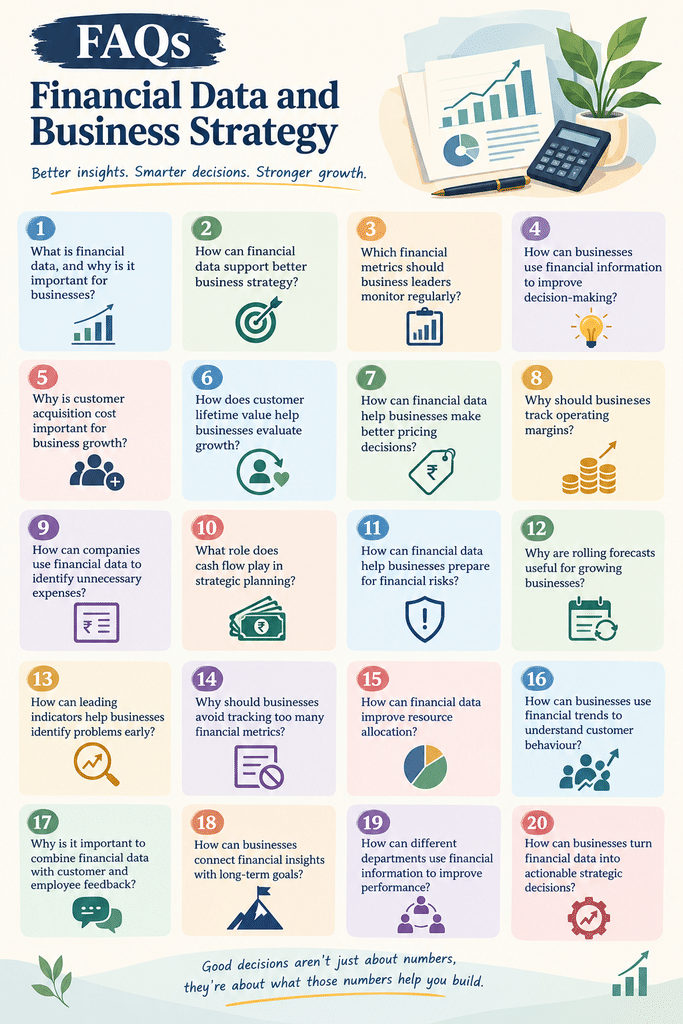
What is financial data, and why is it important for businesses?
How can financial data support better business strategy?
Which financial metrics should business leaders monitor regularly?
How can businesses use financial information to improve decision-making?
Why is customer acquisition cost important for business growth?
How does customer lifetime value help businesses evaluate growth?
How can financial data help businesses make better pricing decisions? Why should businesses track operating margins?
How can companies use financial data to identify unnecessary expenses?
What role does cash flow play in strategic planning?
How can financial data help businesses prepare for financial risks?
Why are rolling forecasts useful for growing businesses?
How can leading indicators help businesses identify problems early?
Why should businesses avoid tracking too many financial metrics?
How can financial data improve resource allocation?
How can businesses use financial trends to understand customer behaviour?
Why is it important to combine financial data with customer and employee feedback?
How can businesses connect financial insights with long-term goals?
How can different departments use financial information to improve performance?
How can businesses turn financial data into actionable strategic decisions?
- How can financial data help businesses identify growth opportunities?
- What financial data should startups monitor regularly?
- How does financial analysis support better resource allocation?
- How can businesses use data to improve profitability?
- Why is cash flow important when making strategic decisions?
- How can financial reports reveal operational inefficiencies?
- How can businesses use margins to evaluate product performance?
- What is the role of financial forecasting in business planning?
- How can businesses use financial trends to manage risk?
- How does financial data support investment decisions?
- How can businesses determine whether a project is financially worthwhile?
- Why should businesses compare actual results with forecasts?
- How can financial data improve budgeting decisions?
- How can businesses use customer data alongside financial information?
- Why are leading indicators important for business planning?
- How can financial data help businesses respond to market changes?
- How does working capital affect business growth?
- How can managers use financial dashboards effectively?
- What are the common mistakes businesses make when interpreting financial data?
- How can businesses turn financial insights into practical actions?
Connect Your Brand with Gen-Z
Unlock high-impact youth marketing strategies with EvePaper.
Book Strategy Call