
7 Powerful Ways career platforms Use Personalised Recommendations to Reach Students
Published: October 7, 2026
career platforms
For students it can at times be like going through an endless number of possible options when trying to find the right internship, job or career path. Although there may be thousands of job vacancies, hundreds of courses and a large number of different career paths, there is still very little clarity regarding which of them actually suit a particular student.
It is at this point that personalised recommendations are having an impact on the way career platforms contact students.
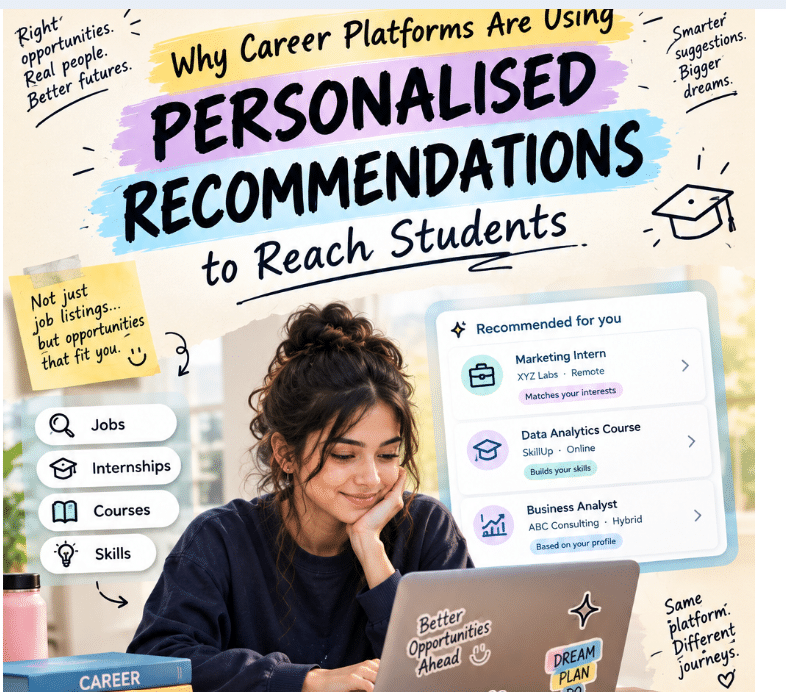
Rather than presenting every user with the same internships, jobs, or career-related content, the platforms could use details such as a person’s skills, interests, past searches, applications, and profile information to recommend opportunities that are more relevant to that individual.
Platforms like LinkedIn and Handshake make use of this method; LinkedIn states that the opportunities it recommends are determined by a user’s profile, their preferences and their activities, while Handshake offers personalised job recommendations according to students’ interests, activities and engagement on the platform.
Why has personalisation become such an important element of career platforms?
- There are too many choices available to students
The issue is not any longer just about finding opportunities; it’s about finding the correct ones.
A student studying commerce who is interested in finance needn’t necessarily be interested in hundreds of software engineering internships, and in a similar way a student studying design might have little interest in accounting positions even if they satisfy the basic eligibility requirements.
Personalised recommendations are able to reduce the information overload.
Rather than asking students to go through all the available material, the platforms can limit the choices to those based on what they already know about the user.
Research into student job-matching systems has particularly pointed out inaccurate matching and a lack of personalisation as problems with conventional methods. An study carried out in 2025 suggested personalised recommendation methods as a way of improving the relevance of job opportunities for students.
- Recommendations Need Not Be Limited to Job Titles
A noteworthy aspect of personalisation is that students often do not know precisely what job title they should use when searching.
A student could be aware that they enjoy analysing businesses but may never have come across positions like equity research, business intelligence or strategy.
A recommendation system is able to link together skills and interests with roles that students might not have found on their own.
For example, LinkedIn’s student career advice promotes the idea of looking at careers that align with one’s strengths and interests. The platform’s AI-driven job search is also able to display job opportunities even if the job title is not the same as the one the student originally expected.
It transforms a career platform from that of a simple job-search website into one which functions as a discovery tool.
- The Students’ Activity Generates Useful Signals
Each interaction can reveal something to the platform.
A student looks for marketing internships and then looks at three social-media positions, saves the content marketing one and leaves the finance ones.
None of these actions actually states, “I want marketing.”
Yet taken together, they give a clear indication.
Career platforms can make use of things like searches, job views, saved jobs and applications in order to improve their future recommendations. For example, Handshake states that its recommendations can take into account a student’s recent searches and job views as well as the information in their profile.
As a result, the recommendations can gradually become more relevant since the platform learns from users’ behaviour.
- Personalisation can help students find hidden opportunities
It is common for students to use terms that they are familiar with.
People who search for “finance internship” might keep coming across job listings that include that exact phrase, but there may be appropriate positions listed under titles like financial planning, risk, corporate banking, investment research or business analysis.
A recommendation engine has the potential to link these related opportunities.
This is especially beneficial for students who are at the stage of exploring possible careers and who have not yet settled on a specific professional identity.
Research into labour-market recommendation systems based on AI has looked at this idea specifically, that is, linking the skills required for occupations as stated in job vacancies with personal learning and career routes.
The advantage is not just a greater number of recommendations; it is giving the student access to possibilities that they might not have thought of.
- Platforms can suggest skills along with jobs
A job recommendation indicates the kinds of positions a student could apply for.
It could also show them what they are missing.
Let us imagine that a student is always interested in becoming a financial analyst but does not have any skills in Excel, financial modelling or valuation; in that case, the platform could link up those gaps with appropriate courses, projects or learning materials.
This creates a more complete career journey:
Find a role, determine the skill gap, learn the skill, get more prepared, and then apply.
Recent research carried out into how college students plan their careers has looked at recommendation systems which combine data on students’ interests with information about possible career paths, aiming to improve the accuracy of the career recommendations.
- Personalized Content Can Keep Students Interested
Career platforms do not merely vie for applications; they also struggle to gain attention.
Students are continually being sent notifications, emails, social-media content and all sorts of other information, and a general message such as ‘Here are today’s opportunities’ is likely to be of no great interest.
A message like “5 marketing internships matching your interests” seems more relevant at once.
For example, Handshake sends out emails on a weekly basis which include personalised recommendations based on the interests that students have selected and their activity on the platform.
The personalisation of this kind encourages students to come back to the platform since the content seems to be related to their own goals.
- Career platforms can go beyond being merely job boards.
The most significant change could be taking place at the platform level.
A traditional job board essentially says:
The jobs are listed here. Go through them.
A personalised career platform can say:
The following include opportunities, skills, career paths and resources which could be of relevance to you.
That’s a quite different experience.
In India, personalised career guidance is extending beyond just matching people with jobs. A case study from 2025, published by the Government of India’s Frontier Technology initiative, spoke about Bodhami, an AI-based career guidance platform which combines psychometric assessments with AI in order to give personalised career recommendations. At the time of the study being published, the platform had reportedly helped 1 lakh students in 357 cities.
It is obvious that the general trend is for career technology to focus on understanding the individual rather than just offering a list of opportunities.
The Challenge With Personalisation
Personalisation may seem useful, but it has a significant limitation.
A platform might lead to a narrow career bubble if it only makes recommendations based on the things a student has already shown an interest in.
A student who is interested in marketing might end up with a number of marketing jobs and thus never find a career in consulting or product management which could also be suitable for their skills.
Privacy is also an issue. Since personalised systems rely on user information and behaviour data, students should know what information is being gathered and how it is going to be used.
Consequently, the most effective recommendation systems have to strike a balance between relevance and discovery on the one hand and personalisation and transparency on the other.
The Future of Career Platforms
Students nowadays have no lack of information but usually lack guidance.
There can be another problem when there’s no simple method of working out what is important to any one individual, since so many jobs, internships, courses, and career options are available.
Which is why personalised recommendations are becoming more and more important for career platforms.
By looking at people’s profiles, interests and activities, the platforms are able to make it easier to come across opportunities, introduce students to different kinds of careers and link jobs with the skills required to attain them.
What we want to achieve is not to decide on a career for the student; instead, we want the search process to become more relevant.
Sometimes the most valuable opportunity isn’t the one a student was originally looking for; it is the one they didn’t know existed.
References
- LinkedIn, “LinkedIn for Students and Future Graduates,” 2026. LinkedIn for Students and Future Graduates
- Handshake, “Jobs Digests and Recommendations”, was updated in January 2025.
- Design and implementation of a student job matching system based on a personalized recommendation algorithm, Systems and Soft Computing, volume 7, 2025.
- Y. Dai and others, “Do personal recommendations need to be personalized? Investigating the relationships between student differences and educational recommendations,” Smart Learning Environments, 2024.
- Xu X. and H. Gao, ‘A knowledge graph-integrated recommendation method for college student career planning’, Discover Artificial Intelligence, 2026.
20 Key Takeaways About Career Platforms
- Career platforms use personalised recommendations to help students discover relevant jobs, internships, courses, and career paths.
- Personalised career platforms can reduce the information overload students face when searching through thousands of opportunities.
- Recommendations can be based on a student’s skills, interests, profile information, searches, job views, saved opportunities, and applications.
- Career platforms can recommend opportunities beyond the exact job titles students initially search for.
- Personalised recommendations can turn career platforms from simple job boards into career discovery tools.
- Student activity creates useful signals that career platforms can use to improve future recommendations.
- Search history and job-view behaviour can help platforms identify a student’s changing career interests.
- Personalised recommendations can help students discover hidden or unfamiliar career opportunities.
- Career platforms can connect related roles based on skills and interests rather than relying only on job titles.
- Recommendation systems can help students identify the skills they need for particular career opportunities.
- Some career platforms can connect job recommendations with courses, learning resources, and skill development.
- Personalised content can make career-related emails and notifications more relevant to students.
- Relevant recommendations can encourage students to return to career platforms more frequently.
- Career platforms can support students throughout the journey from career discovery to skill development and job applications.
- AI-powered career guidance can combine student information with assessments and career data to provide personalised recommendations.
- Personalisation can make career searches more efficient by prioritising opportunities that are more likely to match individual interests.
- Career platforms must avoid creating a career bubble in which students only see opportunities similar to their previous interests.
- Effective recommendation systems should balance personalisation with career discovery.
- Privacy and transparency are important because personalised career platforms depend on user and behavioural data.
- The ultimate goal of career platforms should not be to choose a career for students but to make the process of discovering suitable opportunities easier and more relevant.
30 FAQs About Career Platforms
1. What are career platforms?
Career platforms are digital services that help students and job seekers discover internships, jobs, courses, skills, career paths, and professional opportunities.
2. How do career platforms help students?
Career platforms help students find relevant opportunities by bringing together job listings, internships, career information, learning resources, and personalised recommendations.
3. How do career platforms personalise recommendations?
They can analyse information such as a student’s profile, skills, interests, searches, job views, saved opportunities, applications, and engagement to recommend relevant opportunities.
4. Why are personalised recommendations important on career platforms?
They help students avoid information overload by prioritising opportunities that are more closely aligned with their interests and career goals.
5. Can career platforms recommend jobs students have not searched for?
Yes. Recommendation systems can identify connections between a student’s interests and related roles that may not use the exact job title the student originally searched for.
6. How do career platforms understand student interests?
They can use signals such as searches, job views, saved jobs, applications, profile information, skills, and engagement with career content.
7. Can career platforms recommend internships?
Yes. Many career platforms provide personalised internship recommendations based on students’ profiles, interests, skills, and activity.
8. Can career platforms help students discover new careers?
Yes. Personalised recommendations can introduce students to roles and career paths they may not have previously considered.
9. How do career platforms reduce information overload?
Instead of requiring students to browse every available opportunity, recommendation systems can filter and prioritise opportunities that are more relevant to the individual.
10. Can career platforms recommend jobs based on skills?
Yes. Skill-based recommendations can match a student’s existing abilities with roles that require similar or related skills.
11. Why are job titles sometimes not enough for career recommendations?
Students may not know the correct professional title for a career they are interested in. Skill- and interest-based recommendations can help them discover related roles.
12. How can career platforms help students identify skill gaps?
A platform can compare the skills associated with a target role with the student’s existing skills and highlight areas where additional learning may be useful.
13. Can career platforms recommend courses?
Some career platforms can connect career opportunities with courses, certifications, projects, and other learning resources that may help students prepare for specific roles.
14. How can personalised recommendations improve the student experience?
They can make career searches faster, more relevant, and easier to navigate by reducing the number of irrelevant opportunities students need to review.
15. What data do career platforms use for recommendations?
Depending on the platform, data may include profile information, skills, interests, search activity, job views, saved jobs, applications, and engagement.
16. How does student activity influence recommendations?
Repeated actions can provide signals about changing interests. For example, frequently viewing marketing internships may encourage a platform to recommend more marketing-related opportunities.
17. Can personalised career recommendations change over time?
Yes. As students update their profiles and interact with different opportunities, recommendation systems can adjust the types of jobs, internships, and resources they display.
18. What is a personalised career journey?
It is an experience in which a career platform provides recommendations that are relevant to a student’s individual interests, skills, goals, and stage of career development.
19. How are career platforms different from traditional job boards?
Traditional job boards mainly provide lists of vacancies, while personalised career platforms can recommend jobs, identify skills, suggest career paths, and provide relevant learning resources.
20. Can AI improve career platforms?
AI can help career platforms analyse large amounts of career and user data to identify relationships between students’ interests, skills, job opportunities, and potential career paths.
21. What are the benefits of AI-powered career platforms?
They can provide faster matching, personalised recommendations, career discovery, skill-gap identification, and potentially more relevant job and internship suggestions.
22. Can career platforms help students who are unsure about their career?
Yes. Personalised recommendations can expose students to related careers and opportunities based on their interests and strengths, even when they have not chosen a specific career path.
23. What is the career bubble problem?
The career bubble occurs when a recommendation system repeatedly shows students opportunities similar to their existing interests and prevents them from discovering potentially suitable alternatives.
24. How can career platforms prevent career bubbles?
They can combine personalised recommendations with exploratory suggestions that introduce students to related or unexpected career paths.
25. Why is privacy important for career platforms?
Personalised recommendations rely on user information and behavioural data, so students need transparency about what data is collected and how it is used.
26. Should students trust personalised career recommendations completely?
No. Recommendations should be treated as useful guidance rather than definitive career decisions. Students should also consider their own interests, abilities, goals, research, and professional advice.
27. Can career platforms help students find hidden opportunities?
Yes. Recommendation systems can connect skills and interests with less obvious job titles and career paths that students may not discover through conventional searches.
28. How do career platforms help with career discovery?
They can combine information about a student’s interests and activities with data about jobs, skills, industries, courses, and career paths to suggest new possibilities.
29. What makes an effective career platform?
An effective career platform should provide relevant recommendations while also supporting discovery, skill development, transparency, privacy, and user control.
30. What is the future of career platforms?
Career platforms are likely to move beyond simple job listings toward personalised career ecosystems that connect students with jobs, internships, skills, courses, career paths, and professional development opportunities.
One Marketing Question
How can career platforms use personalised recommendations to improve student engagement and connect students with the right jobs, internships, and career opportunities?
Connect Your Brand with Gen-Z
Unlock high-impact youth marketing strategies with EvePaper.
Book Strategy Call