
7 Powerful Ways Indian Brands Can Use AI Without Losing the Human Side of Marketing
Published: October 7, 2026
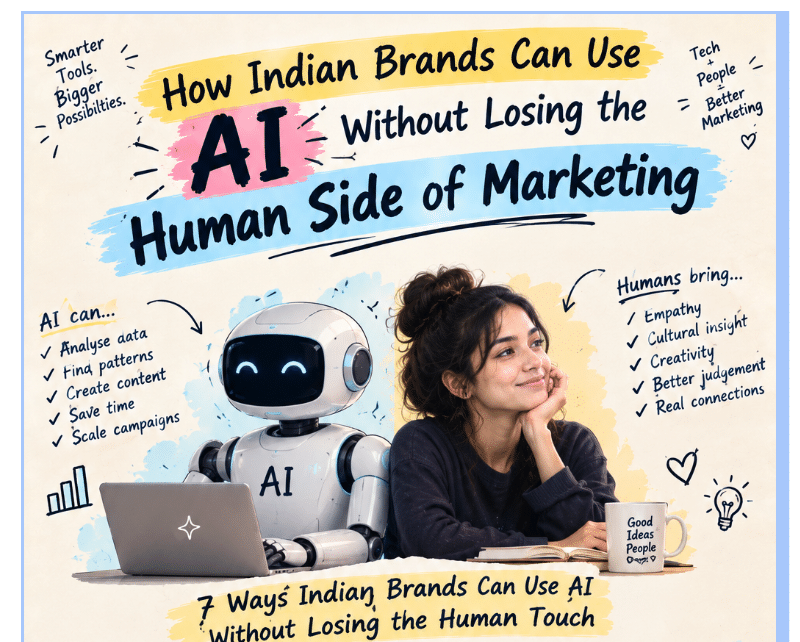
AI marketing
AI is speeding up marketing.
Now a brand is able to produce dozens of different ads, analyse customer behaviour, customise its messages and generate visual content in a fraction of the time it used to take. For Indian brands which have to deal with millions of customers using different languages, in various cities and on different platforms, this speed can be very useful.
However, the story has another aspect as well.
Marketing has never been solely concerned with getting the right message across to the right person; it also involves an understanding of people. For example, why does a specific joke work in one city but not in another? Why does one advertisement seem relatable whereas another comes across as a straightforward sales pitch? And why does a simple story sometimes remain with people longer than an expensive production?
Data alone cannot fully answer these questions.
That is the reason why the true potential of AI in the field of marketing might not lie in replacing the human aspect of branding but in enabling marketers to spend more time on it.
- Have the AI carry out the repetitive tasks
A simple method for Indian companies to make use of AI is to have it carry out the sorts of tasks which people do not actually need to spend hours on.
It could involve sorting out customer feedback, analysing campaign data, producing a number of different content variations, summarising reports or spotting patterns across large datasets.
Google has already been extending its AI-powered tools to marketers in India, the tools covering targeting, creative development, campaign optimisation and measurement.
The key point is that AI can take on the difficult tasks while the marketers decide which items deserve attention.
The problem isn’t a lack of data if a marketer spends three hours preparing a report rather than trying to work out why customers had a negative reaction to the campaign; it is a lack of time.
AI could help return some of that time.
- Use AI to generate ideas, not to create the final brand voice
Generative AI is able to produce headlines, captions, scripts and campaign ideas almost instantly.
It doesn’t mean that all ideas produced by AI should be posted directly onto Instagram.
The initial output may be regarded as a starting point, after which a human team can incorporate the brand’s personality, humour, cultural references and emotional context.
In India the distinction is becoming more and more important. A report by the ASCI Academy on AI in advertising stated that the strength of AI is in enhancing rather than replacing human creativity, and at the same time stressed the importance of responsible AI frameworks.
A useful workflow could therefore be:
AI creates. People ask questions. People improve the result. The brand publishes.
The machine offers speed while the people supply the point of view.
- Keep Cultural Understanding Human
People should handle cultural understanding, not machines. Technology can help share information, but it cannot replace real human experience and empathy. We need to learn about other cultures by talking to people, listening to their stories, and seeing things from their point of view. This personal connection helps us avoid mistakes and misunderstandings that can happen when we rely only on data or automated systems.
The Indian market is not a single, uniform one.
A campaign which is successful in Mumbai will not necessarily work in Jaipur. A phrase that amuses a young consumer in Delhi might sound entirely different in Chennai. Indeed, even within the same language, humour, references and cultural context can change greatly.
Although AI can assist brands in adapting their content for different regions and languages, it still necessary for a person to judge whether that adaptation comes across as natural.
This is especially important as Indian consumers tend to switch more and more between languages and digital platforms. Google points out that Indian consumers are undertaking increasingly complex and non-linear journeys across Search, YouTube, social feeds and shopping platforms.
The greater extent to which marketing becomes automated, the more valuable genuine cultural understanding will be.
- Personalise Without Making People Feel As If They Are Being Watched
Personalisation is one of AI’s biggest marketing benefits.
A brand may recommend products, offers or content according to the items a customer has already viewed or bought.
There is a fine difference between saying “This brand understands me” and asking “How does this brand know that about me?”
Studies carried out on AI-enabled marketing in India have highlighted the conflict between personalisation and privacy. Although consumers can value relevance and convenience they still have worries regarding privacy, manipulation and the way their information is being used. Trust can be affected by transparency and consumer control.
Indian brands should therefore consider going beyond what AI is capable of personalising.
They ought to consider whether or not they should go ahead with personalising it.
A good rule is this: personalisation should make an experience more helpful rather than more uncomfortable.
- Use AI to analyse customers but have humans listen to them
AI is capable of identifying patterns among thousands of reviews, comments, and customer interactions.
That is not always the case with figures.
Suppose that an AI system finds hundreds of customers complaining about the product’s packaging. It will then spot the issue in question. Nevertheless, a human marketer has to figure out why the packaging offends people and what the customers really want to change.
It is here that the use of AI together with traditional market research proves to be powerful.
AI can be used by brands to detect recurring themes and then carry out interviews, surveys, focus groups or social listening in order to understand the emotions associated with them.
In other words:
AI can inform you about what is happening, but humans have to ask why.
- Use AI to Generate a Greater Number of Versions, Not a Greater Amount of Noise
A major creative advantage of AI is the extent of its scale.
A brand can now prepare various versions of an advertisement for different audiences, locations, products, or platforms much more quickly than in the past.
Google has emphasized the cases of Indian companies such as Zepto, Ajio and Zee5 by using AI-driven creative methods in order to speed up and expand marketing production.
Just because more content is produced doesn’t mean that the marketing will be better.
If all brands used AI to produce hundreds of images, captions and videos that look similar, then customers might eventually cease noticing them.
The answer doesn’t have to be less AI.
It is better to have human direction.
Marketers need to determine how the brand should sound, what it should stand for and what makes it identifiable. Once that has been decided, AI can assist in producing various executions.
- Avoid automating the situations that require empathy
In certain customer interactions efficiency is important.
Empathy is more important in other cases.
A chatbot could easily be able to answer a simple question about delivery. However a customer who is frustrated about a serious issue might not want to receive another automated reply.
Indian brands which are using AI for customer service therefore have to know when automation should cease and a human should take over.
The principle is just as applicable to sensitive complaints, unusual requests and emotionally charged situations.
Indian marketers have also stressed in recent debates that AI can enhance execution and personalisation, although human judgement is still necessary for building trust, creativity and an understanding of cultural context.
What we should aim for is not to automate every interaction.
The aim should be to ensure that automation enhances the interactions which can benefit from it while still providing for human involvement when this is required.
What Indian Brands Should Not Lose to AI
There is a tendency to believe that the future of marketing will belong to the brand that makes use of the most advanced AI tools.
However, technology is increasingly becoming easier to access.
The more difficult aspect to imitate is a brand’s personality.
While a model is capable of producing an image, it cannot automatically understand why a specific family moment resonates with Indian consumers.
It is capable of writing a joke, but it cannot guarantee that the joke is actually owned by the brand.
It is capable of analysing thousands of customer comments, but it cannot take over every interaction with an actual customer.
Which is why the human element in marketing is still important.
The Future of AI in Indian Marketing
AI is now being incorporated into everyday marketing activities, covering everything from creative production and targeting to analytics and customer engagement. Indian marketers are becoming more and more reliant on it in order to save time, provide more personalised experiences, and operate on a larger scale.
However, the most effective application of AI in the field of marketing might not involve getting humans out of the process.
It could be concerning the elimination of the unnecessary work which hinders people from carrying out their best work.
The future might be less about AI versus humans and more about AI carrying out the things that machines are good at and humans carrying out the things that people are good at.
AI has the ability to process more information.
Humans can understand context.
AI can create variations.
People can choose the option that seems right to them.
AI can speed up marketing.
People can give it meaning.
For Indian companies, achieving that balance could be what sets mere content production apart from creating marketing that people actually remember.
References
- Google India, “Google Marketing Live 2025: Driving Growth with Search, YouTube & AI,” 2025.
- ASCI Academy, “AdNext: The AI Edition,” 2025.
- Google India, “How AI Search is reshaping the growth playbook for CMOs,” 2026.
- S. Gupta et al., “Balancing Personalization and Privacy in AI-Enabled Marketing Consumer Trust, Regulatory Impact, and Strategic Implications,” Advances in Consumer Research, 2025.
- Exchange4media, “From Zepto to Navi, India’s Growth Leaders Say AI Alone Is Not the Future of Marketing,” 2026.
- Exchange4media, “AI can scale execution, but human judgment will remain indispensable, say marketers,” 2026.
- Google India, “Reimagining ad creatives with AI: How brands drive performance in new ways,” 2025.
20 Key Takeaways About AI Marketing
- AI marketing can help Indian brands automate repetitive marketing tasks and save valuable time.
- AI can analyse large volumes of customer data, feedback, reviews, and campaign results much faster than traditional methods.
- AI-generated content should generally be treated as a starting point rather than the final brand voice.
- Human marketers remain important for adding personality, humour, cultural context, and emotional relevance to AI-generated content.
- AI marketing can help brands create multiple versions of advertisements for different audiences, regions, products, and platforms.
- Indian brands need to consider cultural differences when using AI marketing across different cities, languages, and consumer groups.
- AI can help with localisation, but human review is important to ensure that translated or adapted content feels natural.
- Personalisation is one of the major benefits of AI marketing, but excessive personalisation can create privacy concerns.
- Effective AI marketing should make customer experiences more useful without making consumers feel that they are being excessively monitored.
- AI can identify recurring patterns in customer reviews, comments, and interactions.
- Human research remains necessary to understand why customers feel or behave in particular ways.
- Combining AI analytics with surveys, interviews, focus groups, and social listening can produce deeper customer insights.
- AI marketing enables brands to produce more creative variations without significantly increasing production time.
- Producing more content does not automatically result in better marketing; human strategy and creative direction remain essential.
- Brands should use AI to increase creative possibilities rather than simply increase the volume of content.
- AI-powered chatbots can efficiently handle routine customer-service questions.
- Sensitive complaints, complex problems, and emotionally charged interactions may require human intervention rather than full automation.
- Responsible AI marketing requires attention to privacy, transparency, consumer control, and trust.
- The strongest AI marketing strategies combine machine efficiency with human creativity, judgement, empathy, and cultural understanding.
- The future of AI marketing is likely to focus less on replacing marketers and more on helping them spend more time on strategic and creative work.
30 FAQs About AI Marketing
1. What is AI marketing?
AI marketing is the use of artificial intelligence to support marketing activities such as content creation, customer analysis, personalisation, advertising, campaign optimisation, and customer engagement.
2. How can AI marketing help Indian brands?
AI marketing can help Indian brands analyse customers, personalise campaigns, create content at scale, optimise advertising, identify trends, and manage large volumes of customer interactions.
3. Why is AI marketing becoming important in India?
India has a large and diverse consumer market across different languages, regions, cities, platforms, and customer segments. AI can help brands manage this complexity more efficiently.
4. How does AI marketing save marketers time?
AI can automate repetitive activities such as analysing campaign data, summarising reports, categorising feedback, generating content variations, and identifying patterns.
5. Can AI create marketing content?
Yes. AI can generate headlines, captions, scripts, advertisements, images, and other forms of marketing content. Human marketers should still review and refine the output.
6. Should brands publish AI-generated content without human review?
Generally, no. Human review can help ensure that the content reflects the brand’s personality, cultural context, accuracy, tone, and values.
7. How can AI marketing support creativity?
AI can generate multiple ideas and creative variations quickly, giving marketers more options to evaluate and develop.
8. Can AI replace human creativity in marketing?
AI can support creative production, but human creativity remains important for strategy, cultural understanding, emotional storytelling, judgement, and brand identity.
9. How can AI marketing help with personalisation?
AI can analyse customer behaviour and use relevant information to customise product recommendations, advertising, offers, messages, and content.
10. What is the risk of excessive personalisation?
Consumers may become uncomfortable if personalisation appears intrusive or makes them feel that a brand is monitoring them too closely.
11. How can brands use AI marketing responsibly?
Brands should use relevant data responsibly, provide transparency, respect privacy, give consumers appropriate control, and avoid unnecessary or intrusive personalisation.
12. Why is human judgement important in AI marketing?
Human judgement helps brands evaluate whether AI-generated content, recommendations, or decisions are appropriate, accurate, culturally relevant, and consistent with the brand.
13. How can AI marketing support Indian regional campaigns?
AI can help create and adapt marketing content for different languages, audiences, locations, and platforms. Human teams can then check whether the content feels culturally natural.
14. Can AI understand Indian culture?
AI can identify patterns and process large amounts of information about Indian audiences, but cultural understanding often requires human experience, context, empathy, and judgement.
15. Why is cultural understanding important in AI marketing?
India contains diverse languages, cultures, communities, regions, and consumer behaviours. A message that works in one market may not necessarily work in another.
16. How can AI analyse customer feedback?
AI can process large numbers of reviews, comments, messages, and other customer interactions to identify recurring themes, complaints, preferences, and sentiment.
17. Can AI explain why customers behave a certain way?
Not completely. AI can identify behavioural patterns, but interviews, surveys, focus groups, and direct conversations can provide deeper insight into the reasons behind those behaviours.
18. How can AI and market research work together?
AI can identify important patterns in customer data, while traditional research can investigate the motivations, emotions, and experiences behind those patterns.
19. How does AI marketing improve advertising?
AI can help brands analyse campaign performance, identify audiences, optimise campaigns, and create multiple creative versions for different customer groups.
20. Can AI create different advertisements for different audiences?
Yes. AI can help marketers develop variations of advertisements based on factors such as audience, location, product, language, platform, or campaign objective.
21. Does creating more AI-generated content improve marketing?
Not necessarily. More content can create noise if it lacks originality, relevance, strategy, or a distinctive brand identity.
22. How should brands use AI to create better content?
Brands should use AI to increase creative possibilities while allowing human marketers to establish the strategy, brand voice, message, and final creative direction.
23. Can AI marketing improve customer service?
Yes. AI-powered chatbots and automated systems can handle routine questions and provide quick responses to common customer requests.
24. When should AI customer service hand over to a human?
Human support can be especially important for serious complaints, sensitive situations, unusual requests, complex problems, and emotionally charged interactions.
25. What are the main challenges of AI marketing?
Important challenges include privacy concerns, inaccurate outputs, cultural misunderstandings, excessive automation, lack of transparency, and the risk of losing a brand’s human identity.
26. How does AI marketing affect consumer trust?
AI marketing can improve convenience and relevance, but excessive personalisation, unclear data practices, or overly automated interactions can reduce consumer trust.
27. What is the role of humans in AI marketing?
Humans provide strategic thinking, creativity, empathy, cultural understanding, ethical judgement, brand direction, and the ability to interpret context.
28. Is AI marketing suitable for small Indian businesses?
Yes. Small businesses can use AI marketing tools for tasks such as content creation, customer analysis, campaign optimisation, idea generation, and customer support.
29. What is the future of AI marketing in India?
AI marketing is likely to become increasingly integrated into advertising, content production, analytics, personalisation, customer service, and campaign optimisation across Indian businesses.
30. What is the best approach to AI marketing?
The strongest approach is to combine AI efficiency with human creativity and judgement. AI can process information and generate options, while people provide meaning, context, empathy, and final decision-making.
One Marketing Question
How can Indian brands use AI marketing to improve personalisation and efficiency while preserving human creativity, cultural understanding, and consumer trust?
Connect Your Brand with Gen-Z
Unlock high-impact youth marketing strategies with EvePaper.
Book Strategy Call