
How Indian Start-ups Can Prepare Their Marketing Strategy for Global Expansion
Published: October 8, 2026
startup marketing
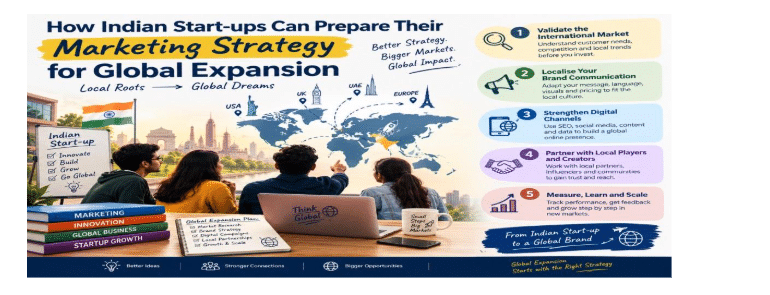
Abstract— Global expansion offers Indian start-ups access to larger customer segments, new revenue opportunities, and international brand recognition. However, entering another country requires more than translating advertisements or increasing digital spending. Start-ups need to understand local customers, adapt their communication, establish trust, and build a marketing strategy that can work across different cultures. Recent developments show that Indian start-ups are increasingly exploring international markets, particularly the United States, United Kingdom, United Arab Emirates, and other regions. This article examines five practical ways Indian start-ups can prepare their marketing strategy for global expansion: validating the target market, adapting brand communication, strengthening digital channels, using local partnerships and creators, and measuring market-specific performance.
Keywords Start-up Marketing, Global Expansion, International Marketing, Indian Start-ups, Digital Marketing, Market Entry.
- INTRODUCTION
India has developed one of the world’s largest start-up ecosystems, giving young companies a strong domestic market from which to build products and brands. However, global expansion introduces a different set of challenges. Customer expectations, purchasing behaviour, competition, regulations, language, and cultural preferences can vary significantly between countries.
A 2025 Economic Times discussion on cross-border scaling highlighted that India’s large and diverse domestic market can act as a testing ground for start-ups before they enter international markets. It also emphasised the importance of product-market fit, standardisation, suitable go-to-market processes, and understanding local cultures.
For start-ups, therefore, international marketing should begin well before entering the new market.
- RESEARCH ANALYSIS
- Validate the Market Before Spending Heavily
The first step is identifying whether a real demand exists in the target country. Start-ups should study customer profiles, competitors, search behaviour, pricing expectations, and purchasing channels.
Instead of launching simultaneously across several countries, a start-up can select one market, test its proposition, and use the results to refine its strategy. This reduces unnecessary marketing expenditure and provides evidence for future expansion.
- Adapt the Brand Without Losing Its Identity
Global marketing does not mean making the brand completely different in every country. The core identity can remain consistent while the communication is localised.
Language, humour, visuals, payment preferences, cultural references, and promotional messages may need modification. A campaign that performs well in India may not automatically produce the same response in the United States or Europe.
This is particularly important because Indian start-ups are increasingly targeting overseas customers. A 2025 Business Standard report found that about 52% of small firms surveyed were expanding cross-border, with the United States, UAE, and UK among the leading export markets.
- Build a Digital-First Global Presence
A start-up entering a foreign market needs to be discoverable before customers are ready to purchase. Search engines, social media, websites, email marketing, online communities, and creator partnerships can help establish awareness.
However, the objective should not simply be to increase followers. Start-ups should connect digital activity with measurable outcomes such as qualified leads, conversions, customer acquisition cost, repeat purchases, and revenue.
AI can also help start-ups scale marketing operations. Reports on Indian startups show growing use of AI and omnichannel strategies for customer acquisition and international growth.
- Use Local Partnerships and Creators
Local knowledge can accelerate market entry. Partnerships with distributors, industry associations, retailers, creators, and local service providers can help a start-up understand customer expectations and establish credibility.
For example, creator-led marketing can introduce a relatively unknown Indian brand to an existing community. The communication should still feel natural rather than appearing as a generic paid advertisement.
Recent start-up marketing trends show that creators are increasingly being used for community-led storytelling and trust building.
- Design Marketing Around Measurable Learning
Global expansion should be treated as a learning process rather than a single campaign. Start-ups can begin with a limited geographic area, measure results, collect customer feedback, and gradually increase investment.
Indian start-ups are already receiving support for this kind of market-entry learning. For example, Antler India’s Embark programme has taken Indian AI and SaaS start-ups to the United States to meet potential customers, attend industry events, and refine go-to-market strategies.
This demonstrates the value of understanding the market directly instead of relying entirely on assumptions made from India.
III. CONCLUSION
For Indian start-ups, global expansion is not simply a matter of selling an existing product in another country. Marketing strategy must evolve with the market. Successful preparation involves validating demand, localising communication, strengthening digital channels, developing local relationships, and continuously measuring customer response.
The growing international activity of Indian start-ups suggests that global opportunities are becoming increasingly accessible. However, sustainable expansion depends on how effectively start-ups combine their Indian strengths with a genuine understanding of international customers.
REFERENCES
[1] The Economic Times, “From Bharat to the world: The cross-border scale playbook for Indian start-ups decoded at the ET Soonicorns Summit 2025,” Oct. 6, 2025. [Online]. Available: The Economic Times article
[2] P. Abrar, “Start-ups use AI, omnichannel push to expand globally, reach deeper locally,” Business Standard, Jun. 28, 2025. [Online]. Available: Business Standard article
[3] Business Standard, “Indian VCs build ‘bridges to America’ as AI startups look westward,” Apr. 29, 2026. [Online]. Available: Business Standard article
[4] U. Srivastav, “Indian start-ups should aim for global prominence, says Piyush Goyal,” Business Standard, Apr. 4, 2025. [Online]. Available: Business Standard article
30 FAQs Using “Startup Marketing”
- What is startup marketing for Indian start-ups?
- Why is startup marketing important for global expansion?
- How can startup marketing help Indian start-ups enter international markets?
- How should Indian start-ups prepare their startup marketing strategy for global expansion?
- How can startup marketing help validate a foreign market?
- What role does startup marketing play in international market research?
- How can startup marketing help identify international customers?
- How can Indian start-ups localise their startup marketing strategy?
- Why is cultural adaptation important in startup marketing?
- How can startup marketing build trust with international customers?
- How can digital channels support startup marketing during global expansion?
- How can SEO improve startup marketing for international markets?
- How can social media strengthen startup marketing globally?
- What role do creators and influencers play in startup marketing?
- How can local partnerships improve startup marketing?
- How can Indian start-ups measure startup marketing performance internationally?
- What startup marketing metrics should Indian companies track during global expansion?
- How can customer acquisition cost influence startup marketing decisions?
- How can Indian start-ups use AI in startup marketing?
- How can startup marketing help Indian SaaS companies expand globally?
- How can startup marketing strategies differ between India and the United States?
- What are the biggest startup marketing challenges during international expansion?
- How can Indian start-ups avoid common startup marketing mistakes?
- How can startup marketing support a digital-first global presence?
- Why should Indian start-ups test one market before scaling startup marketing globally?
- How can startup marketing help adapt pricing and promotional strategies?
- How can customer feedback improve startup marketing in international markets?
- How can Indian start-ups balance global branding with local startup marketing?
- How can startup marketing support long-term international growth?
- What are the best startup marketing strategies for Indian companies expanding globally?
One Marketing Question
How can Indian start-ups use startup marketing to build brand awareness, acquire customers, and establish a strong presence in international markets?
20 Key Takeaways
A well-planned startup marketing strategy can help Indian start-ups turn international expansion into sustainable long-term growth.
Startup marketing plays an important role in helping Indian start-ups prepare for global expansion.
Effective startup marketing begins with validating demand in the target international market.
Indian start-ups should use startup marketing research to understand local customers, competitors, pricing, and purchasing behaviour.
Startup marketing should adapt communication to local cultures without abandoning the brand’s core identity.
Language, humour, visuals, and cultural references can significantly influence startup marketing performance.
A digital-first approach can make startup marketing more scalable across international markets.
SEO, social media, email, online communities, and websites are important startup marketing channels.
Startup marketing should focus on measurable outcomes rather than simply increasing followers.
Customer acquisition cost, conversion rate, qualified leads, repeat purchases, and revenue are useful startup marketing metrics.
AI can help Indian companies improve the efficiency and scalability of startup marketing activities.
Local creators can strengthen startup marketing by helping unfamiliar brands build credibility with existing communities.
Partnerships with distributors, associations, retailers, and local businesses can improve startup marketing effectiveness.
Local partnerships give start-ups valuable customer and market insights that can strengthen startup marketing decisions.
International startup marketing should be tested in a focused market before significant budgets are committed.
Customer feedback is an important source of learning for improving startup marketing in new markets.
Indian start-ups should balance consistent global branding with locally relevant startup marketing communication.
Startup marketing should be treated as a continuous process of testing, measuring, learning, and scaling.
Entering several international markets simultaneously can make startup marketing more expensive and difficult to manage.
Successful startup marketing requires genuine understanding of international customers rather than simply translating Indian campaigns.
Connect Your Brand with Gen-Z
Unlock high-impact youth marketing strategies with EvePaper.
Book Strategy Call