
Study Abroad Scholarships Without IELTS | Global Grants Guide
Published: October 11, 2026
Key Strategy Takeaways
- Explore government scholarships, university-funded awards, and international grants that may be available without IELTS.
- Check whether universities accept alternative English proficiency tests, such as TOEFL, PTE, or Duolingo English Test.
- Investigate IELTS exemption policies for students who have previously studied in English-medium institutions.
- Compare scholarship benefits, including tuition fee coverage, living expenses, accommodation, and travel allowances.
- Verify eligibility criteria, nationality requirements, application deadlines, and English language requirements on official websites.
- Prepare essential application documents, including academic transcripts, a statement of purpose, letters of recommendation, a CV, and a Medium of Instruction (MOI) certificate where accepted.
- Research universities in the UK, USA, Canada, Australia, Germany, and other European countries for potential IELTS alternatives.
- Confirm whether the university admission process and scholarship application have separate English proficiency requirements.
- Avoid misleading claims by verifying scholarship information directly with universities and official funding providers.
- Remember that studying abroad without IELTS does not necessarily mean studying abroad without any English language requirements.
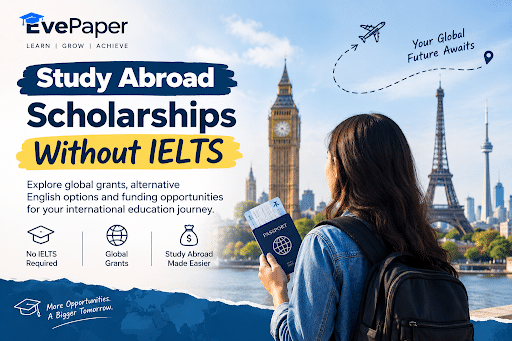
Key Strategy Takeaways
-
Study Abroad Scholarships Without IELTS can help eligible students explore international education opportunities without necessarily taking the IELTS examination. Many universities accept alternative English proficiency tests or offer exemptions to students who meet specific criteria. Understanding these requirements can help students identify suitable scholarships, compare funding options, and prepare stronger applications.
Study Abroad Scholarships Without IELTS | Global Grants Guide
Introduction
Studying abroad can provide access to international education, valuable cultural experiences, and better career opportunities. However, many students believe they must pass the IELTS examination before applying to foreign universities or scholarships. In reality, some universities and scholarship programmes accept alternative methods of demonstrating English proficiency or offer exemptions to eligible applicants.
This has increased interest in study abroad scholarships without IELTS, particularly among students seeking affordable international education. Nevertheless, applicants must understand that eligibility requirements vary by university, course, country, and funding programme.
Can You Study Abroad Without IELTS?
Yes, in certain circumstances. IELTS is one of the most widely recognised English proficiency tests, but it is not the only option available to international students. Depending on the institution, applicants may be able to submit TOEFL, PTE Academic, Duolingo English Test, Cambridge English qualifications, or other accepted evidence of English proficiency.
Some universities also provide English language test waivers to students who have completed their previous education in English. In such cases, applicants may be required to submit a Medium of Instruction (MOI) certificate or other official documentation confirming their language of instruction.
Students searching for scholarships without IELTS should therefore check both the university’s admission requirements and the scholarship provider’s eligibility criteria before applying.
Scholarships and Funding Options Without IELTS
International students can explore several funding opportunities, including government scholarships, university awards, and grants offered by international organisations. Although some programmes may not independently require IELTS, the university providing admission may still impose English language requirements.
Government Scholarships
Several countries offer government-funded scholarships to international students pursuing undergraduate, postgraduate, or research programmes. Depending on the scholarship and host institution, applicants may be able to demonstrate English proficiency through alternative tests or qualify for an exemption.
Scholarship benefits vary considerably. Some programmes provide full or partial tuition fee coverage, while others may include living allowances, accommodation support, travel expenses, health insurance, or research funding.
Applicants should consult the official scholarship website to confirm whether IELTS is mandatory and whether alternative language qualifications are accepted.
University Scholarships
Universities frequently offer scholarships based on academic merit, financial need, research potential, or international student status. These awards may be available to students pursuing bachelor’s, master’s, or doctoral degrees.
English language requirements differ between institutions and academic programmes. A university may accept an MOI certificate or another recognised English qualification instead of IELTS, provided the applicant meets its exemption criteria.
Students should review the university’s scholarship information alongside its admission requirements to determine whether they qualify for both admission and financial assistance.
Global Grants and International Funding
Global grants and international funding opportunities can provide additional financial support for students pursuing higher education, research, or specialised academic projects abroad. Such funding may be offered by international organisations, educational foundations, universities, government agencies, and other eligible funding bodies.
The availability of funding depends on the applicant’s academic background, intended course, nationality, research interests, and the objectives of the programme.
Applicants should carefully distinguish between grants that fund university education and those designed for research, community development, or specific projects. Each funding opportunity may have different requirements for academic performance, English proficiency, admission status, and financial documentation.
Countries Where IELTS Alternatives May Be Available
Students researching study abroad scholarships without IELTS often consider the United Kingdom, the United States, Canada, Australia, Germany, and other European countries.
However, IELTS exemption policies are not uniform across an entire country. Requirements are generally determined by individual universities, programmes, and scholarship providers.
For example, one university may accept proof of previous English-medium education, while another may require IELTS, TOEFL, PTE Academic, or a different approved qualification. Some programmes may also require applicants to meet additional language conditions before enrolment.
Before selecting a destination, students should check the official university website for accepted English proficiency tests, exemption policies, course-specific requirements, and scholarship eligibility conditions.
How to Find Scholarships Without IELTS
Students can follow a structured approach to identify suitable funding opportunities and avoid unnecessary application expenses.
Step 1: Select Universities and Courses
Begin by identifying universities and academic programmes that match your educational background, career goals, preferred destination, and budget. Shortlist institutions that offer scholarships to international students.
Step 2: Check English Language Requirements
Visit each university’s official admissions website and look for information about IELTS exemptions, alternative English proficiency tests, and Medium of Instruction certificates. Confirm whether the exemption applies to your intended course.
Step 3: Research Scholarship Opportunities
Explore university scholarship pages, government funding portals, and recognised international scholarship databases. Review the eligibility criteria and determine whether applicants must secure admission before applying for funding.
Step 4: Verify Eligibility and Deadlines
Check nationality requirements, minimum academic scores, age restrictions where applicable, application deadlines, financial benefits, and language requirements. Confirm whether the scholarship has separate conditions from the university’s admission policy.
Step 5: Prepare the Required Documents
Common application documents include academic transcripts, degree certificates, a statement of purpose, letters of recommendation, a CV or résumé, a valid passport, and financial documentation where required. Applicants seeking an English language exemption may also need an MOI certificate or other supporting evidence.
Preparing these documents in advance can help applicants submit complete applications before the relevant deadlines.
Important Things to Remember
The phrase “without IELTS” does not necessarily mean “without any English language requirement.” Universities may require an alternative recognised test, evidence of previous English-medium education, or another approved qualification.
Applicants should also remember that an IELTS exemption does not automatically guarantee admission or a scholarship. Funding decisions depend on the programme’s eligibility criteria, academic requirements, competition, and available financial support.
Be cautious of websites promising guaranteed scholarships, unconditional admission, or completely free education without verifying the official requirements. Always confirm application procedures and funding details directly with the relevant university or scholarship provider.
Conclusion
Not having an IELTS score does not automatically prevent students from pursuing international education. Some universities and scholarship providers accept alternative English proficiency tests or offer exemptions to eligible applicants.
By researching study abroad scholarships without IELTS, comparing university funding opportunities, and investigating relevant global grants, students can identify programmes that suit their academic qualifications and financial circumstances.
The most important step is to verify the official admission and scholarship requirements before submitting an application. Careful planning can help students avoid unnecessary expenses and make informed decisions about studying abroad.
For more scholarship news and international education tips, visit EvePaper.
Frequently Asked Questions
1. Can I get a scholarship to study abroad without IELTS? 2. Can I study abroad without taking any English proficiency test? 3. Which scholarships are available without IELTS? 4. What documents can replace IELTS for studying abroad? 5. Are scholarships without IELTS fully funded? 6. What are global grants for international students? 7. Do I need university admission before applying for a scholarship without IELTS?
1. Yes, some universities and scholarship programmes allow students to apply without IELTS if they meet specific English language exemption criteria or provide an accepted alternative qualification. 2. Yes, in certain cases. Some universities waive English proficiency tests for students who have completed their previous education in English, subject to their eligibility criteria. 3. Potential options include government-funded scholarships, university scholarships, research funding, and grants offered by international organisations. Requirements vary by scholarship provider and university. 4. Depending on the university, accepted alternatives may include a Medium of Instruction (MOI) certificate, proof of English-medium education, TOEFL, PTE Academic, Duolingo English Test, or Cambridge English qualifications. 5. Some scholarships offer full funding, while others cover partial tuition fees or specific expenses, such as living costs, accommodation, and travel. Applicants should check the official funding conditions. 6. Global grants are funding opportunities offered by universities, governments, foundations, and international organisations to support eligible educational programmes, research projects, and other initiatives. 7. It depends on the scholarship programme. Some require an admission offer before the funding application, while others allow students to apply before securing university admission.
Citations & References
1. British Council. *IELTS: International English Language Testing System.* Available at: https://www.britishcouncil.org/
2. Educational Testing Service (ETS). *TOEFL iBT Test.* Available at: https://www.ets.org/toefl.html
3. Duolingo. *Duolingo English Test.* Available at: https://englishtest.duolingo.com/
4. European Commission. *Scholarships and Funding Opportunities.* Available at: https://education.ec.europa.eu/
5. German Academic Exchange Service (DAAD). *Scholarship Database.* Available at: https://www.daad.de/en/study-and-research-in-germany/scholarships/
6. EducationUSA. *Financial Aid for International Students.* Available at: https://educationusa.state.gov/
Connect Your Brand with Gen-Z
Unlock high-impact youth marketing strategies with EvePaper.
Book Strategy Call