
7 Powerful Campus Podcast Trends Shaping Student Marketing
Published: October 11, 2026
Key Strategy Takeaways
- A small, engaged student audience can offer more value to brands than a larger, less relevant audience.
- Brands should support genuine student conversations instead of relying solely on traditional campus advertising.
- Turn episodes into Instagram Reels, YouTube Shorts, LinkedIn posts, and other social media content to expand reach.
- Connect sponsorships with student interests, including careers, entrepreneurship, technology, personal finance, and campus life.
- Track listens, completion rates, shares, website traffic, event registrations, and conversions to evaluate campaign performance.
- Give student creators creative freedom and provide genuine audience value to maintain trust and long-term sponsorship potential.
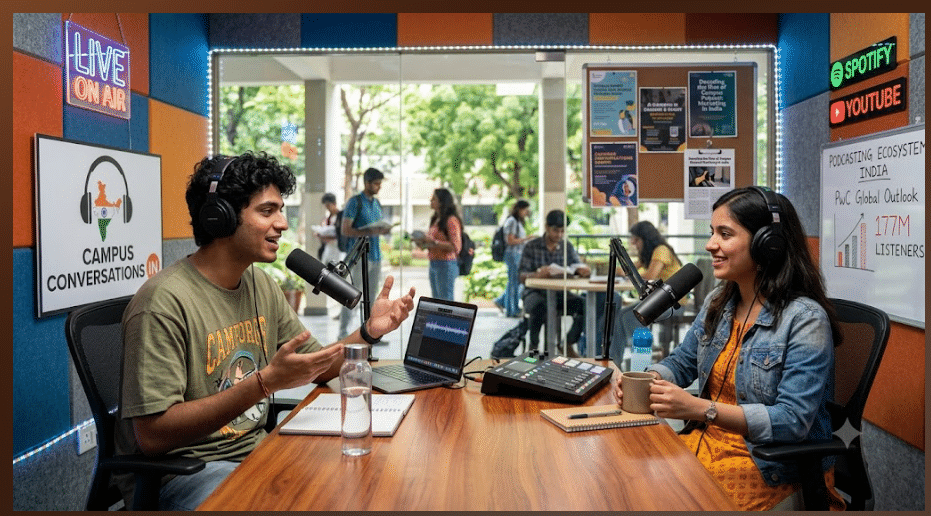
Table of Contents
Introduction: When campus talk meets marketing
India is overflowing with innovations, experiments, and developments that leverage students, influencers, posters, and social media to engage young audiences.
But what about podcasting? Students, societies, publications, faculties, and independent creators are capitalising on the creation of content around campus conversations as both a creative engagement and marketing tool.
India has a thriving podcasting culture — PwC Global Entertainment & Media Outlook 2025–29: India Perspective estimates 177 million monthly podcast listeners in 2024 who are expected to grow to 267 million by 2029.
While it will be hard to estimate the “campus podcast audience” since there are no reader analyses for podcasts, these are the benchmarks against which campus podcasts will be measured.
For colleges, it is an opportunity to market their campus and culture; for companies, it is an opportunity to connect with young consumers; and for students, it is an opportunity to participate in quality productions and distribution.
For brands, a campus podcast can become a useful part of student marketing by creating relevant conversations rather than relying only on traditional campus advertising.
Hence, campus podcast marketing will be a fascinating space to watch.
What Is Campus Podcast Marketing
Campus podcast marketing consists of a broad range of content created by or around campuses that can be leveraged to engage students.
It can take multiple forms, including the campus society that decides to create content around conversations, an entrepreneurship cell that features conversations with founders, the university that creates content around its faculty, or a magazine that covers careers and the campus culture.
Companies can sponsor such podcasts, be involved in the creation of content in partnership with such student creators, or support them with resources, interviews, or other content.
Instead of a company leveraging its campus budget to create an advertisement at a campus event, it could sponsor a podcast episode that could discuss technology, campus internships, and entrepreneurship and the role of the company therein.
The beauty of podcasts is conversation, and in that conversation lies the opportunity for companies and students to connect, without intrusive interruption.
Wherever possible, companies should strive to be a part of conversations, rather than interrupt or intrude.
Why are campus podcasts becoming popular?
Students Want Relatable Conversations
Students are exposed to multiple short-form advertisements, social media influencers, and other verticals; podcasts offer an alternative conversation where a student can spend thirty or forty minutes listening to another student and discussing topics of mutual interest.
It is about relatability and students connecting with students on issues of relevance.
It fits in with the broader campus advertising trends, where companies are realising the value of student ambassadors, as a student voice can often prove more effective than a company representative.
The value of podcasts as a medium is that this relatability can be leveraged beyond a single social media post and be part of a longer conversation.
India’s thriving podcasting culture
India is a land of smartphones and internet users, and a propensity to consume digital content.
The aforementioned PwC report highlighted several reasons why podcasting will thrive in India, ranging from smartphones/internet to overall consumer appetite for digital content.
It estimates that podcast advertising will grow, while remaining a small fraction of overall digital ad spending, making it an interesting medium for advertisers with a young audience, due to a combination of a large market at an inflexion point.
Colleges can be natural ecosystems for experimenting with podcasts as a medium, as a way to test a micro-audience, rather than trying to reach everyone at once.
While a podcast with a hundred million downloads will be great for the creator, a campus podcast with a mere few thousand engaged listeners can be much more valuable to a brand marketer, due to relevance.
A similar-sized audience, but with no interest in the subject, will have very limited value.
Technology Has Made Podcasting Accessible
Lower Production And Distribution Costs Have Democratised Podcasting
Podcasting used to be a medium for the elite – requiring mics, recording studios, and mixing, but smartphones have democratised production and lowered the barriers to entry, leading to an explosion in both supply and demand.
The same can be said for editing, which has become much more accessible due to a combination of technology and tools.
With online platforms, such as YouTube, Spotify, and more, distribution has also become much more accessible, enabling accessibility and ubiquity.
An accessible ecosystem has led to increased production and distribution, which has led to increased consumption, and with it – advertiser budgets.
As for the format itself, podcasts have become much more fluid, with conversations being converted into a YouTube video, a Spotify podcast, an Instagram Reel, a YouTube Short, a LinkedIn post, a WhatsApp message, and more.
This fluidity is critical, since it enables a single conversation to be converted into multiple pieces of content, spanning multiple platforms and multiple formats.
It is hardly surprising that social media influencers play a big role in podcasts, due to consumption patterns.
Social Media Is Turning Podcasts Into Content Engines
The Relationship Between Podcasts And Social Media Is One Of The Most Exciting Trends In Campus Podcasting
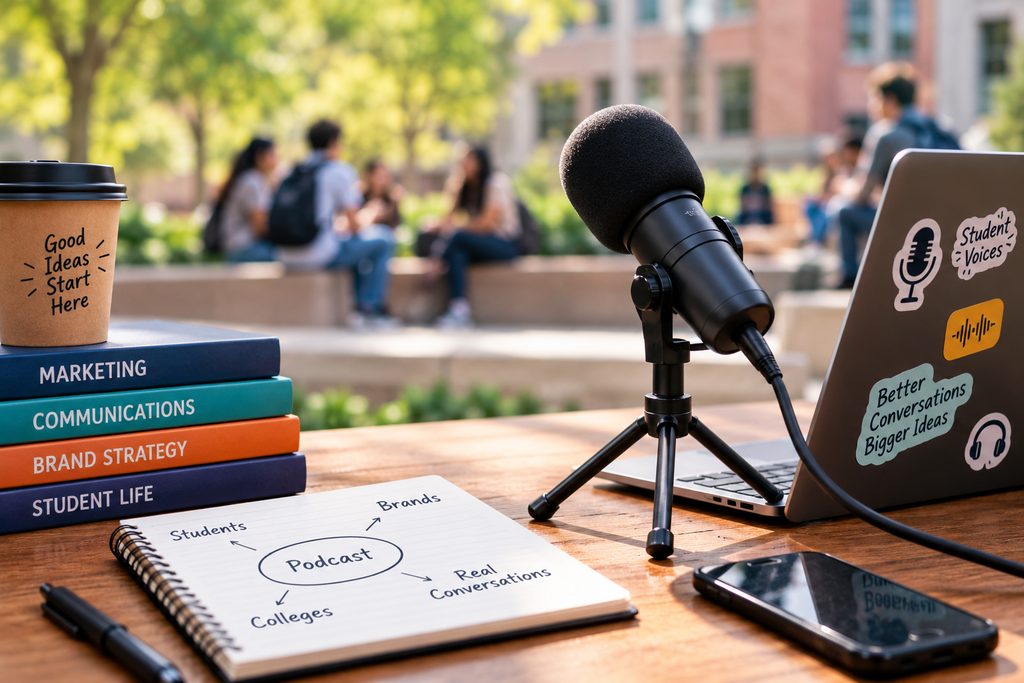
Podcasts and social media are consuming conversations and turning them into content.
A forty-five-minute interview can be turned into multiple pieces of content,
ranging from social posts
highlight clips
YouTube Shorts
Instagram Reels
WhatsApp messages
LinkedIn posts
and more, as part of a broader content campaign.
In the context of campus podcasts, it is important to note that social media offers discoverability, since a student will stumble upon a podcast via a social post, rather than the other way around.
It makes social media a discovery vehicle, and not a replacement, for podcasts, since the two can work together – with social media posts driving traffic to podcasts, and podcasts providing long-form content.
Examples from Indian Campuses
India’s Campus Podcasting Space Is Still Emerging, But There Are Already Some Interesting Podcasts Worth Highlighting.
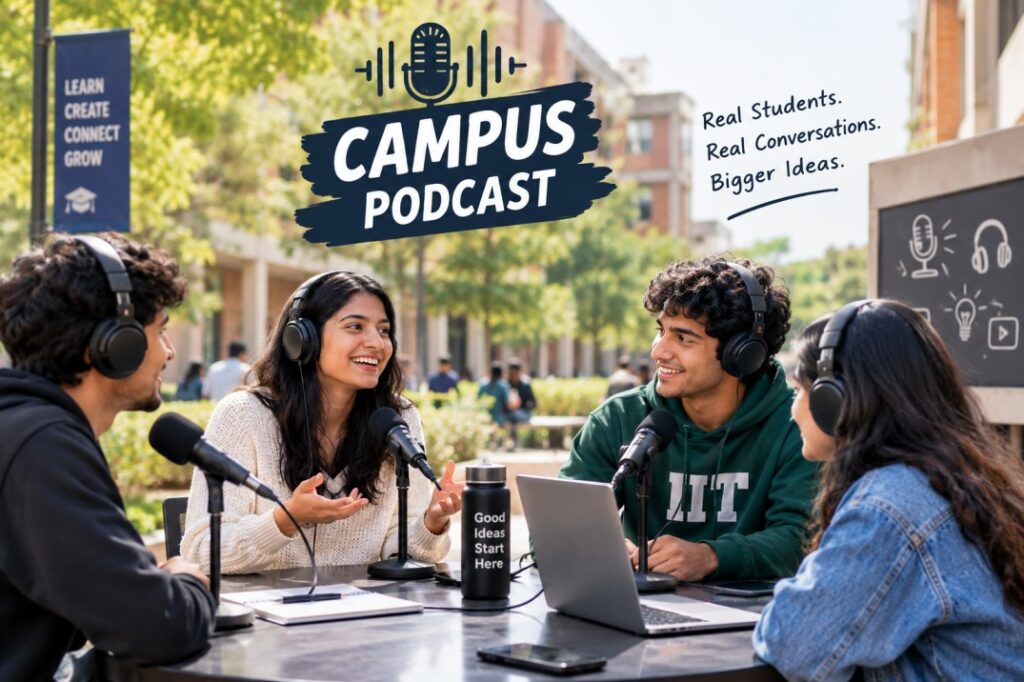
The podcast Insti Fundays covers a range of topics, featuring conversations and stories from across IIT Madras, and is created by The Fifth Estate at IIT Madras.
Another IIT Madras podcast, TOS: The Other Side, spotlights stories from students, featuring conversations about their thoughts on the choices they make in college.
The Stories of IITM BS podcast covers conversations with students and faculty of the IIT Madras BS Degree Programme about their journeys and achievements.
There are also independent student podcasts, such as Campus Startups, which cover young Indians and entrepreneurship.
These are just a few examples, but they highlight the potential of campus podcasts, ranging from entertainment to education, featuring the institute, careers, or influencers/entrepreneurs.
For companies, it is an opportunity to engage these student creators and/or the audiences that they represent.
How can companies use campus podcasts?
When It Comes To Leveraging Campus Podcasts, It Is Important For Companies To Think Creatively
When it comes to podcasts, it is often useful to think of them as content partnerships, since they often involve providing value to students, rather than straight-up advertising.
Let us imagine the requirements of a financial-services company that wants to target students.
Instead of straight advertising, the company could sponsor an episode of a podcast, titled something like Money After College.
The episode could then explore money and personal finance,
ranging from the first salary
Savings
transitioning from student to professional
Budgeting
starting a small business
an introduction to digital payments.
The company could provide speakers/resources, while leaving the conversation to the students.
A similar approach could be taken by a technology company, sponsoring a podcast episode around student productivity, or a recruitment company, sponsoring a conversation around alumni and careers.
It is about identifying relevant topics for students, while providing useful information/resources to the audience.
What student creators bring to podcasts
One Of The Most Interesting Assets Of Student Podcasts Is Authenticity, Which Is Critical To Any Conversation
While corporate podcasts can offer authenticity, student podcasts offer something different, which is why many creators choose to do them – it is all about authenticity.
Not that corporate podcasts are not authentic, but student podcasts offer a different kind of conversation, which is what many creators seek.
A student creator can ask a difficult question to an alumnus, asking them about what they wish they knew before they graduated, and get an honest answer that resonates with other students.
That is the kind of authenticity that student creators bring to podcasts, and why they should be considered as conversation facilitators, since youth-marketing companies are already gravitating towards student ambassadors and influencers.
In many ways, students can extend their ambassadorial roles as podcast hosts, facilitating conversations on topics of interest, rather than straight advertising.
It is a win-win for everyone involved.
Opportunities for colleges and universities
Colleges And Universities Can Also Leverage Podcasting, Either By Facilitating Student Creators, Or By Creating Their Own Campus Podcasts
There are multiple avenues for exploration, ranging from alumni spotlights, where graduates are interviewed about their careers, to faculty spotlights, where professors are interviewed about their area(s) of specialisation/research, to students’ club spotlights, where students can share information on their clubs, events, competitions, etc.
There are also opportunities with career spotlights, where recruiters and alumni can be invited to converse about the corporate world and how students can prepare for it, and entrepreneurship spotlights, where student founders and alumni can share their journeys and lessons learned.
Universities can use podcasts to highlight their strengths, as well as engage their students.
Not many students will connect with a university brochure, but many will connect with real students, alumni, and faculty on a personal level, encouraging them to apply.
The role of data and measurement
The Challenge For Podcast Marketing Is Often Proving Value, Which Podcasts Often Struggle With, And This Is Where Colleges And Companies Need To Think Of Metrics That Make Sense
Quantity, engagement, impressions/views, etc., would be some of the metrics that podcast marketers will need to consider, at least at the beginning.
Some of the metrics could include total views/listens
average time on podcast/view
episode completion rate
social media likes
Shares
Comments
website traffic
QR code scans
event sign-ups/attendance
trials/conversions
student engagement/actions
A company that sponsors a career podcast could track website traffic/views and event sign-ups as a measure of impact. Creators can also use Spotify for Creators audience analytics to understand who is listening and how audiences return to a show.
It makes podcasts comparable to other marketing initiatives, but it is important not to underestimate the value of conversation.
While students may not sign up for a placement drive after listening to a sponsored podcast episode, they may remember the conversation and revisit the podcast, if not the company, later.
The same applies to colleges, which need to think in terms of brand recall, rather than placements, when it comes to podcasting.
Challenges Facing Campus Podcasters
Discoverability
Anyone Who Has Launched A Podcast Knows The Challenge Of Discoverability, Since It Is Not Enough To Create Content – There Needs To Be An Audience
It is one thing to record a podcast, but quite another to get it in front of people.
Student creators will need to think creatively about driving traffic to their podcasts, which may include collaborating with other creators.
Maintaining Consistency
College Students Often Have Multiple Responsibilities, Which Can Make It Difficult To Be Consistent With Podcasting
Student teams will need to think about sustainability, including succession planning, so that there is always someone to carry the podcast, rather than suddenly stopping when the founding members graduate.
Limited Budgets
Most Student Podcasts Are Made On Very Limited Budgets, Which Is Understandable Given The Costs Involved
Sponsors and colleges will need to think about budgets, both in terms of production, as well as promotion.
Measuring ROI
Podcast Advertising In India Is Still An Emerging Space, Which Makes It Hard To Think About Return On Investment At Least In The Short Term
Colleges and companies will need to think in terms of engagement/views/impressions, as part of a metrics-driven approach to podcasts.
Maintaining Authenticity
At Some Point, Student Podcasts Will Need To Think About Monetisation, Which Can Often Undermine Authenticity, And This Is Something Sponsors Will Need To Think About
Authenticity is often the reason why student podcasts exist, and having every episode sponsored can turn away student listeners, who feel that the conversation is compromised.
Sponsors will need to think carefully about the value that they bring to student podcasts.
Recommendations For Brands
For Companies, The Challenge Often Lies In Thinking Creatively About Campus Podcasts, As A Way To Engage Students
That means identifying a relevant audience, being creative about topics/formats, thinking about reach versus relevance, being flexible about creative freedom within parameters, utilising other content pillars, and measuring engagement/views, rather than reach.
Relevance often drives reach – and a smaller audience that engages with a podcast can often be more valuable than one with a larger audience that does not engage at all.
Companies should also think about a series, rather than a one-off episode.
Recommendations For Colleges
For Colleges, It Is Often About Thinking Strategically About Podcasting
That means identifying objectives, thinking about the value to students beyond podcast production, being careful about roles and succession planning, and considering collaborations with alumni, companies, and/or media partners, if applicable.
What Does The Future Hold
Podcasting Will Be Defined By Video, Social Media, Creator Culture,
The creator economy will drive the future of podcasts, as will short-form content, long-form, and everything in between, utilising multiple platforms in the process.
The rise of regional language podcasts, as predicted by the PwC report, will see Hindi creators in Delhi, Tamil creators in Chennai, Bengali creators in Kolkata, and others create content in their respective languages for their regional audiences.
AI will play a role in making production and distribution accessible at an entry level, through transcripts, subtitling, translations, summaries, and more, but human conversations will continue to drive podcasts, with the help of technology.
The future of podcasts will be defined by an ecosystem approach, spanning long-form and short-form, video and audio, social media and podcasts, and multiple platforms, in an effort to maximise reach and engagement.
Conclusion: from campus advertising to campus conversations
Campus podcasts will continue to be a vital force in youth marketing for the foreseeable future, at least until independent data sets emerge that quantify it as a unique advertising medium.
With that said, there are trends that will shape the future of campus podcasting, ranging from India’s broader ecosystem and consumption patterns to the need for young creators to participate in the creator economy, and the value of conversation for both students and companies.
Colleges can benefit from encouraging student voices, engaging alumni, and attracting students with authentic content.
Students can leverage podcasts to hone their communication, research, production, marketing, and distribution skills, while companies can utilise podcasts to engage young consumers and build brand equity.
The future of campus podcast marketing will be defined by the right balance between these opportunities, with companies and students collaborating to realise value for both audiences and sponsors, and with relevance being key, alongside strategic partnerships between student podcasters, universities, and companies, and careful measurement of engagement and impact.
Frequently Asked Questions
1. What is a student podcast?
A student podcast is an audio or video show created by students to discuss campus life, education, careers, entertainment, entrepreneurship, and student experiences.
2. What is a start-up student podcast?
A start-up student podcast explores entrepreneurship, business ideas, funding, innovation, and founder experiences, helping students understand how to launch and grow businesses.
3. What is the student survival podcast?
A student survival podcast shares practical advice on managing academics, budgeting, friendships, mental well-being, time management, and everyday challenges of university life.
4. What is the student paramedic podcast?
A student paramedic podcast discusses emergency medical training, clinical placements, patient care, professional challenges, and experiences of students preparing for paramedic careers.
5. How can campus podcasts support student marketing?
Campus podcasts support student marketing by helping brands reach relevant student audiences through authentic conversations, sponsorships, creator partnerships, and engaging educational content.
6. Why are campus podcasts becoming popular in India?
Campus podcasts are gaining attention because affordable technology, smartphones, social media, and accessible publishing platforms make student content creation easier.
7. How can colleges benefit from campus podcasts?
Colleges can use campus podcasts to showcase student achievements, faculty expertise, alumni experiences, campus culture, academic programmes, and career opportunities.
8. How can companies use campus podcasts for advertising?
Companies can sponsor relevant podcast episodes, collaborate with student creators, share useful resources, and introduce products through conversations rather than intrusive advertisements.
9. How can students start a campus podcast?
Students can start by selecting a relevant topic, using a smartphone and microphone, planning episodes, recording conversations, and distributing content online.
10. How can brands measure campus podcast marketing success?
Brands can track listens, views, completion rates, social shares, website traffic, QR code scans, event registrations, conversions, and student engagement.
11. What are the main challenges of campus podcasting?
Common challenges include limited budgets, inconsistent publishing, audience discovery, measuring return on investment, and maintaining authenticity when working with sponsors.
Connect Your Brand with Gen-Z
Unlock high-impact youth marketing strategies with EvePaper.
Book Strategy Call