
Running a Mock Counselling Session for NEET PG Aspirants
Published: November 15, 2026
neet pg counselling
Helping candidates make informed choices before the real counselling begins
For a lot of med graduates, clearing NEET PG is just the beginning of another very tough phase which is counselling. After all the hard work, all the hours of study and the stress of the entrance exam, you’re now faced with having to make decisions which will in many cases determine the trajectory of your training and your career. You have to understand the counselling process, you have to evaluate your options and you have to respond to the various deadlines that come your way, all of which will be under a degree of uncertainty as to your rank, your fees, your location and your specialty.
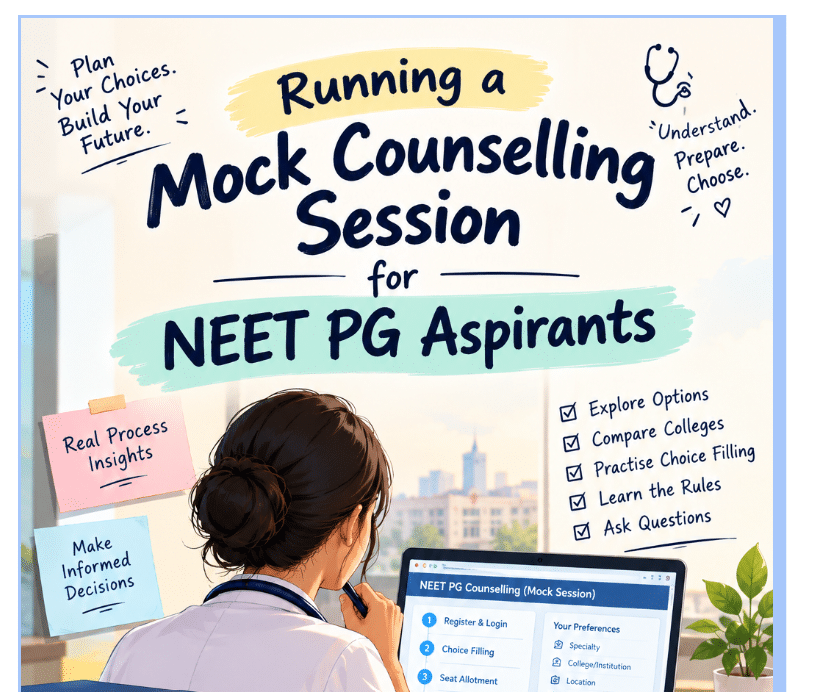
A mock counselling session can go a long way to reduce the intimidation factor. It provides the NEET PG aspirant with an opportunity to go through the key stages of counselling in a guided, low pressure environment and thus get a feel for the process, learn what information they need to have and identify the questions they may have prior to actual counselling taking place.
Why a mock session matters
Counselling is of course more than just picking your preferred speciality. You may have to compare institutions, check seat availability, work out your eligibility and reservation rules, consider the cost of tuition and cost of living and so on. It can be a very confusing process if you’re not at all familiar with the jargon and you’re trying to make sense of a number of different options at the same time.
A mock session will help the participants get a feel for the sequence of decisions. It can also highlight any gaps in their understanding (e.g. confusion about choice filling, locking of choices, reporting requirements or the effect of accepting a seat).
Most importantly it creates the space to ask questions without the pressure of an actual deadline. You can learn from your mistakes whilst you still have the time to check the facts and to prepare.
Setting up the session
A useful mock counselling session is one where the ground rules are very clearly laid out. You need to make it absolutely clear that this is a learning and practice exercise and not the actual counselling process. It should not in any way be construed as guaranteeing you a seat, or predicting your final allocation, or in any way substituting for the instructions you would normally receive from the actual counselling body.
Before the session participants can be asked to bring in their NEET PG rank or a sample rank, a list of their preferred specialties, preferred locations and an approximate budget. Organisers should of course not collect any unnecessary personal details. If sample candidate profiles are being used they should be fictional or anonymised.
The session can be run in small groups with a facilitator going through each stage with the participants. There could be a very brief introductory presentation to explain what the exercise is about, the rules and where the candidates can go to check the official information.
Step one: understand the candidate’s priorities
Before you look at colleges you need to work out what’s most important to you. Some people will have a very specific specialty in mind, others may be quite flexible on that but will want to be as close to family as possible. Some will be all about government institutions and affordability, others will be quite broad in their approach and be open to a range of locations.
Participants can create a simple priority list, splitting the essential from the nice to have. One candidate may have a fee range that is absolutely non-negotiable, location being a matter of preference. Another may have specialty as number one and be willing to consider a number of states.
This exercise serves to remind the candidate that there is no one “best” option for everyone. The decision you make will be one that reflects your own individual priorities, your own practical circumstances and the actual facts of the situation rather than simply what everyone else is doing.
Step two: practise reviewing options
Organisers can provide a list of fictitious institutions and seats (clearly marked as such) for candidates to use as a sample. The candidates can then go on to compare the options against each other using the relevant criteria such as specialty, institution, location, fees, bond conditions etc.
The aim isn’t to learn a list of universities. It’s about learning how to assess information in a systematic way. People should be encouraged to check whether a piece of information is up to date and whether it’s relevant to their own route through counselling.
A comparison sheet can be of use in helping the candidate to structure their thinking. It could contain the institution, the specialty, the estimated total cost, the location, the key conditions and the reason for including it on the preference list. Any information which is in any way uncertain should be flagged for verification rather than treated as fact.
Step three: simulate choice filling
Once the candidates have got a clear understanding of their own priorities and have had a chance to look at the options available to them they can begin to work on the actual ordering of their preferences. Facilitators can provide some sample scenarios to work through e.g. a candidate who is prepared to move for their preferred specialty, or a candidate who absolutely has to stay within a very tight budget.
The exercise is to make it clear that candidates need to be absolutely clear about the official rules before they make or lock any choice. You should not be relying on any assumptions as to how the system will treat your preferences. You need to read the current instructions very carefully and if there’s anything you’re at all in doubt about you should check it with the official source.
Once you’ve submitted your practice list you can then go on to explain why you’ve placed certain items where you have. That can be a very useful exercise in terms of working out whether your list actually reflects your own priorities or whether it’s been influenced by the pressure of friends and family and/or what’s been going on online.
Step four: learn from a sample allotment
A mock session could involve a completely fictional allotment result and ask the participants what they would do next. They could discuss what documents they would need, what questions they would ask and what deadlines they would check.
Facilitators mustn’t be in the position of presenting sample outcomes as if they were predictions. The actual allocation will be determined by the official process and the individual circumstances. The whole point is to get people to practise responding in a calm and systematic way, not to give any kind of guarantee as to what the outcome will be.
Candidates should also be reminded to read the relevant rules prior to deciding whether to accept, upgrade, withdraw or go on to the next round. The options available and the implications of those options can differ from one counselling body to another and from one round to the next.
Common mistakes the session can help prevent
A mock exercise can expose the sort of habits that can lead to a very rapid decision. People can be seen to list institutions without checking the full cost, can completely ignore the conditions of a seat, can put their choices in an order which is not in any way reflective of their actual priorities. Some will be entirely reliant on off the record advice and others will simply assume that last year’s cut-off will be the same this year.
The session should be about stopping and checking. Official notices should be to hand, all the deadlines should be tracked, all the documents that you’re going to need should be in your possession and if you’re at all in any doubt as to what a rule is you should seek clarification. You should be wary of any message or claim that suggests you’re going to be guaranteed a place.
Making the session useful for everyone
The best mock counselling sessions are interactive and non-judgemental. People should be able to ask the obvious questions without feeling awkward. You can finish the session off by asking each person to say one thing they’ve learned and one issue they still need to check on.
A very short follow up checklist can help them turn it into a preparation exercise: go through the official counselling schedule, check eligibility and documents, compare the options, know the rules of each round and keep a close eye on the deadlines.
Practice now, decide with confidence later
NEET PG counselling can be a bit like a second exam really. It can be quite daunting but if you’re properly prepared it can be a lot easier. A mock counselling session is a good way of getting the hang of the decisions, the comparisons and the checks you’ll be making during the actual process.
It can’t eliminate the uncertainty or guarantee you’ll get your preferred seat. What it can do is help a candidate to go into the counselling process with a much clearer set of priorities, a much better set of questions and a far more coherent plan. That preparation can make a huge difference when the actual choice comes to be made.
References
- Medical Counselling Committee (MCC), Official NEET PG counselling information and notices. https://mcc.nic.in/
- National Board of Examinations in Medical Sciences (NBEMS), NEET-PG examination information and notices. https://natboard.edu.in/
15 FAQs: Running a Mock Counselling Session for NEET PG Aspirants
- What is the purpose of organising a mock counselling session for NEET PG aspirants?
- How can mock counselling help candidates prepare for the actual NEET PG counselling process?
- What documents and information should candidates bring to a NEET PG counselling practice session?
- Why is it important for aspirants to identify their specialty, location and budget priorities before counselling begins?
- How can candidates compare medical colleges based on specialty, fees, location and bond conditions?
- What is choice filling in NEET PG counselling, and how can candidates practise arranging their preferences?
- Why should candidates carefully review the official counselling rules before locking their choices?
- How can a mock counselling session help candidates understand seat allotment procedures?
- What should NEET PG aspirants do after receiving a sample seat allotment result during a practice session?
- Why should candidates verify college fees, seat availability and eligibility conditions before adding institutions to their preference lists?
- What are the common mistakes candidates should avoid during NEET PG counselling?
- How can candidates manage family expectations and external pressure while making counselling decisions?
- Why is it important to understand the rules for accepting, upgrading, withdrawing or retaining an allotted seat?
- How can facilitators ensure that a mock counselling session provides accurate guidance without promising admission or predicting seat allotments?
- Where can NEET PG aspirants find official counselling schedules, eligibility requirements and admission updates?
20 Key Takeaways
- NEET PG counselling is an important stage of the postgraduate medical admission process, requiring candidates to make informed decisions about specialties, institutions and locations.
- A mock counselling session gives aspirants an opportunity to understand the admission process in a guided and low-pressure environment.
- Practising the counselling process can help candidates identify gaps in their knowledge before actual registration and choice filling begin.
- Candidates should establish their priorities, including preferred specialties, institution types, locations and budget limitations, before evaluating available options.
- Understanding individual priorities helps aspirants avoid making admission decisions solely because of peer pressure or external expectations.
- A systematic comparison of medical colleges can help candidates evaluate tuition fees, location, specialty availability and bond conditions.
- Candidates should calculate the overall cost of postgraduate medical education rather than considering tuition fees alone.
- Mock counselling organisers should use fictional or anonymised candidate profiles to protect participants’ personal information.
- Practising choice filling helps aspirants understand how to arrange their preferences according to their individual requirements.
- Candidates must carefully review the latest official counselling guidelines before submitting or locking their choices.
- Sample allotment exercises can help aspirants understand the possible next steps after receiving a seat allocation.
- Candidates should familiarise themselves with reporting requirements, necessary documents and important counselling deadlines.
- The rules concerning seat acceptance, upgradation, withdrawal and participation in subsequent rounds must be verified through the relevant official counselling authority.
- Previous years’ cut-offs can provide context but should not be treated as guaranteed indicators of current-year seat allotments.
- Candidates should avoid relying exclusively on unofficial advice, social media claims or unverified admission predictions.
- Facilitators should clearly communicate that mock counselling is a practice exercise and cannot guarantee admission or predict actual seat allocation.
- Interactive discussions allow participants to clarify doubts about eligibility, institutional preferences and the counselling process.
- A preparation checklist covering documents, deadlines, eligibility and official notices can make the actual NEET PG counselling process more manageable.
- Candidates should independently verify all important admission information through the Medical Counselling Committee (MCC) and the National Board of Examinations in Medical Sciences (NBEMS), as applicable.
- Effective mock counselling helps NEET PG aspirants develop confidence, organise their preferences and approach postgraduate medical admissions with a more informed decision-making strategy.
Core Marketing Question
How can a mock NEET PG counselling session help postgraduate medical aspirants understand the admission process, compare institutions, organise their preferences and make confident, well-informed decisions before participating in actual counselling?
Add concise answers to FAQsTurn the questions into marketing FAQs
Connect Your Brand with Gen-Z
Unlock high-impact youth marketing strategies with EvePaper.
Book Strategy Call