
It’s time to retire the student traveler stereotype: the backpacker who “finds themselves” on some flawless beach. This tiresome cliche simply bypasses the gritty, uncomfortable, and scientifically documented fact of what happens to young adults when they leave their home environment.
True cultural travel is not a vacation; it’s a stress test for your identity.
For students these days, the process of stepping out of the academic bubble has little to do with sightseeing and more to do with cognitive restructuring. Research from the *Journal of Personality and Social Psychology* suggests that long-term engagement with foreign cultures doesn’t just change your mood, it changes how your brain processes information.
These are a few ways in which cultural immersion dismantles and rebuilds the student experience.
1.Cognitive Flexibility Over Classroom Theory
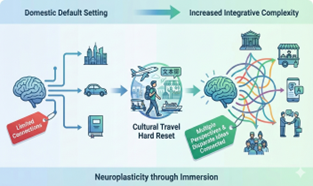
One such academic, Adam Galinsky of The Columbia Business School, has done a raft of research on the connection between international travel and neuroplasticity. He says his findings show that merely visiting a place has little consequence. But deep immersion—being among locals, finding transit systems, and adapting to new norms—raises “integrative complexity.” This refers to the brain’s ability to make connections across ideas.
You are not only buying a souvenir, but you are showing mental flexibility that a lecture hall simply cannot simulate when you have to haggle over a price in a language you barely know.
2. The Death of the “Main Character” Syndrome
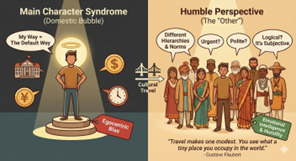
One of the most important parts of the youth experience is coming to realize your worldview is not the default. On your home campus, in your city, your way of life is secured every day.
Traveling strips this validation away. You are the “other”.
The realization of different cultural hierarchies pushes one to confront his or her own personal biases. You realize that your definition of punctuality, politeness, or success is quite subjective. This rather uncomfortable realization makes for a more grounded and less ego-centric personality.
3. Resilience Through Micro-Failures
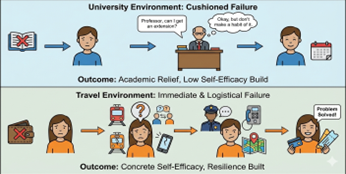
Let’s face it: Travel goes wrong. Trains get missed, reservations get lost, and scams happen.
Any sort of failure is usually cushioned or academic in most controlled university environments; on the road, it’s immediate and logistical. If you lose your wallet in a foreign country, you can’t call a professor for an extension; you have to solve the problem now.
This builds what psychologists refer to as “self-efficacy,” a belief in your capability to perform behaviors that will lead to specific performance attainments. Making it through the chaotic trip provides you with real evidence that you can handle high-pressure situations.
4. Unpacking of Vocational Identity
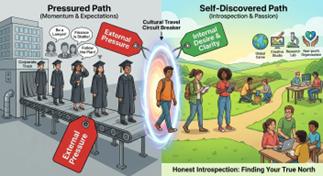
Most students, because of momentum, rush through degrees they are not sure they want; cultural travel acts as a circuit breaker.
Data from the WYSE Travel Confederation indicates that a large percentage of young travelers report that their travel experiences clarified goals and career paths. Stepping away from the pressure of peer groups and family expectations allows for honest introspection. You may find the corporate law track you are on is a product of external pressure rather than internal desire.
5. The “Soft Skills” Differentiator
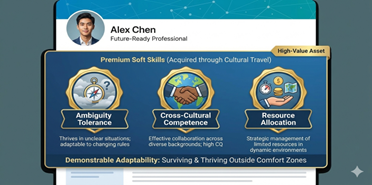
Employers are increasingly skeptical of GPAs as the sole metric of potential. They’re looking for adaptability and skills.
A student who has successfully travelled in a foreign culture exhibits certain high-value soft skills:
- Ambiguity, the ability to function when rules are unclear
- Cross-cultural competence ability of a person to work with individuals from other backgrounds
- Budget Management: real-world resource allocation.
The youth experience of finding their way in a foreign ecosystem proves that one can survive outside of one’s comfort zone. “Adaptability” ceases to be a buzzword on a resume and becomes a proven fact.
The Verdict
There’s nothing magical about travel. If you’re staying in some resort, then you’re going to come back exactly as the person you were when you left. But if you do real cultural travel—embrace the difficulty, the confusion, the novelty—you engage in the best self-education available. It’s not about where you go; it’s about how willing you are to let an experience dismantle who you thought you were.
References
[1] J. Zimmermann and F. J. Neyer, “Do we become a different person when hitting the road? Personality development of sojourners,” Journal of Personality and Social Psychology, vol. 105, no. 3, pp. 515–530, Sep. 2013. [Online].
Available: https://psycnet.apa.org/record/2013-17805-001
[2] W. W. Maddux and A. D. Galinsky, “Cultural borders and mental barriers: The relationship between living abroad and creativity,” Journal of Personality and Social Psychology, vol. 96, no. 5, pp. 1047–1061, May 2009. [Online].
Available: https://pubmed.ncbi.nlm.nih.gov/19379034/
[3] D. K. Deardorff, “Identification and assessment of intercultural competence as a student outcome of internationalization,” Journal of Studies in International Education, vol. 10, no. 3, pp. 241–266, Fall 2006. [Online].
Available: https://journals.sagepub.com/doi/10.1177/1028315306287002
[4] L. Brown, “The transformative power of the international sojourn: An ethnographic study of the international student experience,” Annals of Tourism Research, vol. 36, no. 3, pp. 502–521, Jul. 2009. [Online].
Available: https://www.sciencedirect.com/science/article/abs/pii/S016073830900046X
[5] M. M. Dwyer and C. K. Peters, “The benefits of study abroad,” Transitions Abroad, vol. 37, no. 5, pp. 56–57, 2004. [Online].
Available: https://www.iesabroad.org/system/files/atoms/file/IES%20Abroad%2050-year%20Alumni%20Survey%20Results.pdf
FAQs on Cultural Travel
Q1. What is cultural travel?
Cultural travel is a form of travel where individuals immerse themselves in the local culture, traditions, language, and daily life of a destination rather than staying isolated in tourist resorts.
Q2. How is cultural travel different from regular tourism?
Unlike regular tourism, cultural travel emphasizes interaction with local communities, understanding cultural norms, and adapting to unfamiliar environments instead of comfort and convenience.
Q3. Why is cultural travel important for personal growth?
Cultural travel helps individuals develop adaptability, problem-solving skills, and emotional resilience by exposing them to unfamiliar situations and diverse perspectives.
Q4. What skills does cultural travel develop?
Cultural travel develops cross-cultural competence, tolerance for ambiguity, communication skills, budget management, and real-world decision-making abilities.
Q5. How does cultural travel improve career readiness?
Employers value candidates who can adapt, collaborate across cultures, and think independently—skills that are naturally strengthened through cultural travel experiences.
Penned by Sanskriti
Edited by Pranjali, Research Analyst
For any feedback mail us at [email protected]
Transform Your Brand's Engagement with India's Youth
Drive massive brand engagement with 10 million+ college students across 3,000+ premier institutions, both online and offline. EvePaper is India’s leading youth marketing consultancy, connecting brands with the next generation of consumers through innovative, engagement-driven campaigns. Know More.
Mail us at [email protected]