
Topics: Data Pipelines, Cloud Computing
Introduction
Current organisations rely greatly on Data Pipelines to extract, process, and analyse information from multiple sources. ETL Workflows have been the backbone of business analytics as one of the most widely adopted methods of performing data integration. However, with the evolution of cloud infrastructure and storage solutions, there is a desire among organisations to look into alternative methods of enhancing Data Pipelines and re-evaluating ETL Workflows. Individuals must understand the difference between ETL and ELT before making an architecture decision.
Understanding ETL Process
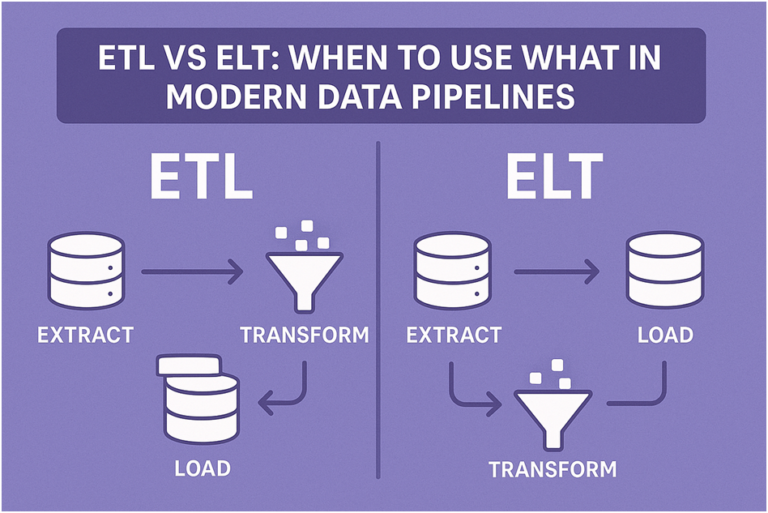
ETL is an acronym that expands to Extract, Transform, and Load. In this method, the data is extracted from the source systems, transformed in the processing layer, and finally loaded into the target data warehouses. The ETL method is best suited for dealing with the issue of data quality
ETL was classically implemented within an on-premise model due to fewer computing resources available, and since the rules regarding the business transformations must be adhered to. With data undergone through transformations and loading activities, an organisation makes sure that only known data is loaded within the data warehouse.
The ELT process differs from ETL in terms of where the transformations occur. The ELT process entails the following steps: Extract, Load, and Transform. Here, the data is extracted from the source systems and loaded into the target environment, which is most likely to be the data warehouse and data lake located in the cloud. Transformation takes place in the target environment.
ELT has also witnessed rising adoption because of its scalability and economies of scale, which are now possible because of cloud computing platforms. It is because ELT is very helpful in storing raw data in its source form. ELT is perfect for data science and fast testing, as there is no need for data re-extraction
Differences Between ETL and ELT
The main point of difference between ETL and ELT is based on Transformations. ETL performs transformation before loading, while transformation is done only after loading in the case of ELT. ETL is employed when data is structured, while ELT is employed when data is semi-structured or unstructured.
ETL is more performance-oriented because it cuts down the data load on the data warehouse,” wherein ELT makes use of the data warehouse’s ability for elasticity,” or flexibility. “Security and compliance considerations may be the deciding element in adopting an ETL process where more control is gained before storing the data itself.
Selecting the Appropriate Method
Whether ETL or ELT, the choice of option depends on the context. ETL is preferred in the regulated environment, legacy, and reporting. ELT is preferred in the cloud, big data, and analytics.
In reality, any given business would choose a combination of the above two approaches depending upon the nature of the data pipelines used for ETL optimisation.
Conclusion
ETL and ELT are integral parts of the modern data architecture landscape. ETL follows more of a control and more structured approach, whereas ELT follows more of a flexible and scalable approach. With the integration of tech capabilities and business objectives, businesses are able to optimize Data Pipelines to their fullest potential and move ahead of ETL Workflows.
References
[1] R. Kimball and M. Ross, The Data Warehouse Toolkit. Hoboken, NJ, USA: Wiley, 2013. [Online].
Available: https://www.wiley.com/en-us/The+Data+Warehouse+Toolkit%2C+3rd+Edition-p-9781118530801
[2] Google Cloud, “ETL vs ELT: What’s the Difference?” Google Cloud Documentation, 2023. [Online].
Available: https://cloud.google.com/learn/what-is-etl
[3] Amazon Web Services, “Modern Data Integration Patterns,” AWS Big Data Blog, 2023. [Online].
Available: https://aws.amazon.com/blogs/big-data/modern-data-integration-patterns/
FAQs
Q1. What is the role of ETL in data workflows?
ETL extracts data, transforms it early, and prepares it before storing it for reporting or analytics.
Q2. How does ELT handle transformations differently?
ELT loads raw data first into storage systems, then processes it using cloud compute power.
Q3. Why is ELT popular in modern pipelines?
It supports large-scale data, faster experimentation, and cloud-based elasticity.
Q4. When should organizations choose ETL over ELT?
When strict data quality, legacy reporting, or heavy governance controls are required.
Q5. Which workflow stores raw data for future use?
ELT preserves data in original form, useful for analysis, modeling, and testing.
Q6. What is lateral movement in data environments?
It refers to internal spread or exchange between systems that shouldn’t communicate without checks.
Q7. What tools strengthen pipeline security and monitoring?
EDR, traffic inspection, identity logs, anomaly tracking, and automation improve visibility and defense.
Q8. What is a key risk in misconfigured pipelines?
It can expose sensitive data, delay detection, and weaken incident response.
Q9. How do data systems reduce warehouse load?
ETL filters and transforms earlier, sending only structured, processed data ahead.
Q10. What is the future of Data Pipelines?
Data Pipelines will evolve with AI automation, real-time anomaly analytics, and adaptive processing for faster and smarter defense.
Penned by Ujjwal
Edited by Komal Rohilla, Research Analyst
For any feedback mail us at [email protected]
Transform Your Brand's Engagement with India's Youth
Drive massive brand engagement with 10 million+ college students across 3,000+ premier institutions, both online and offline. EvePaper is India’s leading youth marketing consultancy, connecting brands with the next generation of consumers through innovative, engagement-driven campaigns. Know More.
Mail us at [email protected]