
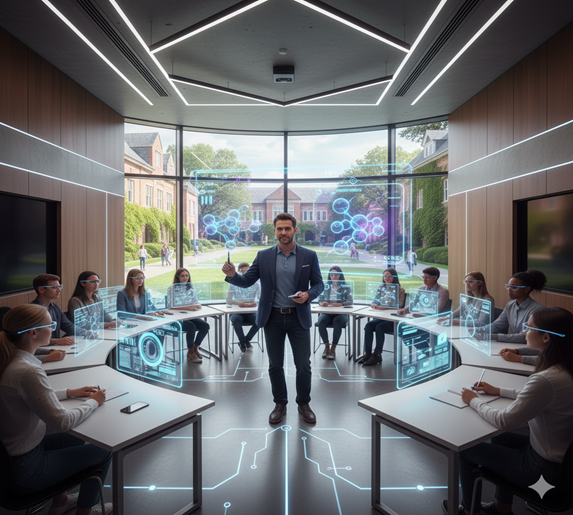
For decades, university education remained largely unchanged—professors delivered lectures in halls, and content was passively consumed. Early “educational technology” simply digitized these old processes, offering little more than uploaded PDFs and syllabi. Today, a fundamental transformation is underway. AI, data analytics, and immersive technologies are not just enhancing convenience—they are enabling a profound shift toward personalized, adaptive, and immersive learning, redefining the very core of the university experience.
3 Key EdTech Innovations Redefining Learning
1. AI-Driven Personalized Learning:
The most important change is the move from a “one-size-fits-all” model to a “one-size-fits-one” model. The new adaptive learning platforms powered by artificial intelligence can follow a student’s progress on a live basis. These systems pinpoint very specific gaps in knowledge and even misunderstandings of concepts. A student who already knows a topic does not waste time with a generic lecture by the AI; instead, advanced topics can be served to this student, while at the same time, the AI can be used to issue targeted exercises for a student who is struggling with the topic. For each individual, this system becomes a personally unique educational journey.
2. Immersive Learning (VR/AR):
One of the major problems in the education system is the separation of theory from practice. The use of Virtual Reality (VR) and Augmented Reality (AR) has helped to lessen this separation. For instance, medical students can operate in a surgical room that is created virtually for them, and thus, there is no harm caused. Besides, engineering students can visually “disassemble” and “inspect” a jet engine or a digital twin of a factory. Moreover, history students can experience “being there” at the time of historical events. Such educational technology solutions facilitate experiential learning, which is not only more efficient but also more lasting compared to the conventional way of learning from a book.
3. Microlearning and On-Demand Skills:
The students of today are managing classes, internships, side-hustles, and a fast life. The traditional 90-minute lecture has lost its exclusivity as a way of learning. EdTech has made “microlearning” feasible, which means that difficult topics can be broken down into bite-sized, on-demand video modules, quizzes, and articles.
3 Major Hurdles EdTech Must Overcome
1. The Digital Divide:
It is, arguably, the most important hurdle that stands in the way of EdTech to overcome. Assuming that each student owns a high-spec laptop and has access to high-speed, unlimited internet is ridiculously out of touch with reality. The more that universities are putting their money into mandatory technology for education, the bigger the two-tier system they are likely to create, where students coming from less privileged families will be left behind. Real innovation must have at its core a plan of guaranteed access for all.
2. Data Privacy and Ethics:
These personalized learning systems, to implement their idea, have to be very large-scale data collectors. They cannot fail to note every interaction, every mistake, and every moment spent on a topic. Thereby, a few ethical questions are raised: Who is the owner of this data? What is done with it? Can it be used to profile students in a biased way? Universities should be very strict and have very detailed policies with regard to the data they hold, which are meant to protect students.
3. Quality Control and Pedagogy:
A state-of-the-art instrument will be of no use if it is not grounded on reliable educational principles. Most of the platforms are just “digital worksheets” – dull, passive, and inefficient. The problem is to make sure that new technologies are educationally beneficial, really interactive, and created by teachers, not only by engineers. Poorly designed technology can be worse than no technology, as it only causes an additional layer of frustration in the learning process without providing a solution.
Conclusion
This change constitutes the next university education model and eventually defines the future of higher education: a hybrid system where the use of technology is to support, not substitute, the human interaction of professors. Through the use of technology, the faculty members are released from the performance of the monotonous tasks and can then devote more time to the mentoring process. At the same time, educational technology enables the development of individually customized, authentic, and mobile learning courses. The point at issue: the use of technology leads to a radical improvement of the university experience and is thus beneficial to all stakeholders, provided that the integration is done in the right way.
References
[1] R. Li, “An article explaining how new digital tools are changing everyday teaching and learning,” Forbes, Mar. 29, 2023. [online].
Available: https://www.forbes.com/advisor/education/how-is-technology-changing-education/
[2] A. Glezos, “A piece discussing how personalised learning methods are becoming more common in modern education,” Forbes, Jun. 21, 2023. [online].
Available: https://www.forbes.com/sites/forbestechcouncil/2023/06/21/personalized-learning-the-future-of-education/
[3] M. Spencer, “An overview of how AI-based tutoring tools are helping students learn in a more customised and flexible way,” EdTech Magazine, Feb. 14, 2024. [online].
Available: https://edtechmagazine.com/k12/article/2024/02/rise-ai-tutors-new-era-personalized-education
Penned by Yug
Edited by Jinal Kapadia, Research Analyst
For any feedback mail us at [email protected]
Transform Your Brand's Engagement with India's Youth
Drive massive brand engagement with 10 million+ college students across 3,000+ premier institutions, both online and offline. EvePaper is India’s leading youth marketing consultancy, connecting brands with the next generation of consumers through innovative, engagement-driven campaigns. Know More.
Mail us at [email protected]