5 Powerful Case Studies Showing How Hybrid Learning Is Transforming Indian Universities
Topics: Hybrid Learning, Online & Offline
Introduction
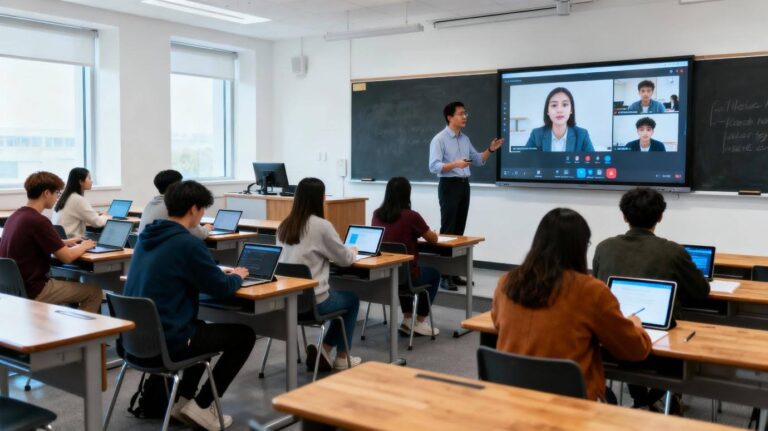
Honestly, hybrid learning in India wasn’t something anyone planned. When the pandemic hit, everything just moved online. And yeah, it was chaotic at first — bad Wi-Fi, muted mics, “Can you hear me?” vibes. But students slowly noticed that a mix of online & offline learning made life a lot easier. You could stay home when needed and still get the real campus experience when it mattered. Now universities are like… “Okay, students clearly like this. Let’s improve it and keep it.”
1. Hybrid Learning Became the New Normal
When COVID shut colleges, the shift to online classes happened overnight. Later, when campuses reopened, students didn’t want to throw away the flexibility they had. At IIT Delhi, teachers didn’t just return to the old style. They changed how they teach — recording lectures, using virtual labs, letting students revisit topics anytime. It’s like university realized that not everyone learns the same way. With hybrid learning, someone from a small town can attend the same session as a student sitting in Delhi. That’s a big win.
2. BITS Pilani WILP: Work + Study Without Drama
Ask any working professional — studying while having a job is tough. But BITS Pilani figured out a pretty cool balance years ago. Their WILP lets people attend weekend live classes, do remote lab work when free, and visit campus sometimes for real experiments. Thanks to online & offline together, more than 50,000 students are currently upskilling without taking a career break. And some of them actually end up in high positions — CEOs and stuff. That kind of success shows that hybrid learning can still be high-quality.
3. Jamia Millia Islamia: Students First, Tech Second
Jamia looked closely at how students felt during hybrid learning. Turns out, people do like technology — but they still need support, teachers who respond, and a place to discuss things. So Jamia teachers started mixing proper classroom conversations with digital tools, like group chats, shared files, and continuous feedback. Not everyone has the best internet, but online & offline together helped students stay connected even during tough times. The focus became: “If students are okay, learning will be okay.”
4. DU SOL: Education That Actually Adapts to Life
DU SOL is a lifesaver for so many students who can’t attend regular classes — maybe they work, or live far away, or have family responsibilities. Through hybrid learning, they get recorded lectures, self-study material, plus centers where they can go for exams and help if needed. The best part? Even with such a huge number of learners, they still maintain NAAC A+ standards. Online & offline together make education feel possible for people who otherwise might have dropped out.
5. The Future is Flexible
More colleges are realizing that students want time for internships, hobbies, freelance work, even rest. And hybrid learning gives exactly that. Classrooms now feel bigger — they include your home, your phone, even your bus ride sometimes. As technology improves, students could get even more customized learning — attend labs in person, switch theory online, and build their own schedule without missing anything. It’s honestly the kind of freedom that older generations never had.
Conclusion
Hybrid learning in India started as a quick fix. But now, it feels like the new shape of education — flexible, fair, and very real. With examples like IIT Delhi, BITS Pilani, Jamia, and DU SOL, we can clearly see that online & offline together help more students learn in the way that suits them. The future of higher education here looks more open and student-friendly than ever.
References
[1] Y. Singh and S. Phoolka, “Hybrid education in the age of Education 5.0: A study of engagement and innovations in the Indian education system amidst COVID-19,” Indian Journal of Educational Technology, vol. 7, no. 1, pp. 309–325, Jan. 2025. [Online].
Available: https://journals.ncert.gov.in/IJET/article/download/848/336/1370
[2] “Rise of hybrid learning in India,” Best Colleges, May 2025. [Online].
Available: https://bestcolleges.indiatoday.in/news-detail/rise-of-hybrid-learning-in-india-3238
[3] “WILP Overview – BITS Pilani | Work Integrated Learning Programmes,” BITS Pilani, Oct. 2024. [Online].
Available: https://bits-pilani-wilp.ac.in
[4] “Mastering hybrid learning: A new-fangled concept,” Amity Global Institute, Jun. 2022. [Online].
Available: https://www.youtube.com/watch?v=ig-lbLZVPyg
FAQs
Q1. What is hybrid learning in Indian universities?
It’s a study model where part of the course happens online and the rest on campus, giving students more flexibility.
Q2. Why is this model becoming popular in India?
Because it makes studying more convenient and accessible for students in different situations.
Q3. How does it support students from remote areas?
Learners can join virtual classes and use digital resources even if they live far away.
Q4. Does this method help improve academic performance?
Yes. Students can rewatch lessons, clear doubts easily, and learn at a pace that suits them.
Q5. Which institutions use this format successfully?
Some strong examples include IIT Delhi, BITS Pilani’s WILP, Jamia Millia Islamia, and DU SOL.
Q6. Is it helpful for working professionals?
Definitely. Programs like BITS Pilani WILP help people continue their education while staying employed.
Q7. Does this approach reduce the need for being physically present?
It cuts down unnecessary travel, while still keeping practical sessions and exams offline when needed.
Q8. Can quality standards be maintained in this system?
Yes. Institutions like DU SOL and IIT Delhi show that strong academic performance is still possible.
Q9. What challenges do students face?
Poor connectivity, device limitations, and less face-to-face interaction can be issues, though blended formats reduce many problems.
Q10. What does the future look like for this model in India?
Expect more personalized schedules, better virtual labs, and improved integration between virtual and classroom learning.
Penned by Gursimar
Edited by Anuj Kumar, Research Analyst
For any feedback mail us at [email protected]
Transform Your Brand's Engagement with India's Youth
Drive massive brand engagement with 10 million+ college students across 3,000+ premier institutions, both online and offline. EvePaper is India’s leading youth marketing consultancy, connecting brands with the next generation of consumers through innovative, engagement-driven campaigns. Know More.
Mail us at [email protected]