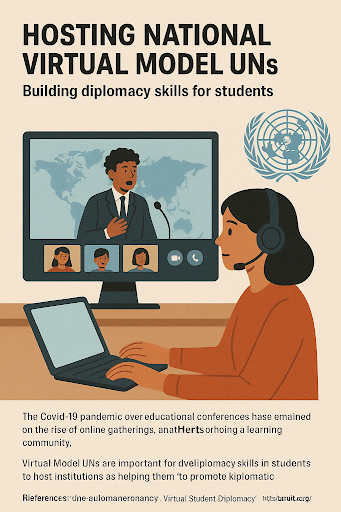
Model United Nations (MUN) has traditionally been a stage where young minds took on the roles of global diplomats, debated issues of the time, and learned to negotiate and lead. These processes typically found space in crowded conference rooms, with tuxedos aplenty, the thump of a gavel, and the nervous fear of speeches. But for the last couple of years, i.e., since the onset of the pandemic, a new paradigm arose: national virtual Model UNs.
Rather than a concession, online with MUNs has altered the character of the way in which students interact, obliterating geographical limitations and offering new modes of engagement in diplomacy. For so many virtual Model UN students, it’s their first experience debating global issues with students across the country without ever leaving their bedrooms.
5 Insights Into How National Virtual MUNs Shape Young Diplomats
The Rise of Virtual MUNs
While schools and universities shut their gates long ago in 2020, MUN conferences were among the various activities shut down to a complete standstill by students. Instead of coming to a standstill, organisers improvised. Conferences at the national level conducted on platforms like Zoom, Microsoft Teams, or tailor-made portals became the new normal. Early on, there were doubts about whether that sense of formality and excitement could be duplicated online. To a pleasant surprise, virtual Model UN students survived, and many thrived.
To have a national virtual Model UN is no longer an issue of doing the best one can under the existing circumstances-it is an issue of exploring the boundary beyond what is possible. Students from rural towns, who would otherwise never have been able to afford to travel to major cities to attend in-person conferences, are now on the same footing as students at elite colleges.
Developing Diplomacy Skills in the Online Age
The essence of MUN lies in learning diplomacy skills. Even in online forums, these diplomacy skills are tested and perfected. Students need to learn to convince verbally, be courteous in tone, and diplomatic in negotiation. Although there is minimal body language in a video conferencing scenario, participants master their communication by strategic word choice and application of virtual means such as position papers, collaborative Google Docs, or off-record chat bargains.
For the virtual Model UN student, the environment is similar to actual modern-day diplomacy exercised in the real world. The majority of the world summits and working sessions of the UN are done online or in hybrid mode. Being a part of a national virtual MUN, therefore, simulates real-world modern-day diplomacy itself.
Advantages of Hosting Virtual MUNs
Accessibility and Inclusivity
All the students from all around the world can attend regardless of travel, accommodation, or cost. This renders MUN democratized.
Technological Skills
Apart from diplomacy, students become digitally literate, learning about the usage of online platforms, breakout rooms, and online public speaking.
Global Networking
Virtual conferences have wider participation levels, even sometimes having global guest speakers or facilitators.
Flexibility and Efficiency
Sessions can be recorded and replayed by the delegate for performance improvement.
Eco-Friendly Approach
The Carbon footprint of mass assembly is reduced through online hosting.
Challenges to Overcome
Of course, there are also negatives to virtual MUNs. Internet connection malfunctions, time-zone synchronization, and muffled microphone silence are all real issues. In addition, students forfeit the social cohesion of on-campus conferences, hallway huddles by the water cooler, all-night research sessions, and the excitement of speaking from behind a podium.
It is similarly challenging for organizers as well to keep participants in line in an online forum. But with creative efforts like interactive ice-breakers, gameplay sessions, and extensive moderation, these issues are being addressed increasingly.
The Human Side of Virtual MUNs
What is so compelling about virtual MUNs at the national level is the humanity brought to the screen. Virtual Model UN students might be logging in from a small bedroom console, but speaking to others as assuredly as the “delegate of France” or “delegate of Kenya.” That transformation, from student to diplomat, is more than the medium.
Accounts of apprehensive first-time virtual Model UN students gaining confidence, or country students from rural areas presenting their nation at a national level for the first time, are commonplace. They are the moments that remind us that MUNs are not about debating—empowerment is.
Conclusion
As education more and more takes on hybrid and virtual forms, the concept of staging national virtual MUNs will also be evolving. Perhaps someday conferences will host metaverse settings, where students are seated as avatars in UN-style virtual rooms. Or perhaps AI-based tools will assist in projecting real-world policy ramifications of debates between delegates.
What is certain is that the diplomacy skills never date, whether acquired in a hotel conference suite or in front of a laptop screen. Virtual MUNs are not supplanting the traditional conference—rather, they are creating new opportunities and making diplomacy skills available to everyone.
With the world fast globalizing, it is more crucial than ever to raise leaders who can communicate from platform to culture. National virtual MUNs are not only an evolution, but a glimpse of things to come for student diplomacy.
References
- “The Impact of Online Model UN Conferences”, Best Delegate. [Online]. Available at: https://bestdelegate.com
- “How Diplomacy Has Gone Digital”, United Nations. [Online]. Available at: https://www.un.org
- “Virtual Diplomacy in the 21st Century”, The Diplomat. [Online]. Available at: https://thediplomat.com
FAQs: National Virtual Model United Nations (MUNs)
1. What is a Virtual MUN?
A Virtual MUN is an online simulation of the United Nations where students debate global issues using digital platforms like Zoom or Teams.
2. How is a Virtual MUN different from a traditional one?
It’s conducted entirely online, removing geographical barriers but maintaining the same format of debate, diplomacy, and resolution drafting.
3. What skills do students gain from Virtual MUNs?
Students develop diplomacy, negotiation, communication, leadership, and digital literacy skills.
4. Which platforms are most commonly used for Virtual MUNs?
Zoom, Microsoft Teams, Google Meet, and specialized MUN portals are popular platforms.
5. Are Virtual MUNs recognized like physical ones?
Yes. Many universities and organizations officially acknowledge participation in Virtual MUNs.
6. Who can participate in a National Virtual MUN?
Students from schools, colleges, and universities across the country can take part, regardless of region or background.
7. How are delegates assigned countries or committees online?
The allocation is done digitally through registration forms and confirmation emails before the conference begins.
8. What documents are required for participation?
Typically, a position paper outlining the delegate’s stance on the agenda is required.
9. How are debates moderated in Virtual MUNs?
Chairs or moderators control the sessions, manage speaking time, and ensure parliamentary procedures are followed.
10. Do Virtual MUNs offer certificates?
Yes, participants receive digital certificates of participation or merit from the organizing institution.
11. How do students network in an online setup?
Through breakout rooms, chat functions, and post-session networking meets organized virtually.
12. What challenges do Virtual MUNs face?
Common issues include poor internet connection, distractions at home, and lack of physical interaction.
13. Are Virtual MUNs inclusive for rural students?
Absolutely. They allow participation without travel costs, bringing rural and urban students together on one platform.
14. Can Virtual MUNs prepare students for real-world diplomacy?
Yes. They simulate modern digital diplomacy, similar to how real UN meetings are increasingly hybrid or virtual.
15. What is the future of Virtual MUNs?
With advancements in technology, Virtual MUNs may soon use metaverse or AI tools for even more immersive experiences.
Penned by Nitya Gosain
Edited by Shashank Khandelwal, Research Analyst
For any feedback mail us at [email protected]
Transform Your Brand's Engagement with India's Youth
Drive massive brand engagement with 10 million+ college students across 3,000+ premier institutions, both online and offline. EvePaper is India’s leading youth marketing consultancy, connecting brands with the next generation of consumers through innovative, engagement-driven campaigns. Know More.
Mail us at [email protected]